
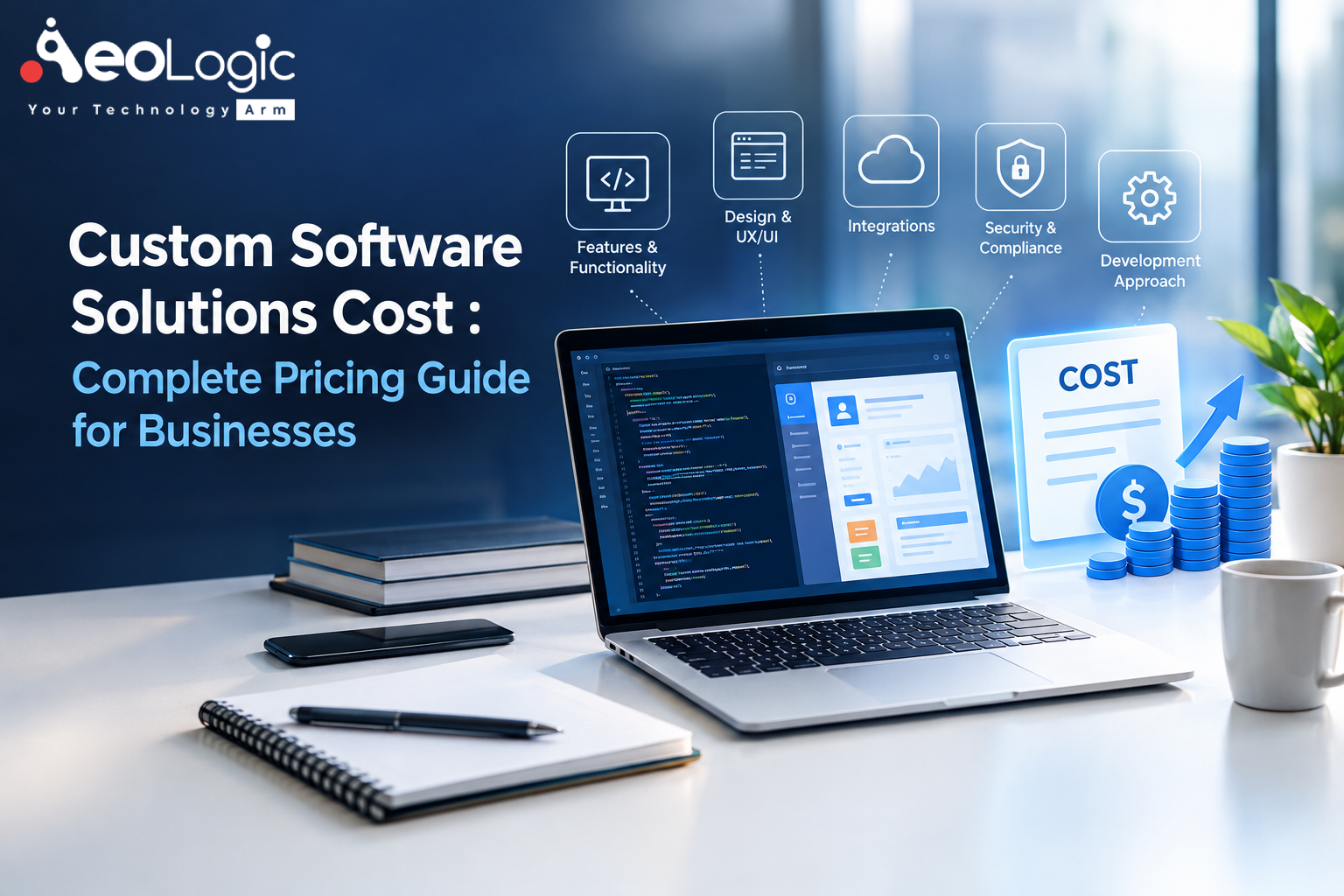

Businesses increasingly rely on software to automate operations, improve customer experiences, manage data, and support long-term growth. While ready-made applications can meet basic requirements, they often become restrictive when business processes become more complex. This is where custom software development becomes valuable, allowing companies to build solutions around their specific workflows, users, integrations, and strategic goals. However, one of the first questions businesses ask before starting such a project is about the Custom Software Solutions Cost and what factors determine the final investment.
Understanding software development pricing is important because there is no universal cost for every custom application. A small internal tool may require a relatively modest budget, while a large enterprise platform involving artificial intelligence, cloud infrastructure, multiple integrations, and advanced security can require a significantly larger investment. The final price depends on the project’s complexity, technology requirements, development time, features, and ongoing support.
What determines the Cost of Custom Software Development?
The Custom Software Solutions Cost is influenced by several connected factors rather than a single pricing formula. Before a development team can provide an accurate estimate, it needs to understand what the software is expected to accomplish, who will use it, which systems it needs to connect with, and how complex the underlying workflows will be.
The scope of the project is usually the starting point. A simple application with authentication, dashboards, forms, and basic reporting will generally require less development effort than an enterprise platform with multiple user roles, real-time data processing, automation, complex analytics, and third-party integrations.
The technology stack also affects the investment. Applications built using modern web frameworks, mobile technologies, cloud services, databases, APIs, artificial intelligence, or machine learning may require specialized development expertise. Businesses should therefore evaluate technology decisions according to long-term requirements instead of choosing a stack based only on initial development pricing.
Typical Custom Software Development Pricing
There is no fixed industry-wide price for custom software because every project has different requirements. However, businesses can use project complexity as a practical way to understand potential investment levels.
Small Custom Software Projects
Small software projects generally focus on a limited number of business processes. Examples can include internal dashboards, employee management tools, basic inventory applications, appointment systems, or workflow automation platforms. These projects typically have fewer screens, user roles, integrations, and technical dependencies.
For such solutions, development costs can often remain relatively controlled because the development team has a smaller scope to design, build, test, and maintain. The project may also be delivered faster compared with a large enterprise platform.
Medium-Complexity Software Solutions
Medium-sized applications usually contain several interconnected features and may serve different departments or customer groups. Examples include CRM systems, logistics management platforms, business intelligence dashboards, e-commerce applications, and operational management software.
These applications may require API integrations, role-based access, reporting, notifications, cloud deployment, data synchronization, and more advanced security controls. As the number of components increases, development and testing requirements also increase, making project estimation more detailed.
Enterprise-Level Software Platforms
Enterprise software projects are significantly more complex because they often need to support large numbers of users, substantial data volumes, multiple business units, and critical operational processes. Such platforms may include ERP systems, enterprise data platforms, supply chain applications, healthcare systems, financial technology platforms, or large-scale customer portals.
Enterprise projects can involve advanced architecture, high availability, extensive integrations, data migration, compliance requirements, cybersecurity controls, analytics, and continuous monitoring. Consequently, their investment can be considerably higher than that of smaller applications.
Key Factors That Influence Custom Software Pricing
Software Features and Functionality
Features are one of the most important components of development pricing. A basic login system requires considerably less work than an application containing advanced dashboards, automated workflows, payment processing, real-time notifications, document management, predictive analytics, or AI-powered functionality.
Each feature requires design, development, testing, integration, and sometimes ongoing maintenance. Businesses should therefore distinguish between essential functionality and features that can be introduced during later development phases.
User Interface and User Experience
Design also contributes to the overall development budget. A straightforward internal application may require a relatively simple interface, while customer-facing software may need extensive UX research, responsive layouts, accessibility considerations, prototypes, usability testing, and customized visual components.
Investing in UX can be particularly important for applications used frequently by customers or employees because confusing workflows can reduce adoption even when the underlying technology is strong.
Third-Party Integrations
Modern businesses rarely operate with isolated software. Custom applications frequently need to communicate with payment gateways, CRM platforms, ERP systems, cloud services, communication tools, analytics platforms, identity providers, or external APIs.
Each integration can introduce additional development and testing requirements. The quality of third-party documentation, authentication methods, data formats, API limitations, and synchronization requirements can all affect project complexity.
Security and Compliance Requirements
Security should be considered during the initial planning stage rather than added at the end. Applications handling financial, customer, healthcare, employee, or business-critical information may require encryption, secure authentication, access controls, audit logs, vulnerability testing, and compliance-related controls.
More stringent security requirements can increase development effort, but they also help protect sensitive information and reduce operational risks.
How Development Team Location Affects Pricing
The development team’s location and expertise can have a noticeable effect on the overall budget. Software companies in different regions operate with different labor costs, market conditions, and levels of specialization.
However, businesses should avoid selecting a development partner solely because of the lowest hourly rate. A cheaper development process can become expensive if poor architecture, communication problems, inadequate testing, or weak documentation create additional work later.
The better approach is to compare the team’s technical expertise, previous projects, communication process, development methodology, quality assurance practices, and post-launch support alongside pricing.
Choosing the Right Development Approach
Fixed-Price Development
A fixed-price model works well when the project requirements are clearly defined before development begins. The scope, deliverables, timelines, and payment structure are established in advance.
This approach can make budgeting easier, but it may become restrictive when requirements change significantly during development.
Time-and-Materials Model
Under a time-and-materials approach, businesses pay according to the development effort involved. This model can provide greater flexibility when requirements are expected to evolve throughout the project.
It is often useful for complex applications where discovering new requirements during development is likely. However, businesses need effective project management and regular progress monitoring to maintain budget visibility.
Dedicated Development Team
A dedicated team can be appropriate for long-term projects requiring continuous development and technical support. Instead of treating the software as a single short-term project, the business works with a team that can continuously improve the product.
This approach can be useful for companies expecting frequent feature updates, integrations, scalability improvements, and ongoing innovation.
How to Reduce Software Development Costs Without Sacrificing Quality
Managing the Custom Software Solutions Cost does not necessarily mean reducing the quality or number of important capabilities. Instead, businesses can control expenditure through better planning and prioritization.
One effective approach is to begin with a minimum viable product that includes the most important functionality. Once users begin interacting with the application, businesses can evaluate feedback and introduce additional features based on actual requirements.
Clear documentation can also reduce unnecessary development work. When business processes, user roles, technical requirements, integrations, and expected outcomes are clearly documented, developers spend less time interpreting ambiguous requirements.
Cloud infrastructure can provide another opportunity for cost optimization. Instead of investing heavily in infrastructure before actual demand is known, businesses can select scalable cloud services that allow resources to increase as usage grows.
Why Long-Term Value Matters More Than Initial Price
Businesses should evaluate software investment based on its expected value rather than focusing exclusively on the initial development quotation. A well-designed application can automate repetitive tasks, reduce manual errors, improve decision-making, accelerate customer service, and create new operational capabilities.
For example, software that automates a process previously requiring several employees to perform repetitive activities may deliver measurable savings over time. Similarly, better data visibility can help management identify operational inefficiencies and make faster decisions.
This makes the Custom Software Solutions Cost an investment decision rather than simply a technology expense. Businesses should consider productivity gains, operational savings, scalability, customer experience, revenue opportunities, and the expected lifespan of the software when evaluating proposals.
Maintenance and Post-Launch Costs
Software expenses do not end when an application goes live. Businesses should also account for maintenance, security updates, infrastructure, monitoring, bug fixes, performance improvements, and future feature development.
Third-party APIs and cloud services may also introduce recurring costs. As the number of users increases, infrastructure requirements can change, potentially affecting operational expenses.
A reliable maintenance strategy helps keep software secure, compatible, and aligned with changing business requirements. Planning these costs from the beginning provides a more realistic picture of the total investment.
How to Estimate Your Custom Software Budget
A practical estimation process begins with defining the business problem rather than immediately discussing technologies. Businesses should identify the processes they want to improve, the users who will interact with the system, the expected outcomes, and the capabilities that are essential for launch.
The next step is to separate must-have features from future enhancements. This allows the development team to create a phased roadmap instead of attempting to build everything simultaneously.
Businesses should then evaluate UI/UX requirements, integrations, security, infrastructure, testing, deployment, maintenance, and scalability. Combining these elements provides a much more realistic estimate than calculating the development cost from the number of screens alone.
The Custom Software Solutions Cost should ultimately be viewed across the complete software lifecycle, including development, deployment, maintenance, and future improvements.
Final Thoughts
Custom software can provide businesses with greater flexibility, automation, scalability, and control than generic applications. However, understanding the investment required is essential before development begins. Project scope, functionality, design, integrations, security, technology choices, development expertise, and ongoing maintenance all influence the final budget.
Instead of searching for the cheapest development quotation, businesses should look for the right balance between cost, quality, scalability, security, and long-term business value. A properly planned software project can become a strategic asset that continues to deliver value as the organization grows.
By evaluating requirements carefully and building the solution in manageable phases, businesses can keep the Custom Software Solutions Cost under control while creating software that genuinely supports their operational and growth objectives.
Frequently Asked Questions
Q1. How much does custom software development cost for a business?
The cost depends on the application’s complexity, features, integrations, technology stack, security requirements, development team, and timeline. A simple business application may require a smaller investment, while an enterprise-grade platform with advanced integrations and AI capabilities can require a significantly larger budget.
Q2. What factors have the biggest impact on software development pricing?
The major factors include project scope, number and complexity of features, UI/UX requirements, third-party integrations, security and compliance needs, technology choices, development team’s expertise, testing requirements, and post-launch maintenance. Clearly defining these requirements before development can make the estimate more accurate.
Q3. Is custom software more expensive than ready-made software?
Custom software generally requires a higher initial investment than ready-made applications because it is designed and developed around specific business requirements. However, it can provide better scalability, flexibility, automation, and integration capabilities, potentially delivering greater long-term value for businesses with specialized operational needs.
Q4. How can businesses reduce custom software development expenses?
Businesses can control development expenses by clearly defining requirements, prioritizing essential features, launching an MVP, selecting the appropriate technology stack, using a phased development approach, and planning integrations carefully. Regular testing and effective project management can also help prevent expensive rework later.
Q5. Does the software development budget include maintenance costs?
Development and maintenance are usually separate costs. After launch, businesses may need ongoing support for bug fixes, security updates, performance optimization, infrastructure management, third-party API changes, and new features. Including these expenses in the initial software roadmap helps businesses plan their total technology investment more accurately.