
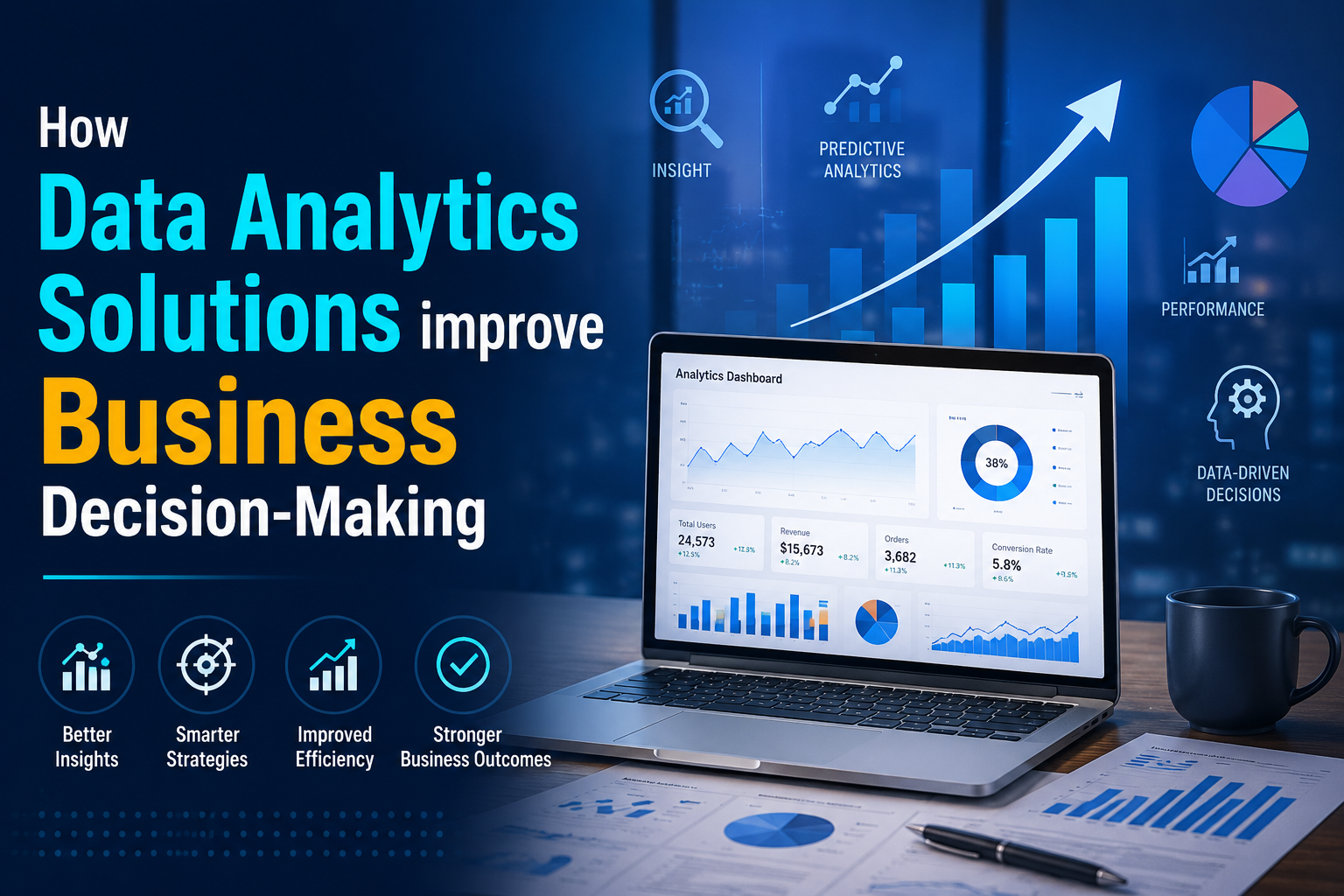

Businesses today generate enormous amounts of data through customer interactions, digital platforms, financial transactions, supply chains, and internal operations. However, data alone has little value unless it is transformed into meaningful insights that guide strategic decisions. This is where Data Analytics Solutions for Business play a vital role. By collecting, organizing, analyzing, and interpreting business data, organizations can make informed decisions, reduce risks, improve operational efficiency, and identify new growth opportunities.
Companies across industries are increasingly relying on data-driven strategies to stay competitive in rapidly changing markets. Rather than making decisions based on assumptions or outdated reports, business leaders now use real-time analytics to understand customer behavior, predict market trends, optimize resources, and improve overall performance. Whether it is a startup looking to scale or a large enterprise managing complex operations, adopting the right analytics solution can significantly improve decision-making at every level.
Understanding Data Analytics Solutions for Business
Data Analytics Solutions for Business refer to technologies, platforms, and methodologies that help organizations collect, process, analyze, and visualize business data. These solutions transform raw information into actionable insights that support better operational, financial, and strategic decisions.
Modern analytics platforms combine data from multiple sources, including enterprise applications, CRM systems, ERP software, websites, mobile applications, IoT devices, and cloud services. By integrating these diverse data streams, organizations gain a unified view of their business performance and customer interactions.
Data analytics is no longer limited to generating historical reports. Advanced analytics solutions use artificial intelligence, machine learning, and predictive modeling to identify hidden patterns, forecast future outcomes, and recommend actions that improve business performance.
Why Businesses need Data-driven decision-making
Organizations operating in competitive industries cannot afford to rely solely on intuition or experience when making important decisions. Market conditions change rapidly, customer expectations evolve continuously, and operational challenges become increasingly complex. Business leaders require accurate, timely, and reliable information to respond effectively.
Data-driven decision-making enables organizations to evaluate opportunities based on measurable evidence rather than assumptions. Instead of guessing which products customers prefer or which marketing campaigns generate the highest return, businesses can analyze actual performance metrics and customer behavior to make confident decisions.
Companies that embrace analytics also gain greater transparency into their operations. Managers can identify inefficiencies, monitor key performance indicators, and quickly respond to emerging challenges before they become major business problems.
The Role of data analytics in business decision-making
Data analytics serves as the foundation for informed business decisions by converting complex datasets into understandable insights. Instead of reviewing hundreds of spreadsheets or manually compiling reports, executives receive dashboards and visualizations that clearly highlight performance trends.
Analytics helps organizations answer critical business questions. Companies can determine which products generate the highest revenue, identify their most profitable customer segments, understand seasonal demand fluctuations, and evaluate employee productivity. These insights allow leaders to allocate resources more effectively and develop strategies based on real business performance.
As organizations adopt predictive analytics, decision-making becomes even more proactive. Businesses can anticipate customer demand, forecast sales, predict equipment failures, and estimate future financial performance, allowing them to prepare for changing market conditions.
How Data Analytics Solutions improve business Decision-Making
Improving strategic planning
Strategic planning becomes significantly more accurate when supported by reliable data. Business leaders can evaluate historical performance, identify growth opportunities, and measure the effectiveness of previous initiatives before defining future strategies.
Analytics provides a comprehensive understanding of market dynamics, customer preferences, and competitive positioning. Instead of relying on broad assumptions, organizations create strategic plans backed by measurable evidence.
Enhancing customer understanding
Every customer interaction generates valuable information that can reveal purchasing habits, preferences, and engagement patterns. Data analytics helps businesses consolidate this information to create detailed customer profiles.
Organizations can identify buying trends, understand customer journeys, personalize marketing campaigns, and improve customer service. This deeper understanding leads to stronger customer relationships, increased retention, and higher lifetime value.
Supporting faster Decision-Making
Business opportunities often require immediate action. Traditional reporting methods can delay decision-making because information becomes outdated before it reaches executives.
Modern analytics platforms provide real-time dashboards that display live operational data. Managers can monitor sales performance, inventory levels, website traffic, customer engagement, and operational metrics as they happen, enabling faster and more confident decisions.
Optimizing operational efficiency
Operational inefficiencies increase costs and reduce productivity. Analytics solutions help organizations identify bottlenecks, unnecessary processes, and areas where resources are underutilized.
Manufacturing companies can optimize production schedules, logistics providers can improve delivery routes, retailers can manage inventory more effectively, and service organizations can streamline workforce allocation. Continuous monitoring ensures that improvements are sustained over time.
Reducing business risks
Risk management is an essential component of successful decision-making. Data analytics identifies unusual patterns, financial anomalies, cybersecurity threats, and operational risks before they escalate.
Predictive models evaluate historical data alongside current trends to estimate potential risks. Businesses can prepare contingency plans, strengthen compliance measures, and minimize financial losses through proactive decision-making.
Improving financial performance
Financial analytics enables organizations to monitor revenue growth, expenses, profitability, cash flow, and investment performance. Decision-makers gain a clear understanding of financial health and can identify areas requiring improvement.
By analyzing financial trends, businesses optimize budgets, reduce unnecessary spending, improve pricing strategies, and maximize profitability while maintaining sustainable growth.
Types of Data Analytics used in Business
Descriptive Analytics
Descriptive analytics focuses on understanding past business performance by analyzing historical data. Organizations use reports, dashboards, and performance summaries to evaluate what has already happened.
This approach provides valuable insights into sales performance, customer activity, operational efficiency, and financial outcomes.
Diagnostic Analytics
Diagnostic analytics investigates the reasons behind business outcomes. Instead of simply identifying declining sales or increasing expenses, businesses analyze contributing factors and underlying causes.
Understanding why specific events occurred allows organizations to implement corrective measures and prevent similar issues in the future.
Predictive Analytics
Predictive analytics uses statistical models and machine learning algorithms to forecast future business outcomes.
Organizations can estimate customer demand, predict purchasing behavior, forecast revenue, identify equipment maintenance requirements, and anticipate market changes before they occur.
Prescriptive Analytics
Prescriptive analytics goes beyond prediction by recommending the most effective actions for achieving desired business outcomes.
Using optimization models and artificial intelligence, businesses receive recommendations for pricing strategies, inventory management, workforce planning, and resource allocation based on data-driven analysis.
Industry Applications of Data Analytics Solutions
Retail and E-commerce
Retail businesses analyze customer purchasing behavior, optimize inventory management, personalize recommendations, and improve marketing effectiveness. Analytics also helps forecast seasonal demand and reduce stock shortages.
Healthcare
Healthcare providers use analytics to improve patient care, optimize hospital operations, predict patient admission rates, and enhance clinical decision-making through evidence-based insights.
Manufacturing
Manufacturers rely on analytics for predictive maintenance, production planning, quality assurance, and supply chain optimization. Data-driven manufacturing improves productivity while reducing operational costs.
Banking and Financial Services
Financial institutions analyze customer transactions, detect fraud, assess credit risks, and personalize financial products. Analytics supports regulatory compliance while improving customer experience.
Logistics and Supply Chain
Logistics companies use analytics to optimize transportation routes, monitor fleet performance, forecast shipment volumes, and improve warehouse efficiency, resulting in faster deliveries and lower operational expenses.
Technologies powering modern Data Analytics Solutions
Cloud computing has made enterprise-grade analytics accessible to businesses of all sizes. Organizations can process large datasets without investing heavily in on-premise infrastructure.
Artificial intelligence and machine learning automate data analysis, identify hidden patterns, and improve prediction accuracy. Business intelligence platforms provide interactive dashboards that simplify data visualization and reporting.
Big data technologies process structured and unstructured information from multiple sources, while IoT devices continuously generate real-time operational data that supports intelligent decision-making across industries.
Challenges businesses face when implementing analytics solutions
Although analytics delivers significant benefits, implementation requires careful planning. Organizations often struggle with fragmented data, inconsistent data quality, integration challenges, and resistance to organizational change.
Many businesses also face skill shortages in data analysis, making it difficult to interpret complex datasets effectively. Selecting scalable analytics platforms, establishing strong data governance, and investing in employee training help organizations overcome these challenges and maximize the value of their analytics initiatives.
Best Practices for successful Data Analytics implementation
Organizations achieve the best results when analytics initiatives align with clearly defined business objectives. High-quality data, standardized processes, and secure data management practices create a strong foundation for reliable insights.
Cross-functional collaboration between business leaders, IT teams, and data professionals ensures that analytics projects address real business challenges rather than focusing solely on technology. Continuous monitoring, regular performance reviews, and ongoing optimization help organizations adapt to changing business requirements.
The Future of data analytics in business
The future of business analytics will be shaped by artificial intelligence, automation, real-time intelligence, and advanced predictive capabilities. Organizations will increasingly rely on intelligent analytics platforms that automatically identify trends, generate recommendations, and support autonomous decision-making.
As data volumes continue to grow, businesses that invest in scalable analytics infrastructure will gain a significant competitive advantage. Personalized customer experiences, intelligent automation, and proactive decision-making will become standard practices across industries.
Conclusion
In today’s digital economy, data has become one of the most valuable business assets. Organizations that successfully transform raw information into actionable insights consistently make better strategic, operational, and financial decisions. Data Analytics Solutions for Business empower companies to understand customers, improve efficiency, reduce risks, optimize resources, and identify new growth opportunities with confidence.
As competition continues to intensify, adopting modern analytics solutions is no longer an optional investment but a strategic necessity. Businesses that embrace data-driven decision-making today will be better prepared to adapt to market changes, drive innovation, and achieve long-term success in an increasingly data-centric world.
Frequently Asked Questions (FAQs)
Q1. What are Data Analytics Solutions for Business?
Data Analytics Solutions for Business are technologies and platforms that collect, process, analyze, and visualize business data to generate actionable insights. These solutions help organizations make informed decisions, improve operational efficiency, identify market trends, and drive business growth.
Q2. How do Data Analytics Solutions improve business decision-making?
Data analytics enables businesses to make decisions based on accurate data rather than assumptions. By analyzing customer behavior, operational performance, financial metrics, and market trends, organizations can identify opportunities, reduce risks, optimize processes, and develop more effective business strategies.
Q3. Which industries benefit the most from Data Analytics Solutions for Business?
Almost every industry can benefit from data analytics, including retail, healthcare, manufacturing, banking, logistics, education, telecommunications, and e-commerce. These solutions help organizations improve customer experiences, streamline operations, increase productivity, and enhance overall business performance.
Q4. What is the difference between business intelligence and data analytics?
Business intelligence primarily focuses on analyzing historical and current data through reports and dashboards to understand business performance. Data analytics goes a step further by using advanced techniques such as predictive analytics, machine learning, and artificial intelligence to forecast future trends and recommend data-driven actions.
Q5. Why should small and medium-sized businesses invest in Data Analytics Solutions for Business?
Small and medium-sized businesses can use Data Analytics Solutions for Business to gain valuable insights into customer preferences, monitor sales performance, optimize marketing campaigns, improve resource allocation, and make faster, evidence-based decisions. Investing in analytics helps businesses remain competitive while supporting sustainable growth.