
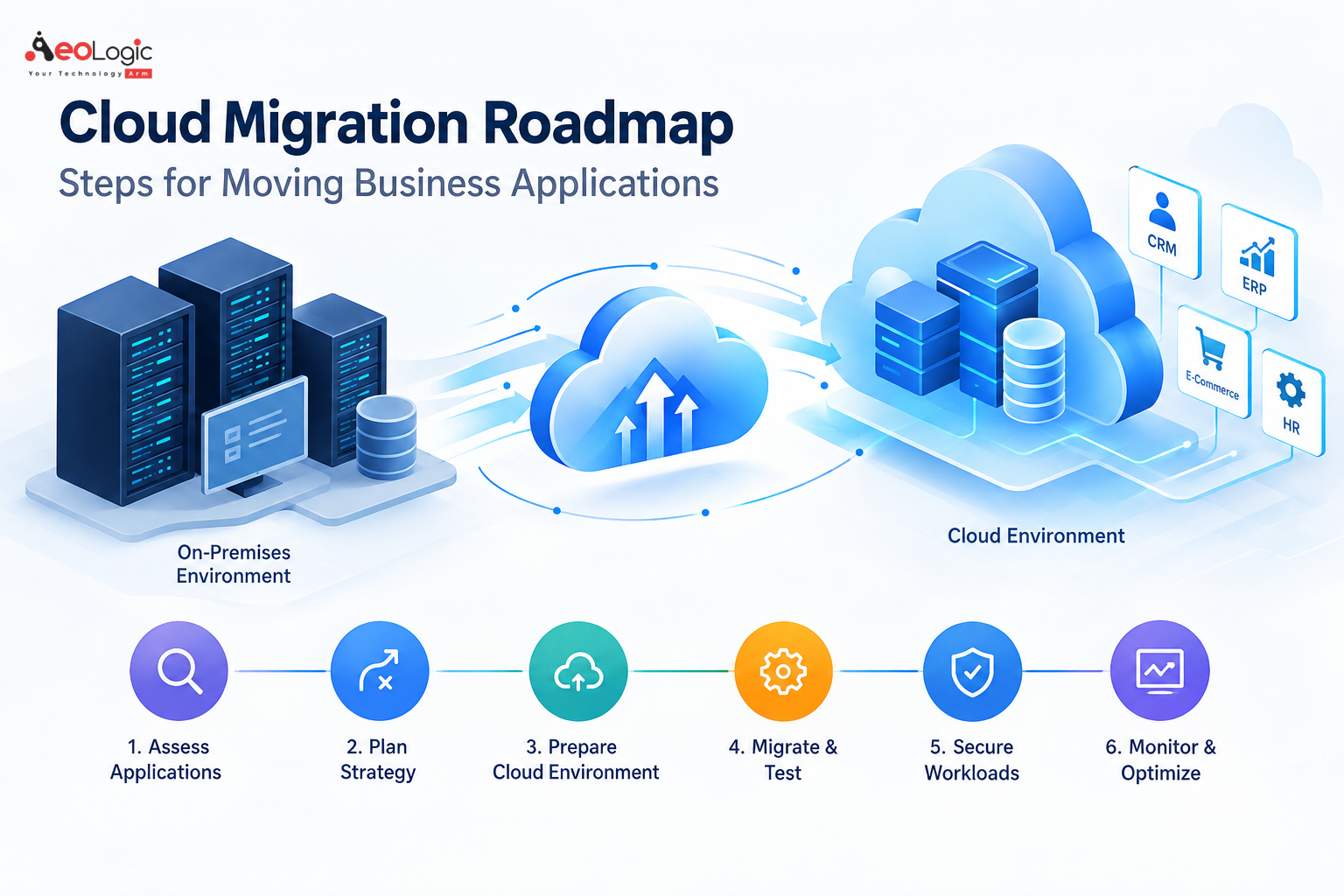

Cloud migration has become an important part of modernizing business applications, improving scalability, reducing infrastructure limitations, and supporting more flexible operations. As organizations expand their digital environments, traditional on-premises applications can become difficult and expensive to maintain. Moving applications to the cloud provides businesses with access to flexible computing resources, managed services, improved accessibility, and modern technology capabilities. However, successful migration requires more than simply transferring applications from physical servers to cloud infrastructure. It requires careful planning, application assessment, security preparation, workload prioritization, testing, and continuous optimization. A well-structured Cloud Migration Roadmap helps organizations move business applications in a controlled and measurable way.
It provides a practical path for understanding the existing environment, selecting the appropriate migration strategy, preparing applications for the cloud, managing risks, and ensuring business continuity throughout the transition.
Understanding the Need for Cloud Migration
Cloud migration involves moving applications, data, infrastructure, and related workloads from traditional environments to cloud platforms. Organizations may migrate applications to improve operational flexibility, modernize outdated infrastructure, support remote access, or create a foundation for digital transformation. The cloud can also provide access to capabilities such as automated scaling, managed databases, analytics platforms, artificial intelligence services, and advanced monitoring.
However, every application does not require the same migration approach. Some applications may be ready to move with minimal changes, while others may need significant modernization before they can operate efficiently in a cloud environment. Understanding these differences is one of the first requirements for developing an effective migration strategy.
Identifying Business Drivers
The migration initiative should begin by identifying why the organization wants to move its applications. Common drivers include reducing infrastructure maintenance, improving application availability, supporting business growth, increasing deployment speed, strengthening disaster recovery, and enabling new digital services.
These business objectives help determine what the migration should achieve. For example, an organization focused on faster application releases may prioritize cloud-native modernization, while a company primarily looking to reduce data-center dependency may initially choose a simpler migration approach.
Assessing Existing Business Applications
Before moving any application, organizations need a clear understanding of their existing technology environment. Application discovery should examine infrastructure, databases, integrations, operating systems, dependencies, performance requirements, licensing, security controls, and data flows.
This assessment helps identify which applications are suitable for migration and which require additional preparation. It also reduces the risk of moving an application without understanding its dependency on another system that remains in the existing environment.
Evaluating Application Dependencies
Business applications rarely operate independently. An enterprise resource planning system may depend on databases, authentication services, APIs, file storage, reporting platforms, and third-party applications. Customer-facing applications may communicate with payment gateways, CRM systems, analytics platforms, and external services.
Mapping these dependencies allows technical teams to understand the potential impact of migration. Applications with significant dependencies may need to be migrated together or in a carefully coordinated sequence. Dependency mapping also helps establish testing requirements before production workloads are moved.
Classifying Applications by Migration Readiness
After assessment, applications can be categorized according to their complexity, business importance, technical condition, and migration readiness. Stable applications with limited dependencies may be suitable for early migration, while highly integrated or mission-critical systems may require deeper modernization and testing.
This classification creates a foundation for prioritizing workloads and developing migration waves rather than attempting to move the entire application portfolio simultaneously.
Choosing the Right Migration Strategy
Different applications require different migration approaches. Organizations commonly consider strategies such as rehosting, replatforming, refactoring, repurchasing, retaining, or retiring workloads. The appropriate choice depends on business objectives, application architecture, budget, technical complexity, and expected long-term value.
Rehosting and Replatforming
Rehosting involves moving an application to the cloud with limited changes. It can be useful when organizations need to reduce dependence on physical infrastructure while keeping application changes relatively small. Replatforming takes the application a step further by making selected changes to use cloud capabilities without completely redesigning the application.
These approaches can help organizations accelerate initial migration while creating opportunities for further modernization later.
Refactoring and Modernization
Refactoring involves redesigning parts or all of an application to take better advantage of cloud-native capabilities. This may include containers, microservices, serverless computing, managed databases, automated deployment pipelines, or cloud-native monitoring.
Although modernization can require greater investment and technical effort, it can provide a stronger foundation for scalability, automation, and future development. Organizations should therefore evaluate whether an application is simply being moved to the cloud or whether migration is an opportunity to improve its underlying architecture.
Building the Cloud Migration Plan
Once applications and strategies have been assessed, organizations can create a detailed Cloud Migration Roadmap that defines migration waves, responsibilities, timelines, technical requirements, testing processes, and success measures. Instead of moving everything simultaneously, businesses can begin with selected workloads that provide manageable complexity and useful learning opportunities.
The initial migration wave can help teams validate connectivity, security configurations, monitoring, deployment processes, backup procedures, and operational responsibilities. Lessons from this phase can then be applied to subsequent migration waves.
Establishing Migration Priorities
Application priority should consider business criticality, technical complexity, dependencies, compliance requirements, downtime tolerance, and potential business value. Applications that are less complex and have limited dependencies may provide suitable opportunities for initial migration.
Mission-critical applications require more extensive preparation because downtime or performance problems can directly affect business operations. Their migration should therefore include detailed rollback procedures, extensive testing, stakeholder coordination, and carefully planned maintenance windows.
Preparing the Cloud Environment
A successful migration requires a properly prepared cloud foundation. This environment should include appropriate account structures, networking, identity and access management, security controls, logging, monitoring, backup policies, and governance mechanisms.
Establishing Security and Governance
Security should be incorporated into the migration architecture rather than added after applications have already moved. Identity management, least-privilege access, encryption, network segmentation, vulnerability management, security monitoring, and audit logging should be considered during cloud preparation.
Governance is equally important because cloud environments can grow rapidly. Organizations need policies for resource management, access control, cost monitoring, data handling, compliance, and operational responsibilities. A clear governance model helps prevent uncontrolled resource usage and inconsistent configurations.
Preparing Data and Integration
Data migration is often one of the most sensitive parts of application migration. Teams must determine how databases, files, backups, and other information will be transferred while maintaining integrity and security.
Integration testing is also essential when applications communicate across cloud and on-premises environments. APIs, network connections, authentication mechanisms, and data exchange processes should be validated before production migration.
Testing Applications Before Production Migration
Testing provides an opportunity to identify problems before users are affected. Functional testing confirms that application features continue to operate correctly, while performance testing evaluates response times, scalability, and resource consumption.
Conducting Security and Performance Testing
Security testing should verify authentication, authorization, encryption, network configurations, and access permissions. Performance testing can help determine whether the migrated application can support expected workloads and whether cloud resources are configured appropriately.
User acceptance testing is also valuable because technical functionality alone does not guarantee that the application meets business requirements. Business users should validate important workflows before the production environment is approved.
Executing the Migration
The actual migration should follow the approved sequence and include clear ownership for every major activity. Teams may use automated deployment tools, infrastructure-as-code practices, data replication, backup mechanisms, and monitoring solutions to reduce manual errors.
A controlled migration process should include a defined cutover plan and rollback strategy. If unexpected problems occur, teams should know how to restore the previous environment or redirect workloads while the issue is investigated.
Managing Business Continuity
Business continuity should remain a priority throughout migration. Organizations need to determine acceptable downtime, establish communication procedures, verify backups, and prepare recovery processes before production workloads are transferred.
For applications requiring minimal downtime, organizations may use approaches such as replication, phased migration, blue-green deployment, or parallel environments. The appropriate technique depends on application architecture and business requirements.
Monitoring and Optimizing the Cloud Environment
Migration does not end when an application becomes available in the cloud. Post-migration monitoring is necessary to identify performance problems, security issues, unexpected costs, and resource inefficiencies.
Cloud monitoring should track application performance, infrastructure utilization, availability, security events, and operational health. Teams can use this information to adjust resources and improve application reliability.
Managing Cloud Costs
Cloud environments operate differently from traditional infrastructure, making cost visibility particularly important. Organizations should monitor resource consumption, eliminate unused resources, select appropriate service configurations, and establish spending controls.
Optimization should continue after migration because application workloads can change over time. Regular reviews can help ensure that cloud resources remain aligned with actual business requirements.
Measuring Migration Success
A successful Cloud Migration Roadmap should include measurable outcomes. Organizations can evaluate migration performance through application availability, deployment speed, infrastructure utilization, operational costs, incident frequency, performance improvements, and user experience.
The appropriate metrics depend on the original migration objectives. If the primary objective was modernization, deployment frequency and scalability may be important indicators. If cost reduction was the main driver, infrastructure spending and resource utilization may receive greater attention.
Creating a Continuous Improvement Process
Cloud adoption should be treated as an ongoing transformation rather than a one-time infrastructure project. After migration, organizations can identify opportunities to modernize additional applications, automate operational processes, improve observability, strengthen security, and introduce advanced cloud services.
This continuous approach allows businesses to gain greater value from their cloud investments while keeping applications aligned with changing operational and customer requirements.
Common Challenges During Cloud Migration
Organizations may encounter several challenges during application migration. Incomplete application inventories, undocumented dependencies, poor data quality, legacy architecture, security concerns, limited cloud expertise, unexpected costs, and resistance to operational changes can complicate the process.
These challenges can be reduced through early discovery, realistic planning, stakeholder involvement, technical testing, and phased execution. Organizations should also ensure that development, infrastructure, security, operations, and business teams collaborate throughout the migration lifecycle.
Conclusion
Moving business applications to the cloud can create opportunities for greater scalability, operational flexibility, improved resilience, and faster technology adoption. However, these benefits depend heavily on how carefully the migration is planned and executed. Organizations need to understand their application portfolio, assess dependencies, select appropriate migration strategies, establish secure cloud foundations, test workloads, and continuously monitor their environments.
A practical Cloud Migration Roadmap provides the structure needed to transform complex migration initiatives into manageable stages. By treating migration as a business and technology transformation rather than a simple infrastructure transfer, organizations can reduce disruption, improve operational outcomes, and establish a stronger foundation for future digital innovation.
Frequently Asked Questions
Q1. What is a Cloud Migration Roadmap?
A Cloud Migration Roadmap is a structured plan that guides an organization through moving its business applications, data, and workloads from on-premises infrastructure to a cloud environment. It typically covers application assessment, migration strategy, cloud preparation, testing, deployment, security, and post-migration optimization.
Q2. What are the key steps in cloud migration?
The key steps include assessing existing applications, identifying dependencies, selecting a suitable migration strategy, preparing the cloud environment, migrating and testing workloads, executing production cutover, and monitoring applications after migration. A phased approach can help organizations reduce operational disruption.
Q3. How long does cloud migration take?
The timeline depends on factors such as the number of applications, application complexity, data volume, integrations, security requirements, and migration strategy. A small application portfolio may be migrated relatively quickly, while large enterprise environments with legacy systems and complex dependencies can require several migration phases.
Q4. What are the common challenges of cloud migration?
Common challenges include application dependencies, legacy architecture, data migration risks, security and compliance requirements, unexpected cloud costs, performance issues, and limited cloud expertise. Detailed assessment, testing, governance, and phased execution can help organizations manage these challenges effectively.
Q5. How can businesses ensure a successful cloud migration?
Businesses can improve migration outcomes by defining clear objectives, assessing applications and dependencies, selecting the appropriate migration approach, establishing strong security controls, testing workloads before deployment, preparing rollback procedures, and continuously monitoring performance and costs after migration.