
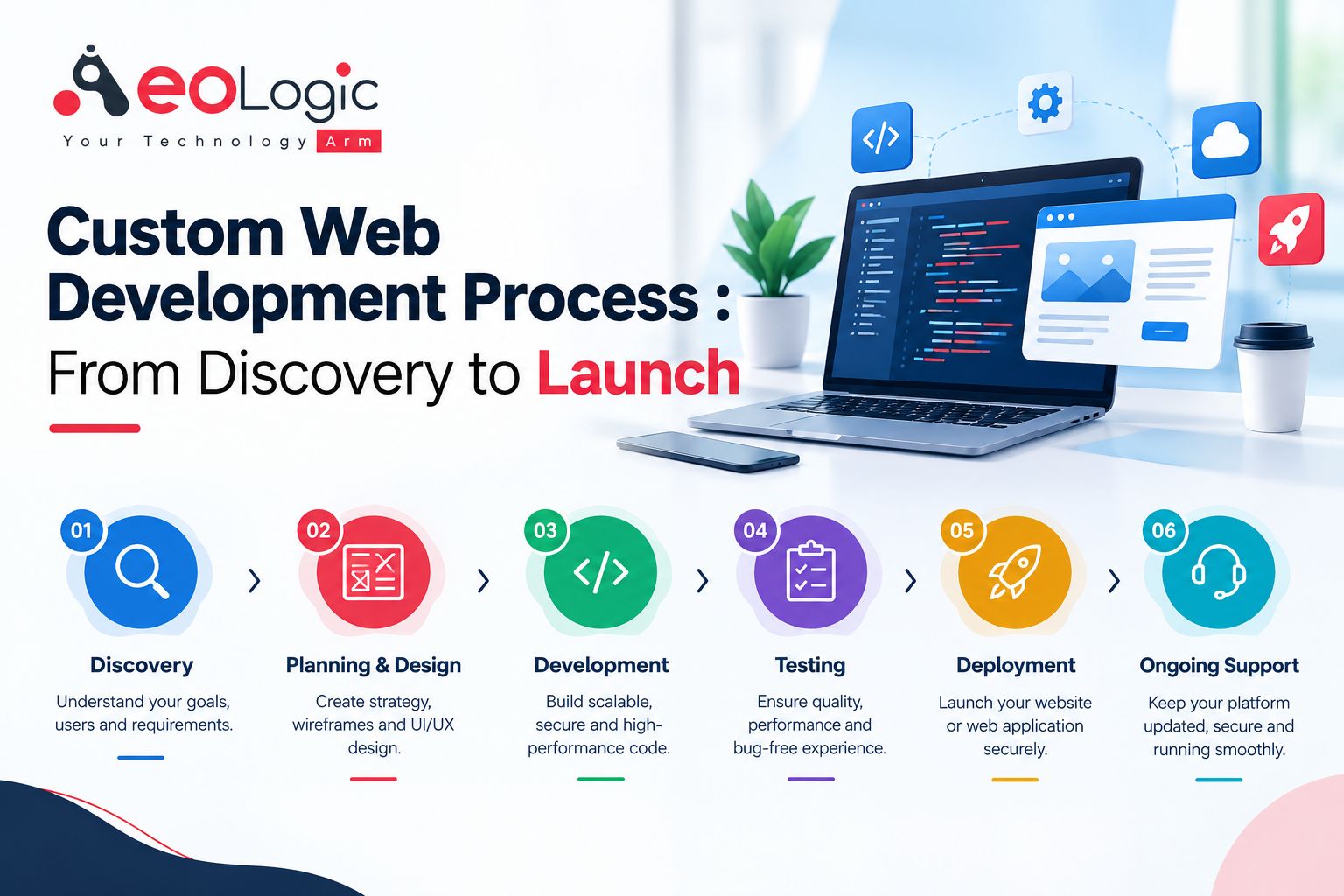

A successful website is more than an attractive interface. It needs to support business objectives, provide a smooth user experience, perform reliably, and remain flexible as the organization grows. This is why businesses often choose custom web development when standard templates and ready-made platforms cannot fully address their operational or customer requirements. A structured Custom Web Development Process helps transform an initial business idea into a functional, scalable, and high-performing digital product.
From understanding business requirements to designing interfaces, developing core functionality, testing the application, and finally launching it, every stage contributes to the quality of the final website. A clear development approach also reduces unnecessary revisions, improves communication between stakeholders and development teams, and creates a stronger foundation for long-term maintenance.
What is Custom Web Development?
Custom web development involves creating a website or web application specifically around the requirements of a business rather than relying entirely on pre-built themes, templates, or generic functionalities. The development team can create tailored features, workflows, integrations, dashboards, and user experiences according to the organization’s objectives.
Unlike conventional website development, custom solutions provide greater control over functionality and architecture. Businesses can decide how users interact with the platform, how information is processed, how external systems are connected, and how the application can evolve in the future.
This approach can be particularly useful for businesses with complex workflows, specialized customer journeys, unique operational requirements, or plans for rapid digital expansion.
Why a Structured Development Process Matters
A well-defined Custom Web Development Process provides a roadmap for moving from an initial concept to a production-ready website. Without proper planning, development projects can face unclear requirements, scope changes, technical issues, delayed timelines, and unexpected costs.
A structured approach allows teams to identify potential challenges before development begins. It also creates clear communication between business stakeholders, designers, developers, and quality assurance teams. Each stage can be reviewed before the project moves forward, helping ensure that the final product remains aligned with the original business objectives.
More importantly, the process does not end when a website goes live. A successful web application requires monitoring, security updates, performance optimization, feature improvements, and ongoing technical support.
Stage 1: Discovery and Requirement Analysis
Understanding Business Objectives
The first stage focuses on understanding why the website is being developed and what the business expects it to achieve. Development teams work with stakeholders to understand business goals, target audiences, existing challenges, competitors, and expected outcomes.
At this stage, teams may examine existing websites, applications, customer journeys, internal processes, and technology environments. The objective is to establish a clear understanding of the problem that the new solution needs to address.
Defining Functional Requirements
Once business objectives are understood, the required functionality can be documented. This may include user registration, dashboards, payment processing, search functionality, content management, third-party integrations, customer portals, reporting systems, or administrative controls.
The discovery stage establishes the foundation for the Custom Web Development Process because technical decisions should be based on clearly understood business and user requirements rather than assumptions.
Stage 2: Planning and Technology Selection
Choosing the Right Technology Stack
After requirements are established, developers determine which technologies are appropriate for the project. The technology stack may include frontend frameworks, backend technologies, databases, APIs, cloud services, content management systems, and security technologies.
The right choice depends on factors such as application complexity, expected traffic, performance requirements, scalability, security, development resources, and future expansion plans.
Creating the Development Roadmap
A development roadmap defines project phases, milestones, responsibilities, dependencies, and expected delivery timelines. Teams can divide the project into manageable development cycles so that progress can be reviewed continuously.
Effective planning also helps identify which features are essential for the initial release and which can be introduced during future development phases. This can prevent unnecessary complexity while keeping the project aligned with business priorities.
Stage 3: UX and UI Design
Designing the User Experience
User experience design focuses on how visitors navigate and interact with the website. Designers analyze user needs and create logical journeys that make important information and functionality easy to access.
Wireframes and prototypes can be used to visualize page structures and user flows before development begins. This allows stakeholders to identify usability issues early, when changes are easier and less expensive to implement.
Creating the Visual Interface
Once the user experience structure is established, designers develop the visual interface. Typography, layouts, navigation elements, forms, buttons, imagery, and other interface components are designed to create a consistent digital experience.
A responsive approach is also essential because users may access the website through desktops, laptops, tablets, and smartphones. The interface should adapt effectively to different screen sizes without compromising usability.
Stage 4: Frontend and Backend Development
Building the Frontend
Frontend development transforms approved designs into interactive web pages. Developers implement layouts, navigation, forms, animations, interactive elements, and responsive behavior using appropriate technologies.
Performance is an important consideration at this stage. Efficient code, optimized assets, responsive components, and appropriate loading strategies can help create a faster and smoother experience for users.
Developing Backend Functionality
The backend handles the logic that powers the application. It may manage databases, authentication, business rules, APIs, transactions, user permissions, and communication with external systems.
A well-designed backend architecture allows the application to process information efficiently while providing a foundation for future expansion. Security should also be considered throughout development rather than being treated as a final-stage activity.
Stage 5: Integration and Data Management
Modern websites frequently need to communicate with other business systems. These may include CRM platforms, ERP systems, payment gateways, marketing tools, analytics platforms, inventory systems, communication services, or third-party APIs.
During this stage, developers establish and test these integrations to ensure that information can move securely and reliably between systems.
Data management is equally important. Developers need to consider how data is stored, accessed, validated, transferred, and protected. Proper database architecture and access controls can improve both application performance and security.
Stage 6: Testing and Quality Assurance
Functional Testing
Testing ensures that the website behaves as expected under different conditions. Quality assurance teams verify forms, navigation, authentication, integrations, business workflows, and other important functions.
Each major feature should be tested individually as well as within the broader application to identify unexpected interactions between components.
Performance and Security Testing
A website may function correctly while still experiencing performance or security problems. Testing therefore needs to examine page speed, server response, application stability, scalability, authentication mechanisms, access permissions, and common security vulnerabilities.
Testing across different browsers and devices is also important for identifying compatibility issues.
The testing stage is a critical part of the Custom Web Development Process because launching without adequate quality assurance can result in technical problems that affect users and business operations.
Stage 7: Deployment and Launch
Preparing the Production Environment
Before launch, the development team prepares the production environment, configures servers and databases, connects required services, and verifies domain and security settings.
A final review should confirm that important functionality is working correctly and that production data and configuration settings are properly protected.
Going Live
Once the application passes final checks, it can be deployed to the production environment. Depending on the project’s complexity, teams may use staged deployment or release the website gradually to reduce operational risk.
Monitoring should begin immediately after launch so that unexpected performance, usability, or technical issues can be identified quickly.
Stage 8: Maintenance and Continuous Improvement
Launching a website is not the end of development. Businesses need to maintain their digital platforms as technologies, customer expectations, security requirements, and business processes change.
Ongoing maintenance may include security updates, bug fixes, performance improvements, infrastructure monitoring, content changes, analytics reviews, and new feature development.
User behavior and business data can also provide valuable insights into future improvements. Regular optimization allows the website to remain useful and competitive instead of becoming outdated after launch.
Common Challenges in Custom Web Development
Custom projects can involve several challenges, particularly when requirements are unclear or stakeholders have different expectations. Scope changes, integration dependencies, technical limitations, security concerns, and insufficient testing can all affect development timelines.
Another common challenge is focusing too heavily on visual design while overlooking performance, accessibility, scalability, or backend architecture. A successful website needs to balance appearance with functionality and technical reliability.
Clear documentation and communication throughout the Custom Web Development Process can help reduce these challenges. Regular reviews also allow teams to identify problems earlier and make informed adjustments without significantly affecting the overall project.
How to Make the Development Process More Effective
Effective custom development begins with clear objectives and realistic expectations. Businesses should communicate their requirements early and involve relevant stakeholders throughout the project rather than waiting until the final stage to review the solution.
Development teams should also prioritize scalability, security, performance, and maintainability from the beginning. Selecting technologies solely because they are popular may not produce the right outcome; technology choices should reflect the application’s actual requirements.
Regular testing, documentation, version control, structured project management, and post-launch monitoring can further improve development quality.
The Role of Custom Web Development in Digital Growth
As businesses increasingly depend on digital platforms for sales, customer engagement, operations, and internal workflows, websites are becoming more closely connected to broader technology ecosystems. Custom development enables organizations to build solutions around their specific processes rather than forcing those processes into the limitations of generic platforms.
A carefully planned Custom Web Development Process can therefore help organizations create digital products that are aligned with their current requirements while remaining adaptable to future needs.
Whether the goal is to build a customer-facing website, an enterprise portal, an e-commerce platform, or a complex web application, the development approach should focus on usability, performance, security, scalability, and long-term business value.
Conclusion
From discovery and planning to design, development, testing, deployment, and maintenance, every stage contributes to the success of a web project. Treating development as a structured journey rather than simply a coding exercise helps businesses build solutions that are more reliable, scalable, and aligned with user expectations.
The Custom Web Development Process provides a practical framework for turning business requirements into a working digital solution while allowing organizations to adapt the platform as their needs evolve. With clear planning, collaborative development, rigorous testing, and continuous improvement, businesses can create web applications that support both immediate objectives and long-term digital growth.
FAQs
Q1. What is a custom web development process?
A custom web development process is a structured approach to creating a website or web application according to specific business requirements. It typically covers discovery, planning, design, development, testing, deployment, and ongoing maintenance.
Q2. How long does custom web development take?
The timeline depends on the project’s complexity, number of features, integrations, design requirements, and testing needs. A simple website may take a few weeks, while a complex enterprise web application can require several months.
Q3. Why is custom web development important for businesses?
Custom web development allows businesses to create digital solutions around their specific workflows, customer requirements, and operational goals. It also provides greater flexibility for integrations, scalability, security, and future feature development.
Q4. What technologies are used for custom web development?
The technology stack depends on project requirements. Developers may use frontend technologies such as React or Angular, backend technologies such as Node.js, PHP, or Python, along with databases, APIs, cloud platforms, and other supporting technologies.
Q5. What happens after a website is launched?
Post-launch activities typically include performance monitoring, security updates, bug fixes, backups, technical support, and feature improvements. Continuous maintenance helps keep the website secure, reliable, and aligned with changing business requirements.