
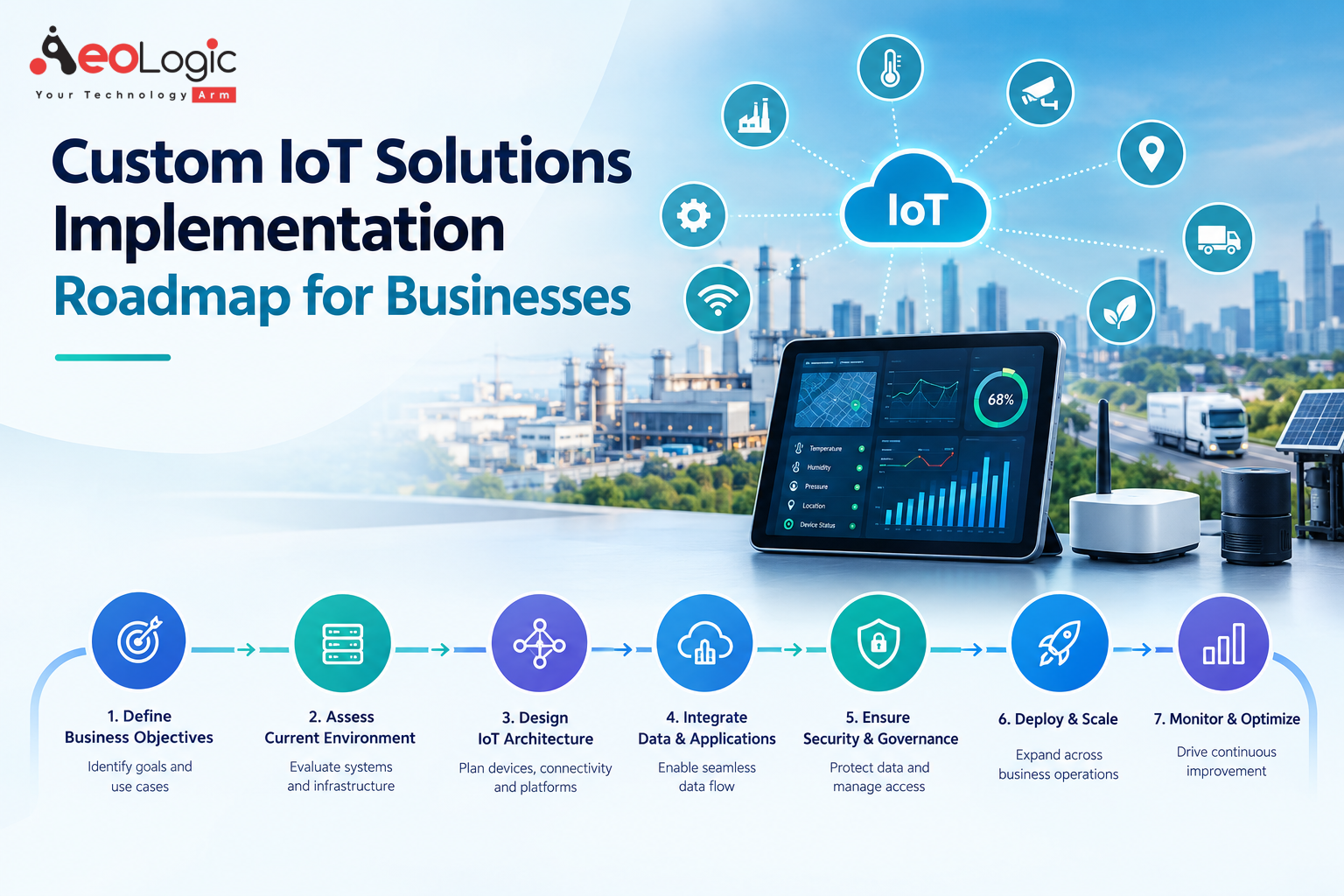

The Internet of Things (IoT) has moved beyond connected devices and basic monitoring. Businesses across manufacturing, logistics, healthcare, retail, energy, and other industries are using connected technologies to collect real-time data, automate processes, improve operational visibility, and make faster decisions. However, implementing IoT successfully requires more than installing sensors and connecting devices. Organizations need a structured approach that aligns technology with business objectives, operational requirements, data infrastructure, and long-term growth plans. A well-planned Custom IoT Solutions Implementation approach helps businesses develop IoT environments around their specific processes rather than forcing operations to adapt to generic technology.
From identifying the right use case to deploying connected devices, integrating data platforms, securing the environment, and measuring business outcomes, every stage plays an important role in determining the success of an IoT initiative.
Understanding the Need for a Structured IoT Roadmap
IoT projects often involve multiple technology layers, including sensors, gateways, communication networks, cloud or edge platforms, analytics systems, applications, and enterprise software. Without proper planning, businesses may end up with disconnected devices, incompatible systems, excessive data, security vulnerabilities, or solutions that fail to deliver measurable value.
A roadmap provides a clear direction for moving from an initial business problem to a scalable connected ecosystem. It allows organizations to define priorities, identify technical dependencies, estimate resources, and establish measurable outcomes before investing heavily in implementation.
The goal of Custom IoT Solutions Implementation is therefore not simply to connect more devices. It is to create an integrated environment where connected data can support meaningful operational improvements and business decisions.
Step 1: Identify Business Objectives and IoT Use Cases
The first stage should focus on understanding why the organization wants to adopt IoT. Instead of beginning with a particular sensor, platform, or communication technology, businesses should begin with operational challenges.
Define the Business Problem
Organizations may want to reduce equipment downtime, improve asset visibility, monitor environmental conditions, optimize inventory, improve fleet utilization, automate inspections, or enhance customer experiences. Clearly defining the problem helps determine which IoT capabilities are actually required.
For example, a manufacturing organization experiencing unexpected machine failures may focus on equipment monitoring and predictive maintenance. A logistics company may prioritize real-time fleet and shipment visibility, while a healthcare organization could focus on monitoring medical assets and critical environmental conditions.
Prioritize High-Value Use Cases
Not every possible IoT application needs to be implemented at once. Businesses should assess potential use cases based on expected business value, implementation complexity, available data, and scalability.
Starting with a focused use case can help organizations demonstrate measurable results before expanding the IoT environment across additional departments or facilities.
Step 2: Assess the Existing Technology Environment
Before introducing new connected technologies, businesses should evaluate their existing infrastructure. Many organizations already operate ERP, CRM, warehouse management, fleet management, manufacturing, or asset management systems.
Evaluate Existing Systems and Infrastructure
The assessment should consider existing databases, applications, communication networks, cloud infrastructure, hardware, APIs, and data workflows. This helps identify where IoT technology can integrate with existing systems instead of creating another isolated technology layer.
During Custom IoT Solutions Implementation, compatibility should be treated as an important consideration because IoT data becomes significantly more valuable when it can flow into the systems employees already use for daily operations.
Identify Technology Gaps
The assessment should also identify missing capabilities such as device connectivity, data processing, storage, analytics, security controls, or application interfaces. These gaps provide a foundation for designing the future IoT architecture.
Step 3: Design the IoT Architecture
Once business objectives and infrastructure requirements are understood, the next stage is architectural planning. A typical IoT environment may contain devices and sensors at the edge, connectivity technologies, gateways, processing systems, data platforms, analytics tools, and business applications.
Select Devices and Sensors
The choice of sensors depends on the use case. Businesses may require temperature sensors, pressure sensors, motion sensors, RFID devices, GPS modules, cameras, industrial sensors, smart meters, or other connected equipment.
Device selection should consider accuracy, operating environment, power requirements, connectivity, durability, maintenance, and expected lifecycle.
Choose Connectivity and Communication Technologies
Different IoT applications require different connectivity models. Wi-Fi, Bluetooth, cellular networks, LoRaWAN, Zigbee, Ethernet, and other technologies can serve different operational requirements.
The right selection depends on factors such as range, bandwidth, power consumption, network availability, deployment environment, and security requirements.
Step 4: Build the Data and Integration Layer
IoT devices can generate large volumes of continuous data. Collecting this data is only the beginning. Businesses need mechanisms for transmitting, processing, storing, and transforming data into information that can support decisions.
Establish Data Processing Workflows
IoT platforms can process incoming data at the edge, in the cloud, or through a hybrid architecture. Edge processing can be useful when businesses require rapid responses or operate in environments where continuous cloud connectivity is not practical.
Cloud-based processing can provide scalability and centralized access to information across locations. A hybrid model can combine the advantages of both approaches.
Integrate IoT With Business Applications
The integration layer connects IoT information with existing enterprise applications. APIs and middleware can help transfer relevant data into ERP, CRM, supply chain, warehouse, maintenance, or analytics platforms.
This integration is a critical component of Custom IoT Solutions Implementation because organizations ultimately need business applications and employees to benefit from connected information.
Step 5: Develop Security and Governance Controls
Security should be incorporated from the beginning rather than added after deployment. Connected devices can increase the organization’s attack surface because every device, gateway, application, and communication channel may represent a potential security entry point.
Secure Devices and Networks
Businesses should establish device authentication, access controls, secure communication protocols, firmware management, network segmentation, and monitoring mechanisms. Devices should also be configured to receive security updates throughout their operational lifecycle.
Establish Data Governance
IoT environments can generate sensitive operational and business information. Organizations should define policies for data access, retention, storage, ownership, privacy, and compliance.
A security-first approach helps reduce operational risks while creating a stronger foundation for scaling IoT initiatives.
Step 6: Build and Test a Pilot
Launching an organization-wide IoT system immediately can introduce unnecessary risks. A pilot allows businesses to validate the architecture, devices, integrations, workflows, and expected business outcomes in a controlled environment.
Test the Solution in a Real Environment
The pilot should represent actual operational conditions as closely as possible. Teams can evaluate device reliability, connectivity, data accuracy, system performance, user experience, and integration quality.
The results can reveal technical issues that may not have been visible during planning. Businesses can then refine the architecture before expanding the solution.
Measure Business Outcomes
A successful pilot should have measurable objectives. Depending on the use case, organizations may track equipment downtime, operational costs, asset utilization, productivity, response times, energy consumption, or inventory accuracy.
These measurements help establish whether the solution is producing meaningful business value.
Step 7: Deploy and Scale the IoT Ecosystem
After successful pilot validation, organizations can begin expanding the solution. Scaling requires careful coordination between technology teams, operations, security teams, business users, and external implementation partners.
Standardize Deployment Processes
Organizations should establish repeatable processes for device provisioning, configuration, testing, monitoring, maintenance, and replacement. Standardization becomes increasingly important as the number of connected devices grows.
Prepare for Future Expansion
The architecture should support additional devices, locations, users, data sources, and applications without requiring a complete redesign. Scalable cloud infrastructure, modular applications, APIs, and flexible data architectures can support this expansion.
A scalable Custom IoT Solutions Implementation strategy enables businesses to begin with a focused initiative while maintaining the ability to expand into broader connected operations.
Step 8: Monitor, Optimize, and Maintain
IoT implementation does not end when devices are deployed. Connected environments require continuous monitoring and optimization.
Monitor Device and Application Performance
Organizations should track device availability, connectivity, data quality, application performance, and system health. Automated alerts can help technical teams identify failures before they significantly affect operations.
Continuously Improve the Solution
Business requirements and technology environments change over time. New devices, analytics capabilities, AI technologies, and connectivity options may create opportunities for improvement.
Continuous optimization allows organizations to refine workflows, improve data quality, strengthen security, and increase the value generated by their IoT investments.
Common Challenges in IoT Implementation
Businesses may encounter several challenges during implementation. These can include integration complexity, inconsistent data, device management difficulties, cybersecurity risks, limited internal expertise, connectivity issues, and unclear return on investment.
Legacy systems can make integration particularly challenging because older applications may not provide modern APIs or flexible data exchange mechanisms. Organizations may also struggle with managing large numbers of devices across multiple locations.
Another challenge is ensuring that IoT projects remain connected to business objectives. A technically successful deployment may still provide limited value if employees cannot easily use the resulting information in their workflows.
A carefully designed Custom IoT Solutions Implementation roadmap can help address these challenges by establishing clear requirements, integration strategies, security controls, testing procedures, and performance measurements before large-scale deployment.
How Businesses Can Build a Sustainable IoT Strategy
A sustainable IoT strategy should combine business priorities with technology planning. Organizations should avoid treating IoT as a standalone technology project and instead consider how connected intelligence can become part of broader digital operations.
Leadership teams should establish clear ownership, technical teams should develop scalable architecture, and operational teams should participate in solution design and testing. Employee training is also important because new IoT-enabled workflows may require teams to interpret dashboards, respond to automated alerts, or work with new applications.
Organizations should also establish a long-term approach to device lifecycle management. Hardware eventually requires maintenance, replacement, upgrades, or decommissioning. Planning for these activities from the beginning can reduce unexpected costs and operational disruption.
The Role of AI and Analytics in Modern IoT
IoT becomes more valuable when connected data is combined with analytics and artificial intelligence. Instead of simply showing what is happening, advanced systems can help identify patterns, detect anomalies, forecast potential failures, and support automated decision-making.
For example, machine data can be analyzed to identify conditions associated with equipment failure. Fleet information can be used to understand driving patterns, route efficiency, and maintenance requirements. Retail businesses can combine connected devices with operational data to improve inventory visibility and customer experiences.
This combination of connected devices, data platforms, analytics, and AI is increasingly shaping intelligent business operations. During Custom IoT Solutions Implementation, organizations should therefore consider how their architecture can support advanced analytics as their data maturity increases.
Conclusion
IoT implementation is a long-term business transformation initiative rather than a simple technology deployment. Organizations need to begin with clearly defined business objectives, assess their existing environment, design an appropriate architecture, establish secure data flows, validate the solution through pilots, and create processes for continuous optimization.
The most effective Custom IoT Solutions Implementation roadmap is one that connects technology decisions directly with measurable business outcomes. By taking a phased and scalable approach, businesses can reduce implementation risks while creating an IoT environment capable of supporting automation, visibility, analytics, and better decision-making.
As connected technologies continue to evolve, businesses that establish a flexible foundation today can expand their IoT capabilities as new devices, AI technologies, analytics platforms, and connectivity solutions become available. The result is not simply a network of connected devices, but a more intelligent and responsive operating environment built around real business requirements.
Frequently Asked Questions
Q1. What is Custom IoT Solutions Implementation?
Custom IoT Solutions Implementation is the process of designing and deploying an IoT ecosystem according to a business’s specific operational requirements, technology infrastructure, and objectives. It can include connected devices, sensors, communication networks, data platforms, analytics, enterprise integrations, and security controls.
Q2. Why do businesses need a Custom IoT Solutions Implementation roadmap?
A structured roadmap helps businesses identify suitable IoT use cases, plan their technology architecture, manage implementation risks, integrate existing systems, and establish measurable business outcomes. It also provides a phased approach for testing and scaling IoT initiatives.
Q3. How long does IoT implementation take?
The timeline varies depending on the project’s complexity, number of connected devices, integration requirements, infrastructure, security needs, and deployment locations. A focused pilot may take significantly less time than a large enterprise-wide IoT deployment involving multiple facilities and systems.
Q4. What technologies are used in IoT implementation?
IoT implementations can involve sensors, RFID, GPS, gateways, edge computing, cloud platforms, APIs, wireless networks, databases, analytics platforms, and artificial intelligence. The technologies selected depend on the organization’s specific use case and operational environment.
Q5. How can businesses measure the success of an IoT implementation?
Businesses can measure success through metrics such as reduced equipment downtime, improved asset utilization, lower operating costs, increased productivity, better inventory visibility, faster response times, improved energy efficiency, and other outcomes directly connected to the original business objectives.