
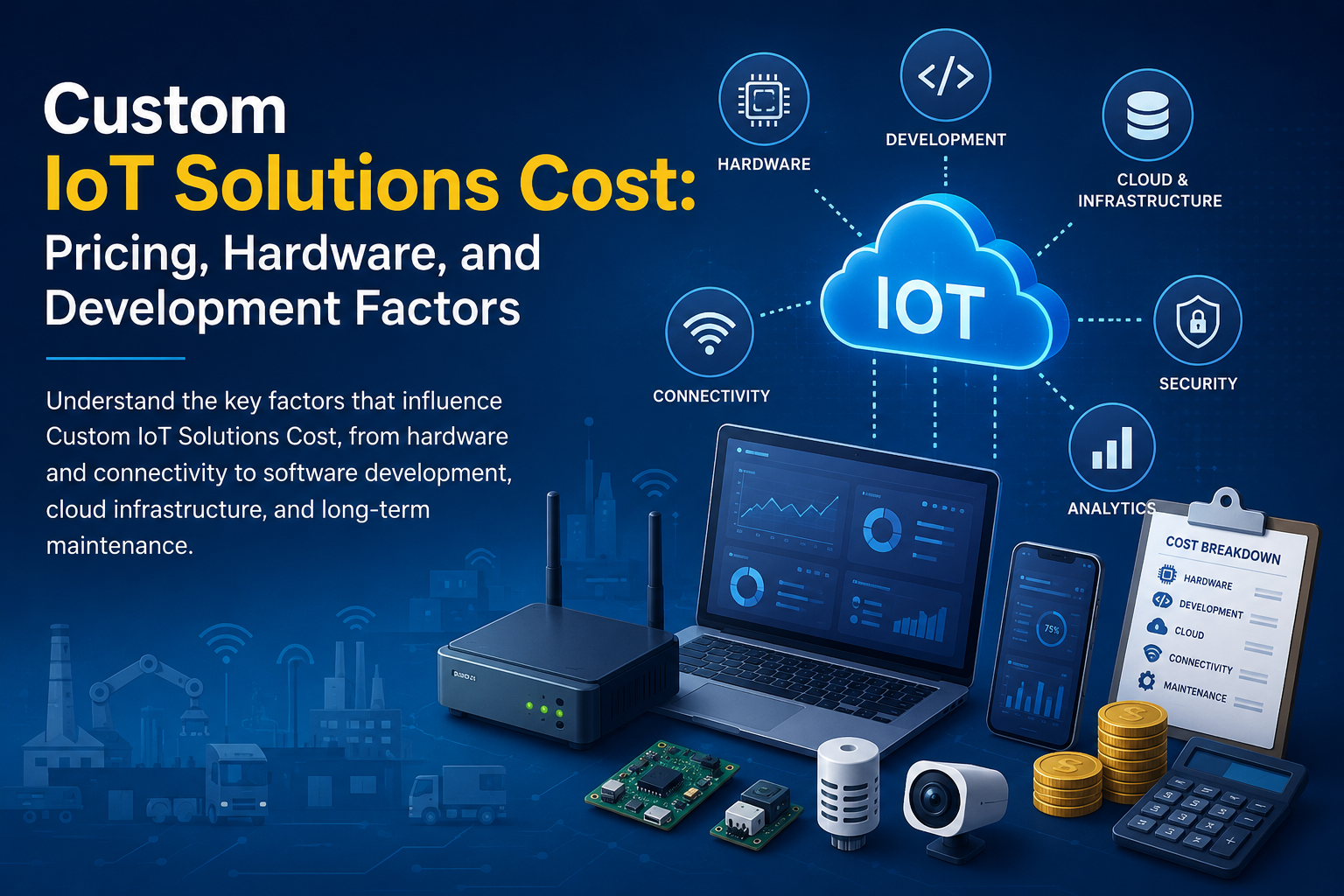

The Custom IoT Solutions Cost can vary significantly depending on the type of connected devices, software requirements, communication protocols, security standards, cloud infrastructure, and development complexity involved. Unlike ready-made IoT platforms, custom IoT solutions are designed around specific business processes, which means the investment depends heavily on what the organization wants to monitor, automate, analyze, and control.
Businesses across manufacturing, logistics, healthcare, retail, agriculture, energy, and other industries are increasingly adopting IoT to connect physical assets with digital systems. However, estimating the cost of an IoT project is not as simple as calculating the price of sensors or connected devices. Hardware, firmware, mobile and web applications, cloud infrastructure, data processing, integrations, security, testing, and ongoing maintenance can all influence the final budget.
Understanding these factors before development begins helps businesses create realistic budgets and choose an IoT architecture that supports long-term growth.
What determines the Custom IoT Solutions Cost?
The Custom IoT Solutions Cost is influenced by the complete technology ecosystem behind an IoT product or platform. A basic solution that collects data from a few sensors will have very different development requirements from an enterprise IoT system that connects thousands of devices across multiple locations.
IoT Hardware Requirements
Hardware is one of the most visible components of an IoT project, but it is only one part of the overall investment. Sensors, gateways, microcontrollers, GPS modules, RFID readers, cameras, industrial controllers, and other connected devices may be required depending on the application.
The type and quality of hardware directly affect project costs. A temperature monitoring system for a warehouse may require relatively simple sensors, while an industrial predictive maintenance solution could need vibration, pressure, temperature, current, and acoustic sensors capable of operating in demanding environments.
Sensors and Connected Devices
Sensors collect the physical data that makes an IoT solution useful. The required sensor type, accuracy, operating environment, measurement range, power consumption, and quantity can influence the budget.
For example, environmental monitoring may use temperature and humidity sensors, while fleet tracking can require GPS modules, fuel monitoring sensors, accelerometers, and vehicle diagnostics. Healthcare applications may require specialized medical sensors with higher accuracy and regulatory considerations.
IoT Gateways and Edge Devices
Gateways connect sensors and devices to the wider network or cloud platform. They can aggregate data, translate communication protocols, perform local processing, and provide connectivity when direct cloud communication is not practical.
A simple IoT project may not need a sophisticated gateway, whereas an industrial deployment could require rugged edge computing hardware capable of processing large volumes of data locally. This additional capability can increase both hardware and software development costs.
Software Development Costs for Custom IoT Solutions
Hardware alone cannot deliver the full value of an IoT system. Custom software is responsible for collecting, processing, visualizing, analyzing, and managing the data generated by connected devices.
IoT Application Development
The software layer may include web dashboards, mobile applications, administrative panels, device management interfaces, reporting systems, alerts, and automation workflows.
A simple dashboard displaying sensor readings requires less development than an enterprise platform with role-based access, real-time monitoring, historical analytics, automated alerts, reporting, and multiple user types.
The number of applications required also affects the overall Custom IoT Solutions Cost. A project involving only a web dashboard will generally have different development requirements from one requiring separate Android and iOS applications along with a web-based administration portal.
IoT Backend and Data Processing
The backend acts as the central processing layer of an IoT ecosystem. It receives information from connected devices, validates and processes the data, stores it, and makes it available to applications and analytics systems.
Backend development becomes more complex when the solution must handle thousands or millions of data points continuously. Developers need to consider scalability, database architecture, APIs, message processing, device communication, and system reliability.
Cloud Infrastructure
Cloud services are commonly used to store and process IoT data because they allow organizations to scale infrastructure as device numbers and data volumes increase.
The choice between public cloud, private cloud, hybrid infrastructure, or an on-premises deployment can significantly affect both initial development and long-term operating costs. Cloud costs can include computing resources, databases, storage, data transfer, monitoring, messaging services, and other infrastructure components.
IoT Connectivity and Communication Protocols
Connectivity is another major consideration when calculating the Custom IoT Solutions Cost. Different IoT applications require different methods of communication depending on device location, data volume, range, power requirements, and network availability.
Wi-Fi, Bluetooth, and Cellular Connectivity
Wi-Fi can be suitable for connected devices operating within buildings or locations that already have network infrastructure. Bluetooth is often useful for short-range communication and low-power applications, while cellular networks can support devices deployed across large geographic areas.
Cellular IoT deployments may introduce additional connectivity and subscription costs, while Wi-Fi-based systems may require network infrastructure and configuration.
LoRaWAN and Other Low-Power Networks
Applications requiring long-range communication with low power consumption may use technologies such as LoRaWAN. These networks can be particularly useful for agriculture, smart buildings, environmental monitoring, and industrial applications where devices need to transmit relatively small amounts of data over long distances.
Selecting the right communication technology during the architecture stage helps balance performance, reliability, battery life, and cost.
IoT Security and Compliance
Security should be considered from the beginning of an IoT project rather than added after development. Connected devices can create additional entry points into an organization’s technology environment, making security an important component of the overall project budget.
Device and Network Security
IoT security can involve secure device authentication, encrypted communication, access control, secure firmware updates, certificate management, and network protection. More advanced deployments may also require continuous monitoring and threat detection.
The level of security required depends on the type of data being collected and the consequences of a security incident. Industrial, healthcare, financial, and critical infrastructure applications generally require stronger security controls than simple consumer monitoring solutions.
Compliance Requirements
Certain industries require IoT systems to follow specific regulatory and data protection requirements. Compliance may influence the architecture, data storage strategy, access controls, audit mechanisms, and development process.
If an IoT solution handles sensitive information or operates in a regulated industry, compliance requirements should be included in the initial cost estimation.
IoT Integration and Customization
Many businesses already use ERP, CRM, warehouse management, fleet management, enterprise asset management, or other business applications. A custom IoT solution often needs to exchange information with these existing systems.
API and Enterprise System Integration
API development allows IoT platforms to communicate with existing business applications. For example, sensor data from a warehouse could be integrated with an inventory management platform, while machine data could be connected to an enterprise maintenance system.
The complexity of integration depends on the number of systems involved, API availability, data formats, authentication requirements, and the amount of data that needs to be synchronized.
Business-Specific Workflows
Customization is another factor that separates a standard IoT platform from a custom solution. Businesses may require automated workflows based on specific conditions.
For example, an IoT system could detect abnormal machine vibration, generate an alert, create a maintenance request, notify the appropriate employee, and update an enterprise system automatically. Building such workflows requires additional backend logic, testing, and integration work.
Data Analytics and IoT Intelligence
IoT systems generate large volumes of data, but collecting information is only the beginning. Businesses increasingly expect IoT platforms to convert raw data into useful insights.
Real-Time Monitoring and Analytics
Real-time dashboards can help teams monitor assets, equipment, vehicles, environmental conditions, or production processes. Historical analytics can identify patterns and support operational planning.
The complexity of analytics affects development requirements. Basic charts and reports are relatively straightforward, while advanced analytics involving anomaly detection, forecasting, predictive maintenance, or machine learning require additional data engineering and model development.
Predictive Maintenance
Predictive maintenance is one of the more advanced IoT use cases. Instead of waiting for equipment to fail, organizations can analyze sensor data to identify patterns associated with potential failures.
Developing this capability may require historical datasets, machine learning models, data pipelines, model monitoring, and continuous optimization. As a result, predictive IoT applications can have considerably higher development costs than basic monitoring systems.
Testing and Deployment Costs
Testing is an essential part of any custom IoT project because the solution must work across both physical and digital environments.
Hardware and Software Testing
Developers need to test sensors, communication networks, firmware, APIs, applications, cloud services, and integrations. Testing may also involve different device models, operating environments, network conditions, and hardware configurations.
IoT solutions deployed in industrial or outdoor environments may require additional testing for temperature, vibration, connectivity interruptions, power failures, and other real-world conditions.
Deployment and Device Provisioning
Once the solution is ready, devices must be configured, registered, authenticated, installed, and connected to the platform. Large deployments can require centralized device provisioning and remote configuration capabilities.
The geographic distribution of devices can also influence deployment costs. Installing thousands of devices across multiple sites requires more planning and operational resources than deploying a small pilot project.
Maintenance and Long-Term IoT Costs
The initial development budget does not represent the complete cost of an IoT solution. Businesses should also plan for ongoing maintenance and upgrades.
Software Updates and Monitoring
IoT platforms require regular software updates, security patches, bug fixes, performance optimization, and infrastructure monitoring. Connected devices may also require firmware updates to address security issues or introduce new functionality.
Hardware Replacement and Scalability
Physical devices have finite lifespans. Sensors may fail, batteries may need replacement, and hardware components can become outdated. Businesses should account for these lifecycle costs when evaluating the total investment.
Scalability is equally important. An architecture designed for 100 devices may not work efficiently when expanded to 10,000 devices. Building scalability into the initial solution can increase development costs but reduce the need for expensive redevelopment later.
How to Estimate the Cost of a Custom IoT Project
A reliable cost estimate begins with defining the project requirements rather than starting with a fixed development price. Businesses should first determine what they want to monitor, how many devices will be connected, what data needs to be collected, where the devices will operate, and what business systems need to receive the information.
The next step is to define the technology architecture, including hardware, connectivity, firmware, backend infrastructure, cloud services, applications, analytics, security, and integrations. Development teams can then estimate the effort required for each layer and calculate both initial development and ongoing operational expenses.
Starting with a small proof of concept or pilot can also help validate the hardware, connectivity, data quality, and business use case before a large-scale deployment. Once the pilot demonstrates value, the solution can be expanded across additional devices and locations.
Why Custom IoT Solutions Can Be Worth the Investment
Although custom IoT development may require a larger initial investment than an off-the-shelf platform, customization allows businesses to build technology around their actual operational requirements.
A custom solution can integrate with existing systems, support organization-specific workflows, scale with business growth, and provide control over data and functionality. It can also reduce unnecessary features that businesses may have to pay for when using generic platforms.
The real value of an IoT project should therefore be evaluated against measurable business outcomes such as reduced downtime, improved asset utilization, lower maintenance costs, better inventory visibility, improved operational efficiency, and faster decision-making.
Conclusion
The Custom IoT Solutions Cost depends on much more than the price of sensors and connected devices. Hardware selection, software development, connectivity, cloud infrastructure, security, integrations, analytics, testing, deployment, and ongoing maintenance all contribute to the final investment.
For businesses considering IoT adoption, the most effective approach is to define the business problem first and then design the technology architecture around it. A well-planned solution can start with a focused pilot and gradually scale as the organization validates results.
With the right combination of hardware, software, connectivity, cloud infrastructure, and data intelligence, custom IoT solutions can become a long-term technology investment that improves visibility, automation, efficiency, and operational decision-making.
Frequently Asked Questions
Q1. What is the average Custom IoT Solutions Cost?
The Custom IoT Solutions Cost varies based on hardware, software complexity, connectivity, cloud infrastructure, integrations, security, and development requirements. A basic IoT solution can cost significantly less than an enterprise platform connecting thousands of devices and supporting advanced analytics.
Q2. What factors have the biggest impact on Custom IoT Solutions Cost?
The biggest cost factors include the number and type of IoT devices, sensor requirements, communication protocols, backend development, mobile or web applications, cloud infrastructure, data analytics, security, third-party integrations, testing, and ongoing maintenance.
Q3. Does IoT hardware significantly increase development costs?
Yes, hardware can have a substantial impact on the overall project budget. Sensor type, device quality, gateways, microcontrollers, connectivity modules, power requirements, and deployment conditions all influence the cost of building and deploying a custom IoT solution.
Q4. Can a custom IoT solution be integrated with existing business software?
Yes. Custom IoT solutions can be integrated with ERP, CRM, inventory management, fleet management, asset management, and other enterprise systems through APIs and other integration methods. The complexity and number of integrations can affect the overall development cost.
Q5. How can businesses reduce the cost of developing an IoT solution?
Businesses can control development costs by clearly defining requirements, selecting appropriate hardware and connectivity technologies, starting with a focused IoT proof of concept, using scalable architecture, and prioritizing essential features before expanding the platform.