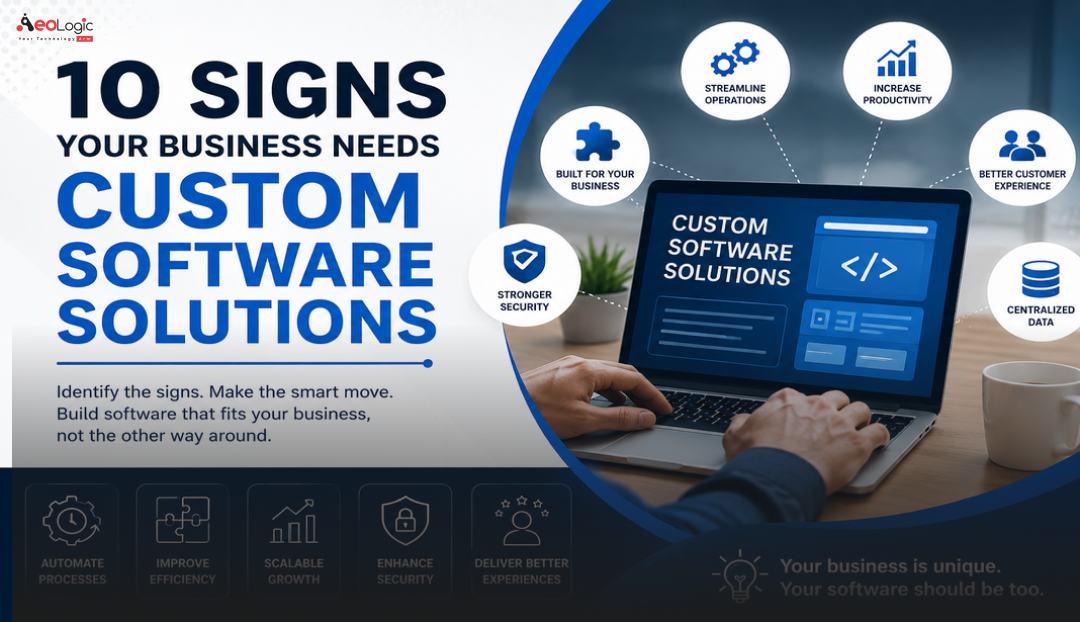

In today’s competitive business environment, companies need technology that supports growth instead of creating limitations. Many businesses begin with off-the-shelf software because it is quick to implement and affordable. However, as operations become more complex, generic software often struggles to meet evolving business needs. This is where Custom Software Solutions become a valuable investment.
Every business has unique workflows, customer expectations, and operational challenges. Relying on software designed for a broad audience can eventually slow productivity, increase manual work, and limit innovation. Recognizing the warning signs early can help organizations make the right technology decisions before inefficiencies begin affecting profitability and customer satisfaction.
This article explores ten clear signs that indicate your organization is ready for Custom Software Solutions and explains how tailored software can improve efficiency, scalability, and long-term business success.
Why Businesses Outgrow Standard Software?
Most businesses start with ready-made applications for accounting, inventory, CRM, HR, or project management. While these tools work well during the initial stages, they are built to satisfy the common needs of thousands of businesses rather than the specific requirements of one organization.
As companies expand, they often introduce new products, serve different customer segments, adopt new business models, or automate more processes. Standard software may not adapt quickly enough to these changes, forcing employees to rely on spreadsheets, manual data entry, or disconnected systems.
Custom software is designed specifically around a company’s operations, ensuring every feature contributes directly to business objectives rather than forcing teams to adjust their workflows.
Sign 1: Your Employees Spend Too Much Time on Manual Tasks
One of the biggest indicators that your business needs custom software is excessive manual work. If employees repeatedly enter the same information into multiple systems, prepare reports manually, or perform repetitive administrative tasks every day, productivity suffers.
Manual processes not only consume valuable time but also increase the likelihood of human errors. Incorrect data entry, duplicate records, and delayed information can affect customer service, financial reporting, and operational efficiency.
Custom software automates repetitive workflows, synchronizes information across departments, and reduces unnecessary administrative work. Employees can then focus on strategic responsibilities that add greater value to the business.
Sign 2: Multiple Software Applications Don’t Work Together
Many organizations gradually build a technology stack consisting of separate applications for finance, inventory, customer management, payroll, marketing, and operations. While each tool performs its intended function, they often fail to communicate with one another.
Disconnected systems create data silos, making it difficult to maintain consistent information across departments. Employees frequently export spreadsheets, copy data manually, or switch between several applications to complete a single task.
Custom Software Solutions can integrate existing platforms into one centralized system, allowing information to flow automatically between departments. This improves collaboration, enhances reporting accuracy, and provides leadership with a complete view of business performance.
Sign 3: Your Business Processes Are Becoming More Complex
As businesses grow, their workflows naturally become more sophisticated. New approval processes, customer requirements, compliance standards, and operational procedures often exceed the capabilities of standard software.
Businesses sometimes modify their operations simply because their software cannot support the preferred workflow. This approach creates unnecessary inefficiencies and limits innovation.
Custom software is designed around the organization’s actual processes rather than forcing the organization to adapt to software limitations. Every workflow, approval stage, automation rule, and reporting requirement can be configured according to business needs.
Sign 4: Reporting Takes Too Long
Accurate and timely reporting is essential for making informed business decisions. If managers spend hours collecting information from different departments before generating reports, valuable decision-making time is lost.
Delayed reports make it difficult to identify sales trends, monitor inventory, track employee performance, or respond quickly to market changes.
Custom software provides centralized dashboards with real-time reporting capabilities. Business leaders can access accurate information instantly, helping them make faster and more confident decisions based on current data.
Sign 5: Your Customers Expect Better Digital Experiences
Modern customers expect businesses to provide fast, personalized, and convenient digital services. Whether they are placing orders, tracking deliveries, submitting service requests, or communicating with support teams, customers value seamless digital interactions.
Generic software may not provide the flexibility required to deliver unique customer experiences that differentiate your business from competitors.
Custom Software Solutions allow organizations to build customer portals, mobile applications, self-service platforms, automated communication systems, and personalized user experiences that strengthen customer relationships and improve satisfaction.
Sign 6: Your Current Software Cannot Scale with Business Growth
Software that performs well for a small team may struggle when transaction volumes, customer numbers, or employee count increase significantly.
Slow system performance, frequent downtime, limited user licenses, and feature restrictions can become major obstacles to business expansion.
Custom software is built with scalability in mind. New modules, users, locations, products, and business functions can be added as the organization grows without requiring a complete system replacement. This flexibility supports sustainable long-term growth while protecting technology investments.
Sign 7: Security and Compliance Have Become Major Concerns
Businesses today handle increasing amounts of sensitive customer information, financial records, intellectual property, and operational data. Protecting this information has become a critical business responsibility.
Standard software often offers general security features that may not fully satisfy industry-specific compliance requirements or internal security policies.
Custom software allows businesses to implement advanced authentication, role-based access control, encryption, audit trails, automated compliance reporting, and industry-specific security measures tailored to their operational requirements. This provides greater control over sensitive information while reducing compliance risks.
Sign 8: You’re Paying for Features You Never Use
Many commercial software platforms offer extensive feature lists designed to appeal to a broad customer base. However, businesses frequently end up paying subscription fees for capabilities that remain unused.
At the same time, the features they actually need may not exist or require expensive third-party extensions.
Custom Software Solutions eliminate unnecessary complexity by including only the features that directly support business operations. Organizations gain a streamlined system that improves productivity while reducing software clutter and long-term licensing expenses.
Sign 9: Decision-Making Depends on Multiple Spreadsheets
If important business decisions require collecting data from numerous spreadsheets, emails, and disconnected applications, it indicates that information management has become fragmented.
Different departments may maintain separate versions of the same data, creating inconsistencies that affect forecasting, budgeting, inventory planning, and customer management.
Custom software centralizes business information into a single source of truth. Real-time access to reliable data enables faster collaboration, improves forecasting accuracy, and supports informed strategic planning across the organization.
Sign 10: Your Competitors Are Innovating Faster
Technology has become a key competitive advantage across nearly every industry. Businesses that automate operations, leverage real-time analytics, and improve customer experiences often respond to market opportunities more quickly than competitors relying on outdated systems.
If competitors consistently launch new digital services, improve operational efficiency, or deliver better customer experiences while your organization struggles with manual processes, your technology may be limiting business growth.
Investing in custom software provides the flexibility to innovate continuously. Businesses can introduce new features, integrate emerging technologies, automate evolving processes, and respond more quickly to changing customer expectations without waiting for third-party software vendors to update their products.
Benefits of Investing in Custom Software Solutions
Organizations that transition to custom software often experience improvements across multiple areas of their business. Tailored applications help automate repetitive processes, reduce operational costs, improve employee productivity, strengthen data security, and deliver better customer experiences.
Custom software also supports easier integration with existing business systems, provides greater flexibility for future enhancements, and offers complete ownership over functionality. Instead of adapting business operations to software limitations, organizations gain technology specifically designed to support their goals.
Over time, these advantages contribute to improved efficiency, stronger competitive positioning, and better return on technology investments.
How to Know When It’s Time to Make the Move?
Every business reaches a stage where existing software no longer supports future ambitions. The decision to invest in custom software should not be based solely on company size but on operational complexity, growth objectives, customer expectations, and long-term technology strategy.
Organizations experiencing repeated workflow bottlenecks, disconnected systems, increasing manual work, security concerns, or limited scalability should evaluate whether custom software can address these challenges more effectively than expanding their collection of generic applications.
Starting the transition before operational inefficiencies become major obstacles allows businesses to implement new systems strategically rather than reacting to growing problems.
Conclusion
Technology should enable growth rather than restrict it. While off-the-shelf applications remain useful for many organizations, there comes a point when they can no longer support evolving business requirements. Recognizing these warning signs early allows businesses to invest in solutions that align with their unique goals and future plans.
Custom Software Solutions provide organizations with greater flexibility, automation, scalability, security, and operational efficiency. Instead of relying on software designed for the average business, companies can build technology that reflects their own processes, supports innovation, and adapts as they grow. For businesses planning long-term success, investing in customized software is not simply a technology upgrade—it is a strategic decision that creates lasting competitive value.
Frequently Asked Questions (FAQs)
Q1. What are Custom Software Solutions?
Custom Software Solutions are software applications specifically designed to meet the unique needs, workflows, and business goals of an organization. Unlike off-the-shelf software, they are built to fit your processes, improve efficiency, and support long-term business growth.
Q2. How do I know if my business needs Custom Software Solutions?
Your business may need Custom Software Solutions if you rely on manual processes, use multiple disconnected software systems, struggle with scalability, face security challenges, or require features that standard software cannot provide.
Q3. What are the main benefits of Custom Software Solutions?
The key benefits include improved productivity, automated workflows, seamless integration with existing systems, enhanced data security, better scalability, personalized user experiences, and lower long-term operational costs.
Q4. Are Custom Software Solutions suitable for small and medium-sized businesses?
Yes. Custom Software Solutions are suitable for businesses of all sizes. Small and medium-sized businesses can benefit by automating operations, reducing repetitive tasks, improving customer service, and building software that grows alongside their business.
Q5. Can Custom Software Solutions integrate with existing business applications?
Yes. Custom Software Solutions can be developed to integrate with existing ERP, CRM, accounting, inventory, HR, payment, and third-party applications. This creates a centralized system, improves data accuracy, and eliminates the need for manual data transfer between platforms.