

As businesses continue to embrace digital transformation, technology has become the backbone of everyday operations. From storing critical business data to managing applications and enabling remote collaboration, organizations rely on reliable IT infrastructure more than ever before. However, maintaining traditional on-premise systems can quickly become expensive, difficult to manage, and unable to keep pace with growing business demands.
This is where a Cloud Service Provider becomes an essential business partner. Instead of investing heavily in physical servers, complex infrastructure, and ongoing maintenance, companies can leverage cloud solutions to access scalable computing resources, improve security, and streamline operations. Whether you operate a startup, a growing enterprise, or an established organization, cloud technology offers the flexibility needed to adapt to changing market conditions.
Many businesses delay cloud adoption because they believe their current systems are still functioning adequately. Unfortunately, waiting too long often results in higher operational costs, increased downtime, security vulnerabilities, and reduced competitiveness. Recognizing the warning signs early allows organizations to make informed decisions before these issues begin affecting productivity and customer satisfaction.
In this article, we’ll explore the top ten signs that indicate your business needs a Cloud Service Provider, along with the benefits of moving to cloud-based infrastructure before existing IT challenges become costly obstacles.
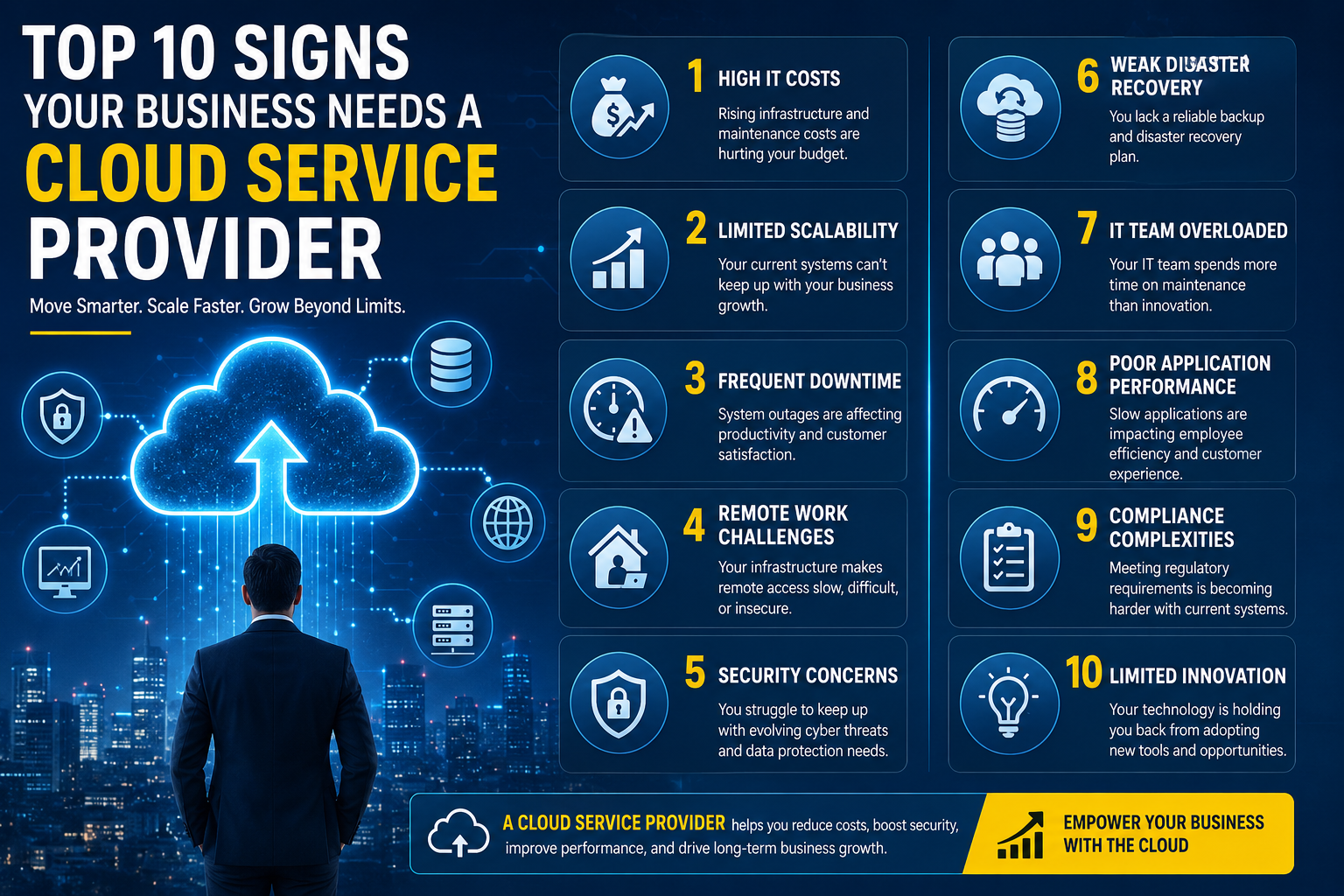
Your IT Infrastructure is Becoming Too Expensive to Maintain
One of the earliest signs that your business should consider working with a Cloud Service Provider is the continuously increasing cost of maintaining on-premise infrastructure. Traditional servers require regular hardware upgrades, software licensing, cooling systems, electricity, security monitoring, and dedicated IT professionals to keep everything running efficiently.
As technology ages, maintenance expenses often increase while system performance declines. Businesses may also face unexpected repair costs whenever hardware failures occur. These ongoing investments can significantly impact operational budgets without delivering proportional business value.
A cloud-based environment eliminates much of this financial burden by replacing large capital expenditures with predictable operational costs. Organizations only pay for the resources they actually use, making budgeting more transparent while reducing unnecessary infrastructure investments.
Your Business Is Growing Faster Than Your Current Systems
Business growth is exciting, but it also puts pressure on existing IT infrastructure. As your customer base expands, employees increase, and digital workloads become more demanding, traditional servers often struggle to keep up with rising requirements.
Slow applications, limited storage capacity, and declining system performance are common indicators that your infrastructure has reached its limits. Expanding on-premise systems frequently involves purchasing new hardware, configuring additional servers, and planning lengthy deployment schedules.
A reliable Cloud Service Provider enables businesses to scale computing resources almost instantly. Whether additional storage, processing power, or application capacity is required, cloud environments can expand without disrupting ongoing business operations.
Frequent Downtime Is Affecting Productivity
Every minute of system downtime translates into lost productivity, missed business opportunities, and dissatisfied customers. If employees regularly experience server failures, application crashes, or network interruptions, your existing infrastructure may no longer be capable of supporting operational requirements.
Unexpected outages often delay projects, interrupt communication, and reduce employee efficiency. In customer-facing industries, downtime can also damage brand reputation and reduce customer trust.
Cloud platforms are designed with high availability and redundancy in mind. Most enterprise cloud environments distribute workloads across multiple servers and data centers, significantly reducing the risk of prolonged outages while ensuring business continuity.
Remote and Hybrid Work Have Become Difficult
Modern workplaces have evolved beyond traditional office environments. Employees increasingly expect secure access to business applications from home, client locations, or while traveling. If your current infrastructure makes remote work slow, unreliable, or difficult to manage, it may be time to move to the cloud.
Legacy systems often depend on office-based servers and complicated VPN configurations that create bottlenecks for remote users. This can reduce employee productivity and negatively impact collaboration across distributed teams.
A Cloud Service Provider enables secure access to applications and business data from virtually anywhere. Teams can collaborate in real time while maintaining consistent performance and enterprise-grade security regardless of their physical location.
Data Security Is Becoming a Major Concern
Cybersecurity threats continue to evolve, targeting businesses of every size. Ransomware attacks, phishing campaigns, unauthorized access attempts, and data breaches have become increasingly sophisticated.
If your organization struggles to implement advanced security controls, maintain regular software updates, or monitor network activity continuously, your infrastructure may be vulnerable.
Leading cloud providers invest heavily in cybersecurity technologies, including encryption, identity management, threat detection, intrusion prevention, continuous monitoring, automated backups, and compliance certifications. While businesses remain responsible for securing their own applications and data, cloud providers deliver a much stronger security foundation than many organizations can build independently.
Disaster Recovery Planning Is Weak or Non-Existent
Many businesses underestimate the importance of disaster recovery until an unexpected event causes significant operational disruption. Hardware failures, cyberattacks, natural disasters, accidental deletions, or power outages can all result in substantial data loss if proper recovery mechanisms are not in place.
Traditional backup systems often require manual intervention and lengthy recovery processes, extending downtime during critical situations.
Working with a Cloud Service Provider allows businesses to implement automated backups, geographically distributed storage, rapid disaster recovery solutions, and business continuity strategies that minimize operational interruptions and reduce recovery time significantly.
Your IT Team Is Spending More Time Maintaining Systems Than Supporting Innovation
Internal IT teams should focus on projects that drive business growth rather than spending the majority of their time maintaining aging infrastructure.
When IT professionals are constantly troubleshooting hardware failures, installing software patches, replacing storage devices, managing backups, and performing routine maintenance, they have less time to work on innovation, automation, process improvement, or digital transformation initiatives.
Cloud services automate many infrastructure management tasks, allowing internal teams to concentrate on strategic projects that improve customer experience, operational efficiency, and business competitiveness.
Business Applications Are Running Slowly
Application performance directly affects employee productivity and customer satisfaction. Slow ERP systems, delayed CRM platforms, lagging databases, and sluggish internal applications often indicate infrastructure limitations.
As workloads increase, traditional servers may struggle to deliver consistent performance. Resource bottlenecks become more frequent, especially during peak business periods.
A professional Cloud Service Provider offers scalable computing resources capable of handling fluctuating workloads efficiently. Businesses can increase processing power whenever necessary, ensuring applications remain responsive even during periods of high demand.
Compliance Requirements Are Becoming More Complex
Many industries operate under strict regulatory frameworks that require organizations to maintain secure data storage, access controls, audit logs, encryption standards, and disaster recovery capabilities.
Meeting these compliance requirements using on-premise infrastructure often requires significant investment in security technologies and documentation processes.
Established cloud providers maintain certifications for various international compliance standards, helping organizations simplify regulatory compliance while improving data governance and operational transparency.
Although businesses remain responsible for their own compliance obligations, cloud infrastructure provides many of the technical controls required to support these initiatives.
Technology Is Limiting Business Innovation
Perhaps the strongest indicator that your organization needs a Cloud Service Provider is when existing technology begins slowing business growth rather than enabling it.
Modern organizations increasingly rely on artificial intelligence, machine learning, big data analytics, Internet of Things (IoT), automation, DevOps, and advanced digital services. Many of these technologies require scalable infrastructure that traditional environments cannot easily provide.
Cloud platforms make it easier to adopt emerging technologies without investing in expensive hardware or building entirely new infrastructure from scratch. This flexibility allows businesses to innovate faster, launch new services more quickly, and remain competitive in rapidly changing markets.
How a Cloud Service Provider Supports Long-Term Business Growth
Choosing the right cloud partner goes far beyond migrating servers or moving files online. A trusted Cloud Service Provider helps organizations design scalable architectures, optimize cloud costs, strengthen cybersecurity, improve disaster recovery, monitor infrastructure performance, and ensure business continuity.
As business requirements evolve, cloud environments can adapt without major infrastructure overhauls. Companies gain access to modern technologies while reducing operational complexity and improving overall efficiency.
By partnering with experienced cloud professionals, organizations can confidently focus on innovation, customer satisfaction, and long-term growth rather than worrying about infrastructure limitations.
Conclusion
Technology should empower businesses to grow, innovate, and respond quickly to changing market demands. If your organization is experiencing rising infrastructure costs, recurring downtime, security concerns, limited scalability, poor remote accessibility, or increasing maintenance workloads, these are strong indicators that it’s time to evaluate cloud solutions.
Partnering with the right Cloud Service Provider enables businesses to modernize their IT environment, improve operational resilience, strengthen security, and support future growth without the burden of maintaining complex on-premise infrastructure. As digital transformation continues to reshape industries, cloud adoption is no longer simply a technology upgrade—it has become a strategic investment that helps businesses remain agile, competitive, and prepared for future opportunities.
Frequently Asked Questions (FAQs)
Q1. What does a Cloud Service Provider do?
A Cloud Service Provider delivers cloud-based computing services such as data storage, servers, networking, databases, software, and security over the internet. These services help businesses reduce infrastructure costs, improve scalability, and access their applications and data from anywhere.
Q2. How do I know if my business needs a Cloud Service Provider?
If your business is experiencing frequent system downtime, rising IT maintenance costs, limited storage, slow application performance, security concerns, or challenges supporting remote work, it may be the right time to partner with a Cloud Service Provider.
Q3. Is moving to the cloud secure for businesses?
Yes. Reputable Cloud Service Providers implement advanced security measures, including data encryption, multi-factor authentication, regular security updates, continuous monitoring, and disaster recovery solutions. However, businesses should also follow security best practices to protect their data and applications.
Q4. Can a Cloud Service Provider help reduce IT costs?
Yes. A Cloud Service Provider helps reduce capital investment in hardware, lowers maintenance expenses, minimizes downtime, and allows businesses to pay only for the cloud resources they use. This results in more predictable IT spending and improved operational efficiency.
Q5. How do I choose the right Cloud Service Provider for my business?
When selecting a Cloud Service Provider, consider factors such as scalability, security features, industry experience, pricing, customer support, compliance certifications, disaster recovery capabilities, and the ability to customize cloud solutions according to your business needs.