
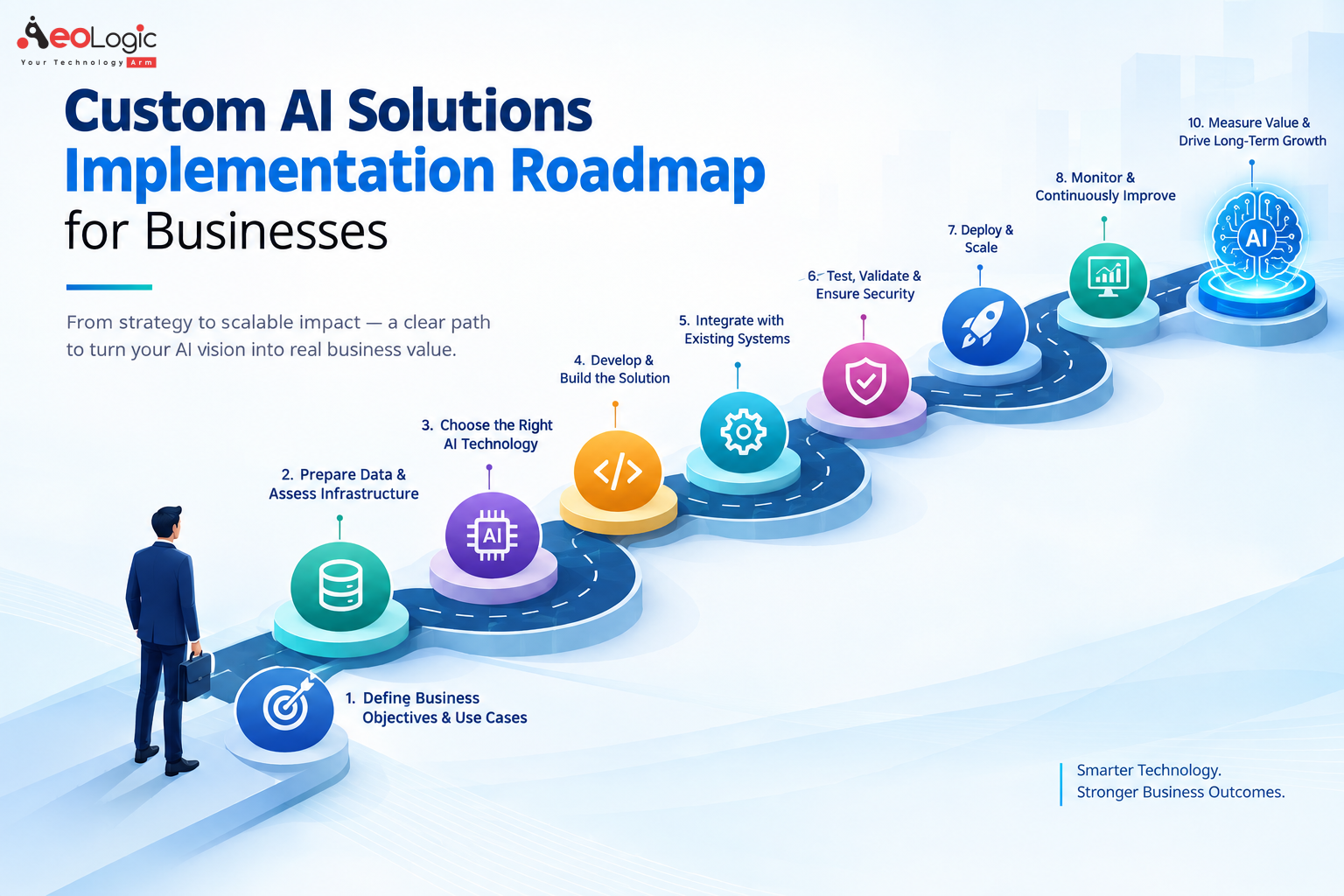

Artificial intelligence is becoming a strategic business capability rather than a technology used only for experimentation. Companies across industries are adopting AI to automate repetitive work, improve decision-making, personalize customer experiences, reduce operational costs, and discover new sources of revenue. However, successful AI adoption requires more than selecting a powerful model or purchasing an AI platform. Businesses need a structured approach that connects AI initiatives with measurable business objectives, existing technology infrastructure, data capabilities, and long-term growth plans.A well-designed Custom AI Solutions Implementation roadmap helps organizations move from identifying an opportunity to deploying an AI solution that delivers measurable business value.
It creates a clear path for evaluating use cases, preparing data, selecting technologies, developing models, integrating systems, testing performance, and continuously improving the solution after deployment. This approach also reduces implementation risks because every stage can be aligned with business priorities and operational requirements.
Understanding the Need for a Structured AI Implementation Roadmap
AI projects can become complicated when organizations begin development without clearly defining what they want to achieve. A business may have access to advanced machine learning models, generative AI platforms, or automation technologies, but these technologies will not automatically solve operational problems.
The first objective should be identifying a specific business challenge where AI can create meaningful value. This could involve predicting customer demand, automating document processing, detecting anomalies, improving inventory planning, supporting employees with intelligent assistants, or analyzing large volumes of business data.
A structured Custom AI Solutions Implementation approach connects the technology with the problem instead of starting with the technology itself. This allows organizations to determine whether AI is actually appropriate for a particular challenge and establish realistic expectations before significant resources are invested.
Defining Business Objectives and AI Use Cases
Start With Business Problems
The roadmap should begin with business objectives rather than technical features. Organizations need to understand which processes consume significant time, generate high operational costs, create frequent errors, or require complex decision-making.
Once these challenges are identified, potential AI use cases can be evaluated based on their business impact, technical feasibility, data availability, implementation complexity, and expected return on investment.
Prioritize High-Value Opportunities
Not every AI opportunity should be implemented simultaneously. Businesses should prioritize use cases that can generate measurable benefits while remaining practical to implement within the existing environment.
For example, an organization may begin with intelligent document processing before moving toward predictive analytics or autonomous workflow automation. Starting with a focused project allows teams to develop internal expertise and demonstrate value before expanding AI adoption across other departments.
Assessing Data Readiness and Infrastructure
Evaluating Data Quality
Data is one of the most important foundations of any AI initiative. Organizations need to determine whether their existing data is accurate, relevant, consistent, accessible, and sufficiently representative of the business problem they want to solve.
Poor-quality data can negatively affect model performance and create unreliable predictions. Data preparation therefore needs to include activities such as cleaning, validation, transformation, labeling, integration, and governance.
Reviewing Existing Technology Infrastructure
The next stage involves assessing the systems that will support the AI solution. This can include cloud platforms, databases, APIs, enterprise applications, ERP systems, CRM platforms, IoT devices, data warehouses, and existing analytics environments.
A successful Custom AI Solutions Implementation strategy considers these systems from the beginning so that the final solution can operate effectively within the organization’s technology ecosystem rather than becoming an isolated AI application.
Selecting the Right AI Technology
Choosing Models and Development Approaches
The appropriate AI technology depends on the business requirement. Some applications may require machine learning models for prediction, while others may benefit from natural language processing, computer vision, generative AI, recommendation engines, or intelligent automation.
Organizations should avoid selecting technology simply because it is currently popular. The choice should be based on accuracy requirements, scalability, cost, security, latency, explainability, integration requirements, and the complexity of the business process.
Balancing Custom Development and Existing Models
Businesses can combine pre-trained models, APIs, open-source technologies, and custom-developed components depending on their requirements. A highly specialized business process may require additional customization, while a general-purpose use case may be handled effectively through an existing model.
The goal of Custom AI Solutions Implementation is not necessarily to build every component from scratch but to create an AI solution that is optimized for the organization’s specific workflows, data, objectives, and operational environment.
Designing and Developing the AI Solution
Once the technology direction has been established, development can begin with a clearly defined architecture. Developers and data scientists can create data pipelines, model workflows, application interfaces, automation logic, and integration components according to the requirements established during the planning stage.
Development should generally begin with a manageable proof of concept or minimum viable solution. This allows organizations to test assumptions, evaluate model performance, identify technical limitations, and gather feedback before moving toward a larger production environment.
During this phase, organizations should also consider security and governance requirements. Sensitive business information needs appropriate protection, access controls must be established, and AI outputs should be monitored to reduce the risks associated with inaccurate or inappropriate results.
Integrating AI With Existing Business Systems
Connecting AI With Enterprise Applications
An AI solution creates greater value when it becomes part of existing business workflows. Instead of requiring employees to move information between multiple applications, AI capabilities can be connected directly with systems they already use.
APIs, middleware, data pipelines, and integration platforms can connect AI applications with ERP, CRM, HR, supply chain, customer service, finance, and operational systems. This enables AI-generated insights or actions to become part of normal business processes.
Creating Intelligent Workflows
AI integration can transform individual tasks into connected intelligent workflows. For example, an AI system can analyze incoming documents, extract relevant information, validate the data, update an enterprise application, and notify an employee when human intervention is required.
A strong Custom AI Solutions Implementation strategy therefore focuses not only on model performance but also on how AI interacts with people, applications, databases, and business processes.
Testing, Validation, and Performance Measurement
Before an AI solution is deployed at scale, it needs comprehensive testing. Testing should evaluate accuracy, reliability, response time, scalability, security, usability, integration performance, and behavior under different operating conditions.
Depending on the use case, these metrics may include processing time, error reduction, cost savings, conversion rates, forecast accuracy, employee productivity, customer satisfaction, or operational efficiency.
Continuous validation is also important because business conditions and data patterns can change over time. A model that performs effectively during initial deployment may require adjustments as new data becomes available.
Deploying AI Across the Organization
Starting With a Controlled Production Environment
Once testing demonstrates that the solution meets the required standards, deployment can begin in a controlled environment. Organizations can initially introduce the solution to a specific department, workflow, location, or user group.
This approach makes it easier to monitor performance and identify unexpected issues before expanding the system across the organization.
Scaling Successful AI Initiatives
After successful deployment, businesses can gradually extend AI capabilities to additional processes and departments.
Cloud infrastructure, modular architecture, reusable APIs, centralized data platforms, and monitoring systems can help organizations expand AI capabilities without rebuilding the entire solution for every new use case.
Establishing AI Governance and Security
AI adoption introduces important governance considerations that businesses cannot ignore. Organizations need policies covering data privacy, model access, security, human oversight, compliance, monitoring, and responsible AI usage.
Organizations should also establish clear responsibilities for reviewing AI-generated decisions and handling situations where the system produces uncertain or incorrect results.
Effective Custom AI Solutions Implementation therefore requires collaboration between technology teams, business leaders, security professionals, data specialists, and operational stakeholders.
Monitoring and Continuously Improving AI Systems
AI implementation does not end when a solution goes live. Continuous monitoring is necessary to ensure that the system continues to deliver reliable results as business requirements, customer behavior, datasets, and technology environments change.
Organizations should monitor model performance, data quality, system availability, user feedback, security events, and business outcomes. Regular reviews can identify opportunities for retraining models, improving workflows, updating integrations, or introducing additional AI capabilities.
A mature Custom AI Solutions Implementation lifecycle treats AI as an evolving business capability rather than a one-time technology project. Continuous improvement enables organizations to maintain performance and adapt solutions as new opportunities emerge.
Measuring Business Value and Return on Investment
The final objective of an AI roadmap is measurable business value. Organizations should compare the outcomes of an AI initiative against the original objectives established during planning.
Financial benefits may come from reduced manual effort, lower operational costs, improved resource utilization, increased sales, reduced errors, or faster decision-making. Non-financial benefits can include better customer experiences, improved employee productivity, stronger operational visibility, and faster access to business insights.
A successful Custom AI Solutions Implementation program connects technical performance with business outcomes so leadership can clearly understand whether the investment is producing meaningful results.
Building a Long-Term AI Strategy
Moving From Individual Projects to an AI Ecosystem
Businesses should avoid treating every AI initiative as an independent experiment. Once several successful implementations are established, organizations can create reusable AI capabilities, shared data infrastructure, standardized governance frameworks, and common integration patterns.
Preparing for Future AI Capabilities
AI technology will continue evolving through advancements in generative AI, agentic systems, multimodal models, computer vision, predictive analytics, and intelligent automation.
A scalable Custom AI Solutions Implementation roadmap gives organizations the flexibility to introduce emerging capabilities without constantly rebuilding their technology foundation.
Conclusion
Implementing AI successfully requires a strategic combination of business planning, data readiness, technology selection, solution development, system integration, security, testing, deployment, and continuous optimization. Organizations that approach AI without a structured roadmap may struggle with unclear objectives, poor data quality, integration challenges, unexpected costs, and limited adoption.
A thoughtful Custom AI Solutions Implementation roadmap provides a practical framework for transforming AI opportunities into measurable business outcomes. By starting with real business problems, developing solutions around organizational requirements, integrating AI into existing workflows, and continuously measuring performance, companies can build AI capabilities that support sustainable efficiency, innovation, and long-term growth.
Frequently Asked Questions
Q1. What is Custom AI Solutions Implementation?
Custom AI Solutions Implementation is the process of designing, developing, integrating, deploying, and optimizing AI systems according to a business’s specific requirements, workflows, data, and operational objectives.
Q2. Why do businesses need a structured AI implementation roadmap?
A structured roadmap helps businesses identify valuable AI use cases, prepare their data, select suitable technologies, manage implementation risks, integrate AI with existing systems, and measure business outcomes effectively.
Q3. How long does it take to implement a custom AI solution?
The implementation timeline depends on the complexity of the use case, data readiness, integration requirements, model complexity, security needs, and deployment environment. A simple solution may take weeks, while enterprise-level projects can require several months.
Q4. How can businesses measure the success of an AI implementation?
Businesses can measure success through metrics such as cost reduction, productivity improvements, processing time, prediction accuracy, customer satisfaction, revenue growth, error reduction, and overall return on investment.
Q5. What should businesses consider before implementing AI?
Businesses should evaluate their objectives, data quality, existing technology infrastructure, security requirements, integration needs, scalability, budget, workforce readiness, and expected business value before starting an AI implementation.