
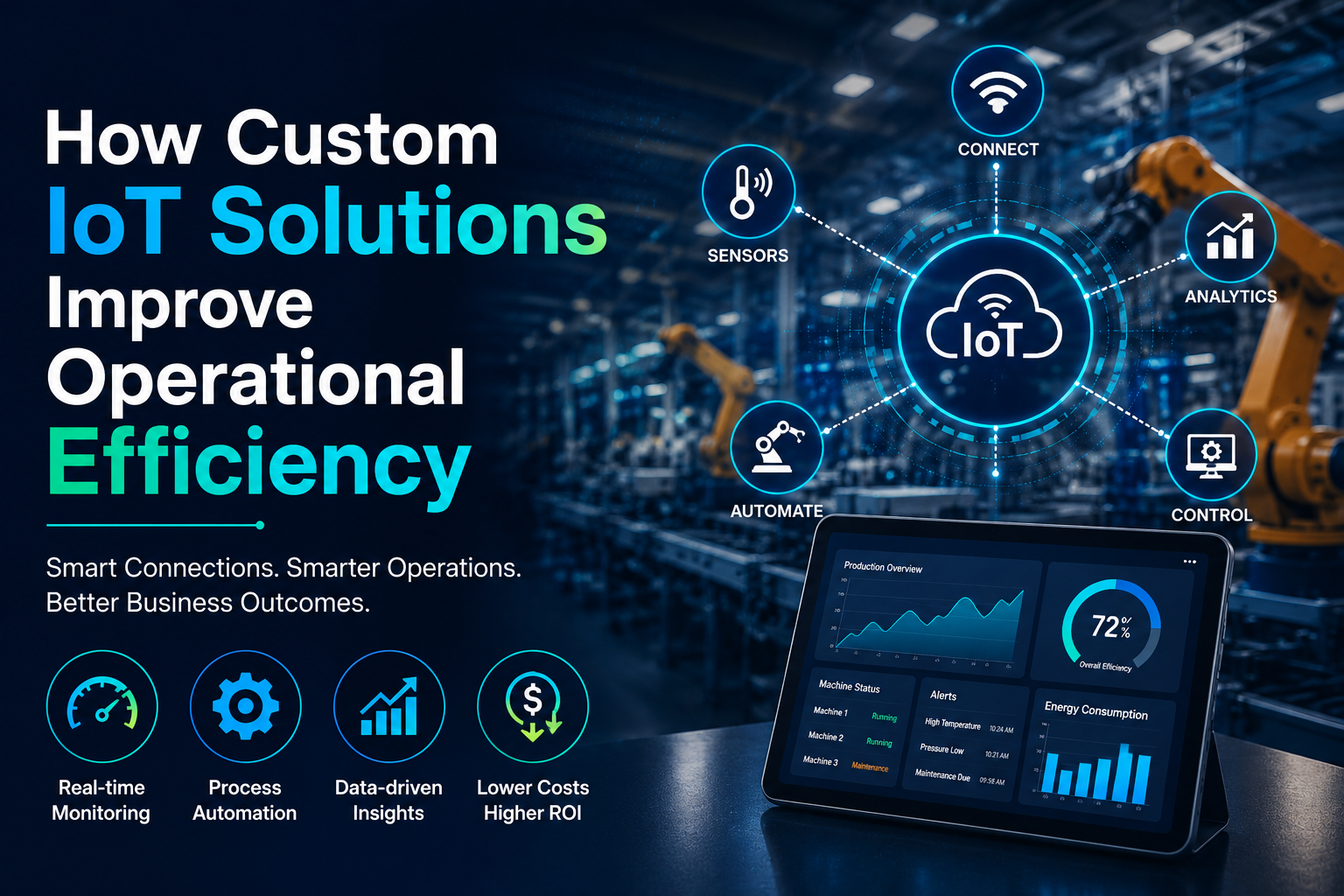

In today’s competitive business environment, improving operational efficiency is no longer limited to reducing costs or increasing employee productivity. Businesses need real-time visibility, faster decision-making, accurate data, and better control over their daily operations. This is where Custom IoT Solutions Operational Efficiency becomes increasingly important. By connecting machines, devices, sensors, software platforms, and business systems, custom IoT solutions help organizations monitor operations continuously and respond to issues before they affect productivity.
Unlike generic IoT platforms, custom IoT solutions are designed around the specific processes, infrastructure, and objectives of a business. They can collect operational data from connected assets, analyze that information, automate repetitive activities, and provide actionable insights to different teams. As a result, organizations can reduce downtime, improve resource utilization, streamline workflows, and create more efficient operations.
What are Custom IoT Solutions?
Custom IoT solutions are Internet of Things systems developed specifically to address the operational requirements of a particular organization. They typically combine connected sensors, IoT devices, communication networks, cloud or edge computing, analytics platforms, dashboards, and business applications into one integrated ecosystem.
How Custom IoT Solutions Work
A custom IoT system begins by collecting data from physical assets and operational environments. Sensors can capture information such as temperature, pressure, location, vibration, energy consumption, machine performance, inventory levels, or equipment status. This information is transmitted through suitable communication technologies to an IoT platform where it can be processed and analyzed.
The processed information can then be presented through dashboards, alerts, reports, or automated workflows. Managers can use these insights to understand what is happening across their operations and take timely action.
Why Customization Matters
Every organization has different workflows, equipment, technology environments, and performance requirements. A standard IoT product may provide basic monitoring capabilities, but it may not fit the way a business actually operates.
Custom IoT development allows organizations to select the right sensors, integrations, data models, dashboards, automation rules, and analytics capabilities according to their specific needs. This makes the technology more relevant to business processes and creates greater opportunities for improving operational efficiency.
How Custom IoT Solutions Improve Operational Efficiency
The main value of IoT comes from turning physical operations into measurable, connected, and more manageable processes. Custom solutions can improve efficiency across multiple areas of an organization.
Real-Time Monitoring of Operations
Traditional operational monitoring often depends on manual inspections, periodic reports, or information collected after an issue has already occurred. This can create delays and make it difficult for managers to understand current operational conditions.
Custom IoT solutions provide continuous visibility into connected assets and processes. Sensors can monitor equipment performance, environmental conditions, inventory movement, and other operational parameters in real time.
For example, a manufacturing company can monitor production equipment continuously instead of relying only on scheduled inspections. If a machine begins showing unusual vibration or temperature levels, the system can generate an alert for the maintenance team. This allows employees to investigate the issue before it develops into a major operational disruption.
Reducing Equipment Downtime
Unexpected equipment failure can significantly affect productivity, delivery schedules, and operating costs. Custom IoT solutions can help businesses move from reactive maintenance toward predictive and condition-based maintenance.
IoT sensors continuously collect equipment data, while analytics systems identify unusual patterns or changes in performance. Maintenance teams can receive alerts when equipment requires inspection or servicing.
Predictive Maintenance for Better Asset Performance
Predictive maintenance enables businesses to plan maintenance activities based on actual equipment conditions rather than relying entirely on fixed schedules. This can reduce unnecessary maintenance while also lowering the likelihood of unexpected failures.
Over time, historical equipment data can help organizations understand recurring failure patterns and identify assets that require additional attention. This contributes directly to better asset utilization and more consistent operational performance.
Automating Repetitive Business Processes
Manual processes can consume significant amounts of employee time and may introduce errors into operational workflows. Custom IoT solutions can automate several routine activities by allowing connected devices and systems to communicate without constant human intervention.
Automated Alerts and Notifications
Instead of requiring employees to continuously monitor dashboards or inspect equipment, an IoT platform can automatically send alerts when predefined conditions are detected.
For example, a cold-chain business can receive an immediate notification when the temperature of a storage unit moves outside the acceptable range. Similarly, a warehouse can trigger alerts when inventory levels fall below predefined thresholds.
This reduces monitoring effort and allows employees to focus on tasks that require human judgment.
Workflow Automation
IoT data can also trigger automated workflows across connected business systems. A sensor reading can initiate a maintenance request, update an inventory record, notify a supervisor, or generate a service ticket.
Such automation reduces delays between detecting an operational event and taking corrective action. It also helps create more consistent processes across departments.
Improving Resource Utilization
Efficient resource utilization is essential for controlling operational costs. Businesses often have limited visibility into how machines, vehicles, energy, materials, and other resources are being used.
Custom IoT solutions provide data that can help organizations understand resource consumption and identify areas of waste.
Smarter Energy Management
IoT-enabled sensors can monitor electricity, water, fuel, heating, cooling, and other forms of resource consumption. Businesses can analyze this information to identify unusual usage patterns and inefficient processes.
For example, a commercial facility can identify areas where energy consumption remains high during periods of low activity. Management can then adjust equipment schedules or automate controls to reduce unnecessary consumption.
Better Asset Utilization
Organizations can also use IoT data to understand how frequently equipment and other assets are being used. This information can support better scheduling and resource allocation.
Instead of purchasing additional equipment simply because existing assets appear unavailable, managers can analyze utilization data and determine whether scheduling or allocation improvements could solve the problem.
Enhancing Decision-Making With Real-Time Data
Operational decisions are more effective when they are based on accurate and timely information. However, businesses often have data distributed across machines, spreadsheets, applications, and separate operational systems.
Custom IoT solutions can bring data from connected assets into centralized dashboards and analytics platforms.
Centralized Operational Dashboards
IoT dashboards can provide managers with a unified view of important operational metrics. Depending on the business, these dashboards may display machine health, production output, asset location, inventory levels, energy usage, environmental conditions, or other key performance indicators.
This makes it easier for decision-makers to identify problems, compare performance, and respond quickly to changing conditions.
Data-Driven Performance Improvement
Historical IoT data can also reveal trends that may not be visible through manual monitoring. Businesses can compare operational performance over time, identify recurring inefficiencies, and determine where process improvements can deliver the greatest impact.
This creates a continuous improvement cycle in which operational data supports better decisions and those decisions lead to more efficient processes.
Improving Supply Chain and Inventory Operations
Supply chain operations involve multiple assets, locations, suppliers, transportation activities, and inventory movements. Lack of visibility at any stage can lead to delays, stockouts, excess inventory, or inefficient transportation.
Custom IoT solutions can connect assets and processes across the supply chain to improve visibility.
Real-Time Asset and Inventory Tracking
IoT-enabled tracking systems can provide real-time information about the location and status of assets and inventory. Businesses can monitor shipments, containers, equipment, and high-value goods throughout their operational journey.
This reduces dependency on manual tracking and helps teams respond more quickly when assets are delayed, misplaced, or moved unexpectedly.
Improving Warehouse Efficiency
Connected sensors and tracking technologies can help warehouses understand inventory movement and storage conditions. Businesses can use this information to improve stock management, optimize warehouse processes, and reduce unnecessary movement.
When IoT data is integrated with inventory or enterprise systems, employees can gain more accurate information about stock availability and asset status.
Supporting Better Quality Control
Maintaining consistent quality is another important aspect of operational efficiency. Quality problems can result in rework, product waste, customer complaints, and additional operational costs.
Custom IoT solutions can continuously monitor production and environmental conditions that influence quality.
Continuous Process Monitoring
Sensors can monitor parameters such as temperature, humidity, pressure, speed, vibration, and machine settings. If conditions move outside predefined limits, the system can generate an alert.
This enables teams to identify potential quality issues earlier rather than discovering them after production has been completed.
Reducing Human Error
Automated data collection also reduces the need for employees to record operational information manually. More consistent data collection improves the reliability of performance reports and quality records.
As a result, organizations can spend less time correcting data inconsistencies and more time improving their processes.
Integrating IoT With Existing Business Systems
The effectiveness of a custom IoT solution increases when it can work with the systems a business already uses. Organizations may have ERP, CRM, warehouse management, manufacturing, asset management, or other enterprise applications.
Connecting IoT With Enterprise Platforms
Custom IoT systems can be integrated with existing software through APIs and other integration methods. This allows operational data to move between connected devices and business applications.
For example, equipment data collected through IoT sensors can be connected with an enterprise maintenance system. When a machine requires attention, the system can automatically create a maintenance request and provide relevant equipment information to the responsible team.
Creating a Connected Operational Environment
Integration eliminates isolated data and helps different departments work with consistent information. Instead of treating IoT as a separate technology layer, businesses can make it part of their broader digital infrastructure.
This connected environment can improve coordination between operations, maintenance, supply chain, IT, and management teams.
Improving Operational Efficiency Across Industries
The benefits of custom IoT solutions apply to a wide range of industries because the technology can be adapted to different operational environments.
Manufacturing
Manufacturers can use IoT for machine monitoring, predictive maintenance, production tracking, energy management, quality control, and automated process monitoring.
Logistics and Transportation
Logistics companies can monitor vehicle locations, fuel consumption, cargo conditions, driver behavior, and shipment status to improve fleet and transportation efficiency.
Healthcare
Healthcare organizations can use connected devices for equipment monitoring, asset tracking, environmental monitoring, and facility management.
Retail
Retail businesses can use IoT to monitor inventory, store conditions, energy consumption, customer environments, and connected equipment.
Agriculture
Agricultural organizations can use sensors to monitor soil conditions, temperature, humidity, irrigation requirements, and crop environments, helping optimize the use of water and other resources.
Best Practices for Implementing Custom IoT Solutions
Successful IoT implementation requires more than connecting devices and collecting data. Businesses should begin by identifying specific operational problems that need to be solved.
Start With Clear Business Objectives
Organizations should define measurable objectives before selecting IoT technologies. These objectives could include reducing machine downtime, improving inventory visibility, lowering energy consumption, or increasing asset utilization.
Select Scalable Technology
The IoT architecture should be capable of supporting additional devices, locations, integrations, and data volumes as the organization grows. A scalable foundation prevents businesses from having to redesign the entire system later.
Prioritize Security
Connected devices create additional entry points into an organization’s technology environment. Device authentication, data encryption, access controls, network security, and regular monitoring should therefore be considered from the beginning.
Focus on Data Quality
IoT analytics are only useful when the underlying data is reliable. Organizations should select appropriate sensors, establish data validation processes, and ensure that connected devices are properly maintained.
The Future of Custom IoT Solutions Operational Efficiency
IoT is becoming increasingly connected with artificial intelligence, machine learning, edge computing, cloud platforms, and advanced analytics. This combination can make IoT systems more intelligent and responsive.
Future IoT environments will increasingly move beyond simple monitoring. Systems will be able to analyze operational conditions, identify patterns, recommend actions, and automate responses with limited human intervention.
For businesses, this means Custom IoT Solutions Operational Efficiency will increasingly involve intelligent decision-making rather than basic device connectivity. Organizations that build flexible and scalable IoT infrastructures today can create a stronger foundation for advanced automation and data-driven operations in the future.
Conclusion
Custom IoT solutions can transform operational efficiency by connecting physical assets with digital systems and turning real-time operational data into actionable insights. From predictive maintenance and automated workflows to asset tracking, resource optimization, quality monitoring, and data-driven decision-making, IoT can address many of the challenges that limit business productivity.
The biggest advantage of a custom approach is that the solution can be designed around the organization’s actual processes rather than forcing operations to adapt to a generic platform. When implemented with clear objectives, strong security, scalable architecture, reliable data, and proper system integration, IoT becomes more than a connected technology. It becomes a practical foundation for building faster, smarter, and more efficient operations.
Frequently Asked Questions
Q1. How do custom IoT solutions improve operational efficiency?
Custom IoT solutions improve operational efficiency by connecting devices, machines, and business systems to collect real-time data. Businesses can use this information to monitor operations, automate workflows, reduce downtime, optimize resources, and make faster data-driven decisions.
Q2. What industries can benefit from custom IoT solutions?
Manufacturing, logistics, healthcare, retail, agriculture, transportation, energy, and many other industries can benefit from custom IoT solutions. The technology can be tailored to industry-specific processes, assets, and operational requirements.
Q3. Can custom IoT solutions reduce equipment downtime?
Yes. Custom IoT solutions can continuously monitor equipment performance and detect unusual conditions such as abnormal vibration, temperature, or pressure. These insights can support predictive maintenance and help businesses address potential failures before they cause significant downtime.
Q4. How do custom IoT solutions help businesses reduce operational costs?
Custom IoT solutions can reduce costs by improving resource utilization, automating repetitive processes, minimizing equipment downtime, optimizing energy consumption, and reducing manual monitoring and data collection. These improvements can contribute to more efficient day-to-day operations.
Q5. Can custom IoT solutions integrate with existing business software?
Yes. Custom IoT solutions can be integrated with existing ERP, CRM, inventory management, maintenance, warehouse management, and other enterprise systems. This allows IoT data to move between connected devices and business applications for better visibility and workflow automation.