

Businesses today operate across multiple departments, applications, teams, and data sources. As organizations grow, managing these connected processes becomes increasingly difficult when systems work independently or rely heavily on manual workflows. Enterprise solutions help businesses bring these operations together, improve visibility, automate repetitive tasks, and support better decision-making.
However, choosing an enterprise platform is only the beginning. The real value comes from implementing it correctly and aligning the technology with business objectives. A poorly planned implementation can lead to operational disruption, unnecessary costs, low employee adoption, and systems that fail to deliver the expected results.
This is where Enterprise Solutions Implementation becomes important. A structured implementation approach helps organizations move from selecting the right solution to deploying it successfully across business operations. This guide explains the major stages involved in implementing enterprise solutions and how businesses can make the process more effective.
What is Enterprise Solutions Implementation?
Enterprise Solutions Implementation is the process of introducing an enterprise-level software solution into an organization’s existing business environment. It includes planning, requirements analysis, solution configuration, integration, data migration, testing, employee training, deployment, and ongoing optimization.
Enterprise solutions can include ERP systems, CRM platforms, supply chain management software, business intelligence platforms, enterprise content management systems, cloud applications, and other technologies designed to support large-scale business operations.
The implementation process needs to consider both technology and business operations. Installing software alone does not guarantee success. The solution must fit the organization’s workflows, data requirements, security policies, and long-term business goals.
Why a Structured Implementation Approach Matters
Enterprise systems often become deeply connected to daily business operations. Employees may depend on them for financial transactions, customer management, inventory control, procurement, reporting, communication, and other critical activities.
Reducing Implementation Risks
A structured approach allows businesses to identify technical, operational, financial, and organizational risks before they become major problems. Early planning can help teams identify integration issues, data-quality problems, security requirements, and resource limitations.
Improving Employee Adoption
Employees are more likely to use a new system effectively when they understand why it is being introduced and how it will improve their daily work. Implementation should therefore include communication, training, testing, and user feedback rather than focusing only on technical deployment.
Maximizing Business Value
The objective of an enterprise solution should not simply be to replace an old system. It should improve business performance. A well-planned implementation connects technology capabilities with measurable objectives such as faster processes, better reporting, reduced operational costs, improved customer service, or stronger collaboration.
Step 1: Define Business Objectives and Requirements
The first stage of Enterprise Solutions Implementation is understanding why the organization needs the solution. Businesses should begin by identifying existing operational problems and defining the outcomes they want to achieve.
Identify Existing Business Challenges
Organizations should examine their current processes and identify areas where inefficiencies exist. These may include duplicated data, manual approvals, disconnected applications, delayed reporting, poor communication between departments, or limited visibility into operations.
Understanding these challenges creates a clear foundation for implementation planning.
Establish Measurable Objectives
Business objectives should be specific enough to evaluate after implementation. For example, an organization may want to reduce order-processing time, improve customer response rates, automate financial reporting, or increase supply chain visibility.
These objectives become important benchmarks for measuring whether the enterprise solution is delivering the expected value.
Step 2: Analyze Current Processes
Before configuring a new solution, organizations need to understand how their existing workflows operate.
Map Existing Workflows
Business and technical teams should document important processes across departments. This can reveal unnecessary manual steps, duplicated activities, approval bottlenecks, and dependencies between different systems.
Process mapping also helps implementation teams determine which workflows should be retained, improved, automated, or redesigned.
Identify Process Gaps
A gap analysis compares the organization’s current capabilities with the capabilities required from the new enterprise solution. This helps identify missing functionality, integration requirements, reporting needs, security requirements, and customization needs.
A clear understanding of these gaps can prevent expensive changes later in the implementation process.
Step 3: Select the Right Enterprise Solution
Once business requirements are clear, the organization can evaluate potential enterprise solutions.
Evaluate Technology Capabilities
Businesses should consider whether the solution supports their required workflows, integrations, data volumes, security requirements, reporting needs, and scalability expectations. The system should also be capable of supporting future business growth rather than solving only today’s problems.
Consider Integration and Scalability
Enterprise environments rarely depend on a single application. The selected solution may need to communicate with CRM systems, ERP platforms, payment applications, cloud services, databases, analytics tools, or specialized business applications.
Scalability is equally important because system requirements can increase as the organization expands. A solution that performs well for a small operation may not necessarily support a significantly larger environment.
Step 4: Create an Implementation Strategy
After selecting the solution, the organization should develop a detailed implementation strategy.
Establish Roles and Responsibilities
Successful implementations require cooperation between business leaders, IT teams, solution providers, department representatives, and end users. Each stakeholder should understand their responsibilities throughout the project.
A dedicated implementation team can coordinate technical activities while ensuring that business requirements remain central to the project.
Define the Implementation Timeline
The implementation plan should establish major project phases, dependencies, testing periods, training activities, deployment schedules, and post-launch support. A realistic timeline helps teams manage expectations and prepare employees for upcoming changes.
Organizations should avoid unrealistic deadlines that force teams to skip testing or training.
Step 5: Prepare and Migrate Business Data
Data is one of the most important components of an enterprise system. Poor-quality or inconsistent data can negatively affect the new solution even when the technology itself is functioning correctly.
Clean Existing Data
Before migration, organizations should review existing records for duplicates, outdated information, missing fields, inconsistent formats, and inaccurate values. Data cleansing helps ensure that the new system starts with reliable information.
Plan Data Migration Carefully
Migration should be tested before the final transition. Teams need to determine which data should be transferred, how it should be transformed, and how its accuracy will be verified after migration.
For large organizations, phased migration may be more practical than transferring everything at once.
Step 6: Configure and Integrate the Solution
The next stage involves configuring the enterprise solution according to established business requirements.
Configure Business Workflows
Organizations can configure processes such as approvals, notifications, user permissions, reporting structures, and automated workflows. The objective should be to support efficient business processes without introducing unnecessary complexity.
Customization should also be carefully controlled. Excessive customization can increase maintenance requirements and make future upgrades more difficult.
Integrate Existing Systems
Integration connects the enterprise solution with other applications used by the organization. Proper integration allows information to move between systems without requiring employees to repeatedly enter the same data.
APIs, middleware, connectors, and other integration technologies can help create a more connected enterprise environment.
Step 7: Test the Entire System
Testing is a critical stage before the solution is launched across the organization.
Conduct Functional Testing
Functional testing verifies whether individual features work according to business requirements. Teams should test important workflows, calculations, approvals, reports, notifications, and user permissions.
Perform Integration and User Testing
Integration testing checks whether connected applications exchange information correctly. User acceptance testing allows employees and business representatives to evaluate whether the solution supports real-world processes.
Testing should use realistic scenarios rather than only simple technical examples. Any major issues identified during testing should be resolved before deployment.
Step 8: Train Employees and Manage Change
Technology adoption depends heavily on people. Even an advanced enterprise solution can fail to deliver value if employees do not understand how to use it.
Develop Role-Based Training
Different employees interact with enterprise systems in different ways. Training should therefore be based on specific roles and responsibilities. Users should learn the workflows and features relevant to their daily tasks rather than being overwhelmed with unnecessary information.
Communicate the Benefits of Change
Employees may resist new systems when they do not understand the reason behind the change. Clear communication can explain how the solution will improve processes, reduce repetitive work, provide better information, or simplify collaboration.
Change management should continue beyond the initial training period because employees may need additional support as they begin using the system in real business situations.
Step 9: Deploy the Enterprise Solution
After successful testing and training, the organization can move toward deployment.
Choose the Right Deployment Method
Businesses may choose a phased rollout, pilot deployment, or full implementation depending on the complexity and risk associated with the project. A phased approach can allow organizations to introduce the system to selected departments before expanding it across the business.
Monitor the Initial Launch
The first days and weeks after deployment are important. Technical teams should monitor system performance, integrations, user activity, data accuracy, and reported issues.
A responsive support process can help resolve problems quickly and maintain employee confidence in the new system.
Step 10: Measure Performance and Continuously Improve
Enterprise Solutions Implementation should not end when the software goes live. Enterprise environments change continuously, and systems need to evolve with business requirements.
Track Key Performance Indicators
Organizations should compare post-implementation results with the objectives established at the beginning of the project. Metrics may include processing time, operational costs, system adoption, customer response time, data accuracy, productivity, and system availability.
These measurements help determine whether the solution is producing the expected business outcomes.
Optimize the Solution Over Time
Regular reviews can identify new opportunities for automation, integration, reporting, and process improvement. Organizations should also monitor software updates, security requirements, user feedback, and changing business needs.
Continuous optimization ensures that the enterprise solution remains useful as the organization grows.
Common Challenges in Enterprise Solutions Implementation
Enterprise implementations can involve several challenges. One common issue is unclear requirements, which can result in a system that does not adequately support business processes. Poor data quality can create migration problems, while weak integration planning can leave departments working with disconnected information.
Employee resistance is another challenge, particularly when a new system changes established workflows. Organizations may also face budget overruns when implementation requirements are underestimated.
Strong project governance, realistic planning, stakeholder involvement, thorough testing, and effective change management can significantly reduce these risks.
Best Practices for Successful Enterprise Solutions Implementation
A successful implementation starts with business objectives rather than technology alone. Organizations should involve business users from the beginning, maintain clear communication between technical and operational teams, and prioritize data quality throughout the project.
It is also important to avoid unnecessary customization and focus on scalable processes. Testing should be performed using real-world scenarios, while training should continue after deployment.
Most importantly, organizations should treat implementation as an ongoing transformation rather than a one-time technology project. Continuous monitoring and optimization help ensure that the solution continues to generate business value.
Conclusion
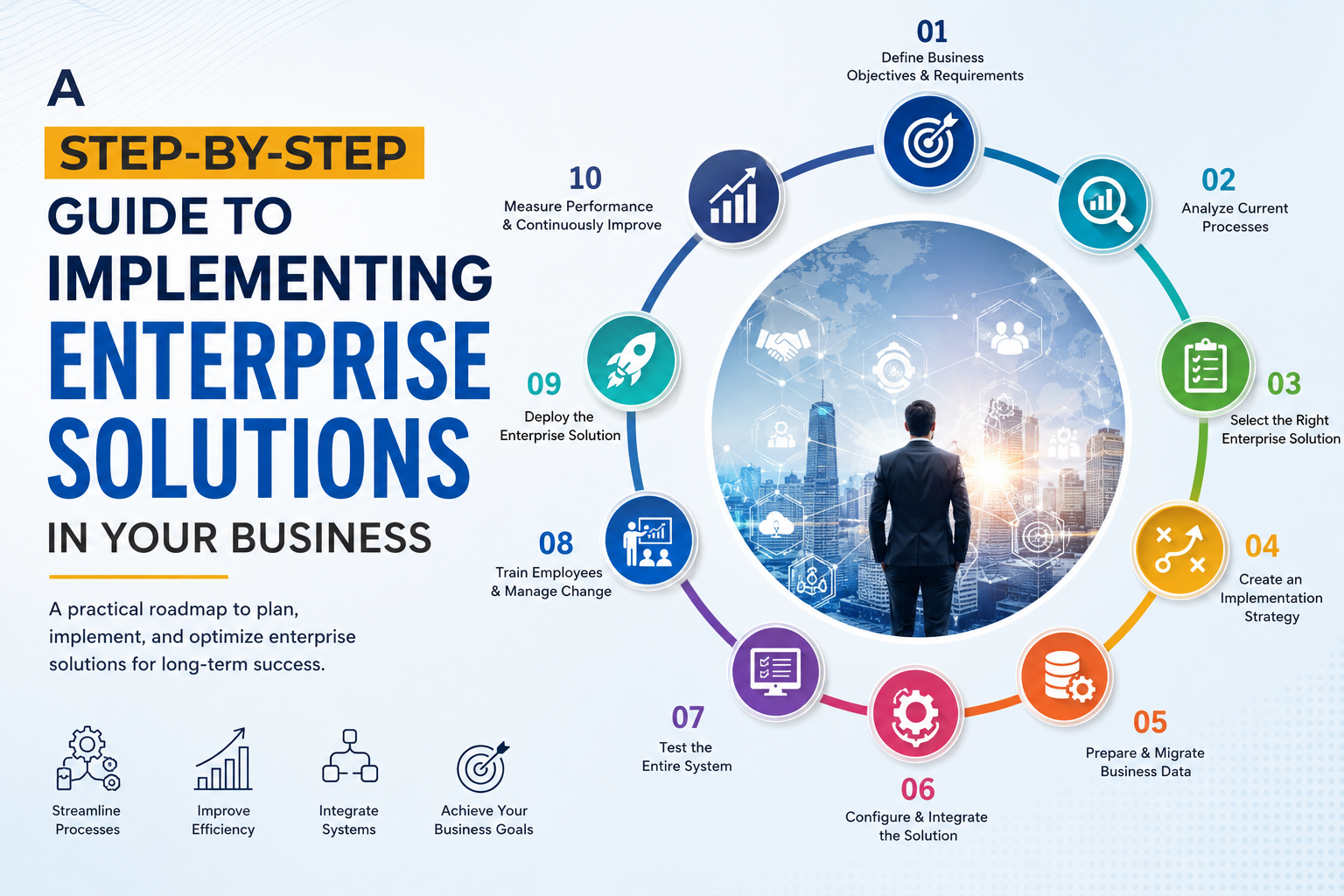
Implementing an enterprise solution requires more than selecting software and deploying it across an organization. It involves understanding business requirements, analyzing existing processes, preparing data, configuring technology, integrating systems, testing workflows, training employees, managing change, and continuously measuring performance.
A structured approach to Enterprise Solutions Implementation enables businesses to reduce implementation risks while creating a technology environment that supports efficiency, collaboration, scalability, and better decision-making. When technology, people, processes, and business objectives are aligned, enterprise solutions can become a foundation for long-term digital growth rather than simply another software investment.
Frequently Asked Questions
Q1. What is Enterprise Solutions Implementation?
Enterprise Solutions Implementation is the process of deploying and integrating an enterprise software solution into a business to improve workflows, data management, automation, and overall operational efficiency.
Q2. How long does Enterprise Solutions Implementation take?
The timeline depends on the size of the organization, solution complexity, number of integrations, data migration requirements, customization, and employee training needs. Large enterprise projects may take several months or longer.
Q3. What are the main stages of Enterprise Solutions Implementation?
The main stages include defining business objectives, analyzing existing processes, selecting the solution, planning the implementation, preparing data, configuring and integrating systems, testing, employee training, deployment, and continuous optimization.
Q4. What challenges can businesses face during enterprise solution implementation?
Common challenges include unclear requirements, poor data quality, integration issues, employee resistance, inadequate training, unexpected customization requirements, budget constraints, and difficulties managing organizational change.
Q5. How can businesses ensure successful Enterprise Solutions Implementation?
Businesses can improve implementation success by establishing clear objectives, involving stakeholders, maintaining data quality, conducting thorough testing, providing role-based training, managing change effectively, and continuously monitoring system performance after deployment.