
In today’s competitive business environment, organizations are expected to deliver better results while managing growing workloads, increasing customer expectations, and complex operational processes. Off-the-shelf software can help businesses handle basic requirements, but it may not always address the specific challenges of a particular organization. This is where Custom Software Solutions become valuable.
Custom software is designed around a business’s unique processes, objectives, users, and technology environment. Instead of forcing employees to adjust their workflows to fit generic software, custom applications can be developed to support the way a business actually operates. This can reduce unnecessary manual work, improve collaboration, streamline operations, and help employees focus on higher-value activities.
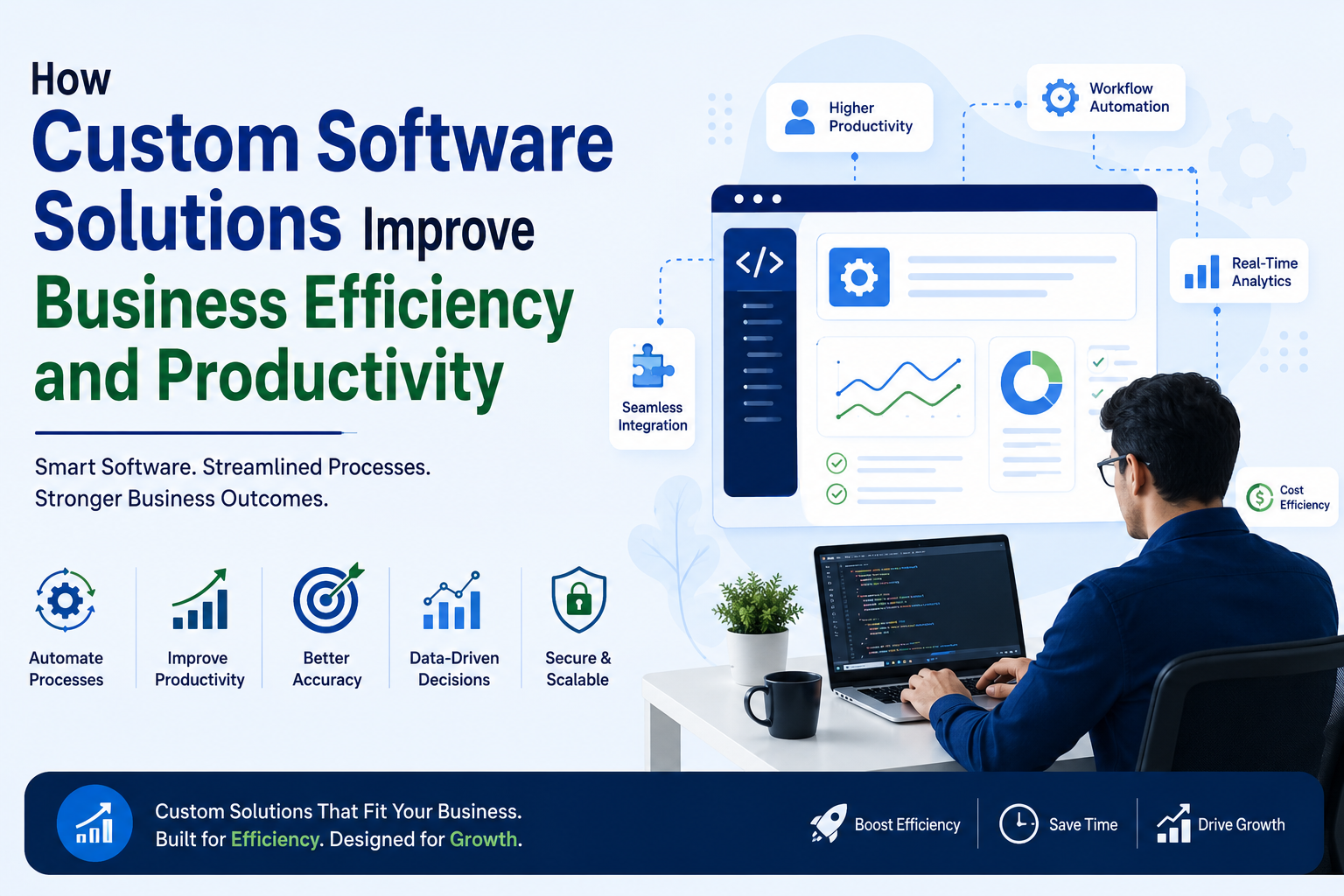
When implemented strategically, Custom Software Solutions can improve both business efficiency and workforce productivity while creating a stronger foundation for long-term growth.
What are Custom Software Solutions?
Custom Software Solutions are applications and software platforms developed specifically to meet the requirements of an individual business or organization. They can be designed for internal operations, customer-facing services, data management, automation, reporting, communication, or industry-specific processes.
How Custom Software Differs From Off-the-Shelf Software
Off-the-shelf software is created for a broad market and generally provides standardized features that can be used by many organizations. While this makes implementation relatively straightforward, businesses may have to modify their processes to work within the software’s limitations.
Custom software takes the opposite approach. The development process starts by understanding the organization’s existing workflows, operational challenges, user requirements, and future objectives. The resulting system is built around those requirements, allowing businesses to create a more efficient and relevant technology environment.
How Custom Software Improves Business Efficiency
Business efficiency depends on how effectively an organization uses its people, technology, information, and resources. Software plays an important role in connecting these elements. When applications are properly aligned with business processes, organizations can reduce unnecessary steps and improve the speed and accuracy of everyday operations.
Automating Repetitive Business Processes
Employees often spend significant amounts of time performing repetitive activities such as data entry, document processing, report preparation, order management, notifications, and routine approvals. These tasks may appear small individually, but they can consume considerable working hours when performed repeatedly.
Custom software can automate processes according to specific business rules. For example, a company can create an automated workflow for approving requests, assigning tasks, updating records, generating reports, or sending notifications. This reduces manual intervention and allows employees to dedicate more time to activities that require decision-making and creativity.
Reducing Operational Bottlenecks
Business bottlenecks often occur when employees depend on manual approvals, disconnected systems, spreadsheets, or repetitive communication. These delays can affect departments throughout an organization.
A custom application can connect different stages of a workflow and ensure that information moves to the right person at the right time. Managers can monitor pending activities, employees can access relevant information, and automated notifications can help prevent tasks from being overlooked.
By removing unnecessary delays, organizations can create smoother and more predictable operations.
Improving Data Management
Businesses generate large amounts of information through sales, customers, employees, operations, finance, supply chains, and other activities. Managing this information across multiple disconnected systems can make it difficult to maintain consistency and accuracy.
Custom software can centralize relevant business data and provide users with structured access based on their roles. Instead of searching through multiple files or applications, employees can access the information they need from a unified system.
Better data management also helps organizations maintain consistency and reduce the possibility of errors caused by duplicate or outdated information.
How Custom Software Increases Employee Productivity
Productivity is not simply about making employees work faster. It is about helping them spend more time on meaningful activities while reducing unnecessary effort.
Simplifying Employee Workflows
Complex software interfaces and unnecessary processes can make routine tasks more difficult than they need to be. Custom applications can be designed around actual employee workflows, making important functions easier to access and use.
For example, if employees repeatedly need to complete several actions to update a customer record, a custom system can combine those actions into a simpler workflow. This can reduce the time required for routine activities and improve the overall employee experience.
Providing Role-Based Access
Different employees require different information and functionality. Providing every user with access to every feature can make software difficult to navigate and may create unnecessary security risks.
Custom software can provide role-based interfaces that show users only the features and information relevant to their responsibilities. An employee in sales may see customer and sales functions, while a manager may have access to performance reports and approval workflows.
This creates a cleaner working environment and helps employees find what they need more quickly.
Reducing Manual Errors
Manual data entry and repetitive processes increase the possibility of human error. Incorrect information can lead to delays, inaccurate reports, customer service issues, and additional administrative work.
Custom software can introduce automated validation, calculations, notifications, and workflow controls. By reducing unnecessary manual intervention, businesses can improve data accuracy and reduce the time employees spend correcting mistakes.
Custom Software Solutions and Better Decision-Making
Efficient decision-making depends on having accurate and timely information. When business data is distributed across different systems, managers may struggle to obtain a complete picture of current operations.
Centralized Business Information
Custom software can bring important business information together within a connected environment. Depending on business requirements, the system can integrate information from sales, operations, finance, inventory, customer service, or other departments.
This allows decision-makers to work with more consistent information instead of relying on manually collected reports.
Real-Time Reporting and Analytics
Businesses increasingly need access to current operational information. Custom applications can include dashboards, reporting systems, and analytics capabilities that present important performance indicators in an accessible format.
Managers can monitor operational trends, identify potential problems, evaluate performance, and make informed decisions without waiting for lengthy manual reporting processes.
Integrating Custom Software With Existing Systems
Businesses rarely operate using a single application. They may use CRM platforms, ERP systems, accounting software, cloud services, communication tools, databases, and industry-specific applications.
Connecting Disconnected Business Systems
Custom software can be developed with integration capabilities that allow different applications to exchange relevant information. This reduces the need for employees to repeatedly enter the same information into multiple systems.
For example, customer information captured through a sales platform could be transferred to another internal system automatically when appropriate. Such integration can reduce duplication and improve workflow continuity.
Creating a More Connected Technology Environment
Software integration also helps departments work with consistent information. When systems communicate effectively, employees can spend less time switching between platforms and more time completing productive work.
A connected technology environment can therefore support better collaboration while reducing operational complexity.
Improving Customer Experience Through Custom Software
Business efficiency also influences how customers experience a company. Slow responses, inconsistent information, and complicated service processes can negatively affect customer satisfaction.
Faster Customer Service
Custom applications can give customer service teams quicker access to relevant information. Employees can view customer records, previous interactions, service requests, order details, or other information from a centralized interface.
This can help employees respond more quickly and provide more consistent support.
Personalized Customer Interactions
Businesses can also use custom software to support customer-specific workflows and services. Applications can be designed to capture customer preferences, transaction history, and behavioral information where appropriate.
With better access to customer information, organizations can create more relevant experiences while improving the efficiency of customer-facing teams.
Scalability and Long-Term Business Growth
A software system that works for a small organization may become difficult to manage as the business expands. More employees, customers, transactions, locations, and operational requirements can place additional pressure on existing systems.
Adapting Software to Changing Requirements
One of the major advantages of Custom Software Solutions is their ability to evolve with business needs. New features, integrations, workflows, and user roles can be introduced as requirements change.
This flexibility can be especially valuable for growing organizations that do not want their technology strategy to remain limited by a fixed software package.
Supporting Expansion
Custom applications can also be designed with future growth in mind. Businesses can plan their architecture and infrastructure according to expected requirements, making it easier to expand functionality as operations become more complex.
This makes custom development more than a short-term technology investment. It can become part of a long-term digital strategy.
Security and Control With Custom Software
Security is another important consideration for businesses managing sensitive operational and customer information.
Building Security Around Business Requirements
Custom applications can incorporate security measures according to the organization’s specific needs. Access controls, authentication mechanisms, user permissions, data protection, activity monitoring, and other security features can be considered during development.
This allows businesses to create a security model that is aligned with their operational environment rather than relying entirely on generic configurations.
Greater Control Over Software Development
Businesses also gain greater control over how their software evolves. Instead of waiting for a third-party vendor to introduce a required feature, organizations can work with development teams to prioritize functionality based on their own requirements.
This can provide greater flexibility when business processes or market conditions change.
Measuring the Business Value of Custom Software
The success of a custom software project should not be measured only by whether the application has been launched. Businesses should evaluate how effectively the software improves operational outcomes.
Evaluating Efficiency Improvements
Organizations can compare process completion times, manual effort, error rates, workflow delays, and employee productivity before and after implementation. These measurements can help determine whether the software is delivering meaningful improvements.
Monitoring Productivity and Business Outcomes
Businesses can also evaluate improvements in customer response times, reporting efficiency, operational costs, employee utilization, and decision-making speed. These indicators provide a clearer understanding of the software’s contribution to business performance.
Conclusion
Custom Software Solutions can play an important role in improving business efficiency and productivity by aligning technology with the way an organization actually works. From automating repetitive processes and reducing operational bottlenecks to improving data management, system integration, employee workflows, and customer service, custom software can address challenges that generic applications may not fully solve.
The greatest value comes when software development begins with a clear understanding of business objectives rather than technology alone. By designing applications around current requirements while allowing room for future expansion, organizations can build a technology environment that supports both immediate productivity improvements and long-term growth.
As businesses continue to adopt digital processes, the ability to create flexible, connected, and purpose-built software can become an important competitive advantage. Custom Software Solutions therefore offer organizations a practical way to turn technology investments into measurable improvements in efficiency, productivity, and overall business performance.
Frequently Asked Questions
Q1. What are Custom Software Solutions?
Custom Software Solutions are software applications developed specifically around a business’s unique requirements, workflows, processes, and operational goals. They provide functionality that may not be available in standard off-the-shelf software.
Q2. How do Custom Software Solutions improve business efficiency?
Custom Software Solutions improve efficiency by automating repetitive tasks, reducing manual processes, connecting business systems, improving data management, and streamlining workflows. This helps businesses save time and reduce operational errors.
Q3. Can Custom Software Solutions increase employee productivity?
Yes. Custom software can simplify employee workflows, provide role-based access to information, automate routine activities, and reduce unnecessary administrative work. This allows employees to spend more time on important business activities.
Q4. Are Custom Software Solutions suitable for growing businesses?
Yes. Custom software can be designed with scalability in mind, allowing businesses to add new features, users, integrations, and workflows as their requirements evolve. This makes it suitable for businesses planning long-term growth.
Q5. How do businesses measure the success of Custom Software Solutions?
Businesses can measure success by tracking improvements in process completion time, employee productivity, operational costs, error rates, customer response times, and overall workflow efficiency. These metrics help determine the practical business value of the software.