
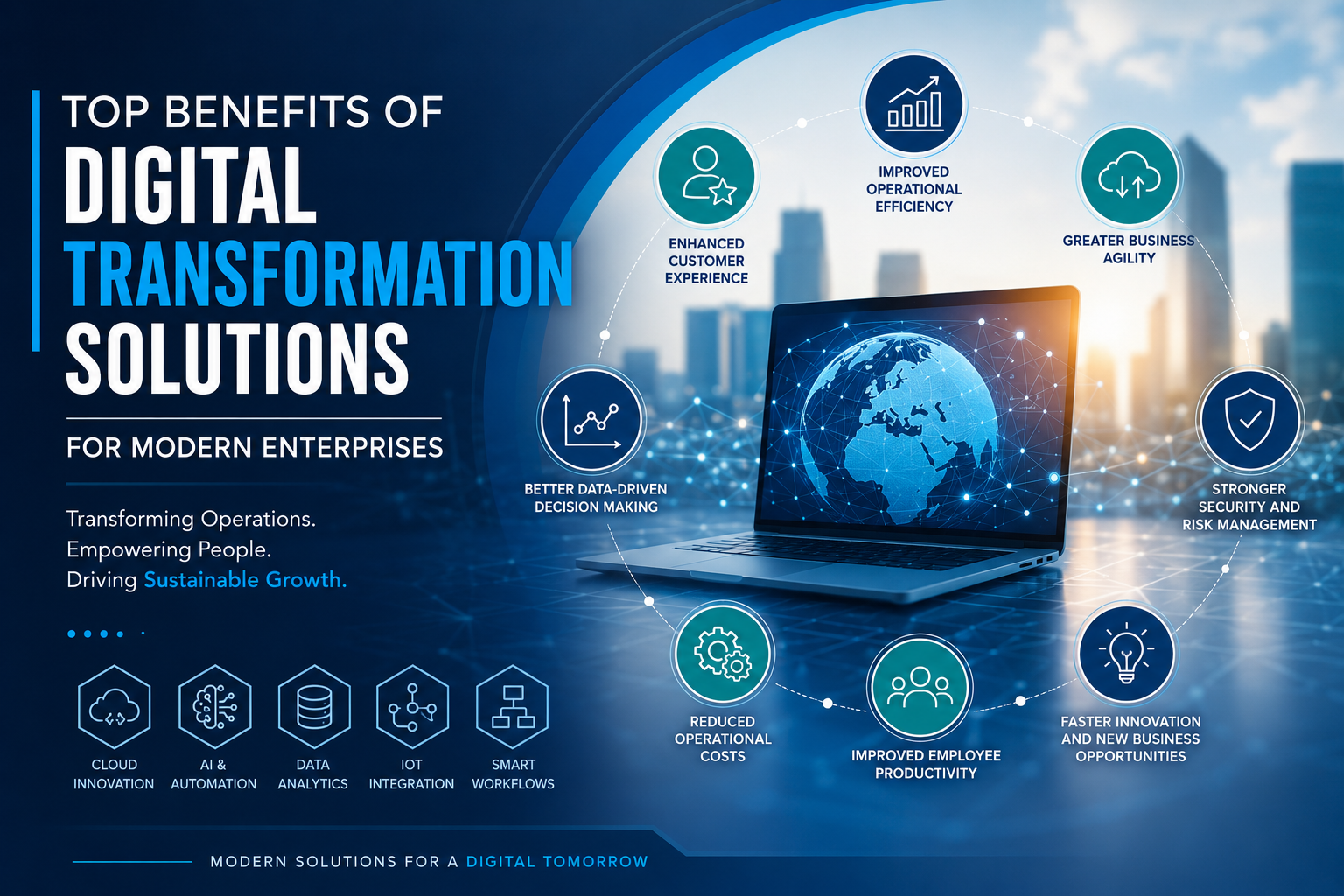

Modern enterprises are under constant pressure to improve efficiency, respond faster to changing customer expectations, and stay competitive in increasingly digital markets. Traditional business processes, disconnected systems, manual operations, and outdated technologies can make it difficult for organizations to achieve these goals. This is where Digital Transformation Solutions for Enterprises become increasingly important. By combining modern technologies with redesigned business processes, enterprises can create more connected, efficient, and customer-focused operations.
Digital transformation is not simply about adopting new software or moving existing systems to the cloud. It involves using technology strategically to improve how an organization operates, serves customers, manages information, and makes business decisions. From cloud computing and artificial intelligence to automation, data analytics, Internet of Things, and modern enterprise applications, digital transformation can influence almost every area of a business.
What are Digital Transformation Solutions for Enterprises?
Digital Transformation Solutions for Enterprises are technology-driven solutions designed to modernize business operations, applications, workflows, and customer experiences. These solutions help enterprises replace inefficient manual processes, integrate disconnected systems, improve access to information, and create more flexible digital operations.
Enterprise digital transformation can involve upgrading legacy applications, implementing cloud infrastructure, automating repetitive processes, developing digital platforms, integrating enterprise systems, adopting advanced analytics, and introducing artificial intelligence into everyday workflows. The exact approach depends on the organization’s business model, existing technology environment, industry requirements, and long-term objectives.
The most successful transformation initiatives focus on business outcomes rather than technology alone. Instead of adopting technology simply because it is new, enterprises identify operational challenges and use appropriate digital solutions to address them.
Why Digital Transformation Has Become Important for Modern Enterprises
Business environments are changing rapidly. Customers expect faster services, employees require better digital tools, and organizations need real-time access to reliable information. At the same time, enterprises are managing increasingly complex operations across multiple departments, locations, applications, and markets.
Legacy systems can make these requirements difficult to manage. Data may remain distributed across different applications, employees may spend significant time performing repetitive tasks, and decision-makers may not have immediate access to accurate business information.
Digital transformation addresses these challenges by connecting technology, people, processes, and data. When implemented strategically, it allows enterprises to create a more responsive operating environment while establishing a stronger foundation for future growth.
Improved Operational Efficiency
One of the biggest benefits of Digital Transformation Solutions for Enterprises is improved operational efficiency. Many organizations still rely on manual processes for activities such as data entry, reporting, approvals, document management, inventory updates, and internal communication. These processes can consume valuable employee time and increase the possibility of human errors.
Digital transformation allows enterprises to automate repetitive workflows and connect business applications so information can move between systems more efficiently. Automated workflows can reduce unnecessary administrative work while allowing employees to focus on activities that require creativity, analysis, and strategic thinking.
For example, an enterprise can integrate its customer relationship management platform with its sales, finance, and support systems. Instead of employees manually transferring information between applications, relevant data can move automatically through connected workflows. This creates faster processes and reduces operational friction.
Better Data-Driven Decision-Making
Data has become one of the most important resources for modern enterprises. However, having large amounts of data does not automatically result in better decisions. Organizations need systems that can collect, integrate, analyze, and present information in a useful way.
Digital transformation helps enterprises create stronger data environments by connecting information from different business systems. Modern analytics platforms can provide dashboards, reports, performance indicators, and predictive insights that help management understand what is happening across the organization.
With better visibility into business performance, decision-makers can identify trends, detect operational problems, understand customer behavior, and evaluate opportunities more effectively. Instead of depending entirely on historical reports or assumptions, enterprises can make decisions using timely and relevant information.
Enhanced Customer Experience
Customer expectations have changed significantly with the growth of digital services. Customers increasingly expect businesses to provide convenient interactions, faster responses, personalized experiences, and consistent service across different channels.
Digital Transformation Solutions for Enterprises help organizations create connected customer experiences across websites, mobile applications, customer portals, communication platforms, CRM systems, and support channels.
For example, customer information collected through one digital channel can be made available to authorized employees through another system. This allows customer service teams to understand previous interactions and provide more relevant assistance.
Artificial intelligence and automation can further improve customer engagement by supporting chatbots, personalized recommendations, automated notifications, and intelligent customer service workflows. When these technologies are implemented appropriately, enterprises can improve customer satisfaction while reducing unnecessary service delays.
Greater Business Agility
Modern enterprises need to respond quickly to changing market conditions. New competitors, changing customer preferences, economic pressures, regulatory requirements, and emerging technologies can influence business strategies within a short period.
Organizations using outdated systems may struggle to adapt because their processes and technologies are difficult to modify. Digital transformation creates a more flexible technology environment where enterprises can introduce new services, update workflows, integrate new applications, and scale digital capabilities more efficiently.
Cloud-based infrastructure, API integrations, modular applications, and automated processes can make it easier for organizations to adapt their operations. This flexibility is particularly valuable for enterprises operating across multiple markets or business units.
Reduced Operational Costs
Digital transformation can also contribute to long-term cost optimization. While implementing new technologies requires investment, the resulting improvements in automation, resource utilization, process efficiency, and system management can reduce unnecessary operational expenses over time.
Automation can reduce the amount of manual work required for repetitive activities. Cloud technologies can provide more flexible infrastructure management, while integrated systems can reduce duplication across applications and departments.
Digital transformation also helps organizations identify inefficient processes. Once workflows become measurable and connected, management can determine where resources are being wasted and where improvements can produce greater business value.
Stronger Collaboration Across Teams
Large enterprises often have multiple departments working with different applications and information sources. Sales teams may use CRM platforms, finance teams may use ERP systems, operations teams may use specialized applications, and management may rely on separate reporting tools.
When these systems are disconnected, collaboration becomes more difficult. Employees may need to request information from other departments or manually combine data from multiple sources.
Digital transformation promotes better collaboration by integrating systems and creating centralized or connected digital environments. Employees can access the information they need based on their roles and responsibilities, making communication and coordination more efficient.
Cloud collaboration platforms can also support distributed teams by allowing employees to work with shared information from different locations. This creates greater flexibility without compromising organizational visibility.
Improved Cybersecurity and Risk Management
As enterprises become more dependent on digital technologies, cybersecurity becomes a critical business priority. Digital transformation provides an opportunity to modernize security practices while upgrading outdated infrastructure and applications.
Modern enterprise environments can incorporate identity and access management, encryption, security monitoring, endpoint protection, backup systems, and automated threat detection. Organizations can also establish stronger controls around who can access sensitive information and how that information is handled.
Digital transformation should therefore include security as part of the overall architecture rather than treating cybersecurity as an additional layer added after implementation. A security-focused approach helps enterprises reduce digital risks while supporting business continuity.
Better Scalability for Business Growth
Enterprise systems must be capable of supporting growth. As organizations expand, they may need to handle more customers, employees, transactions, locations, products, and data.
Legacy systems can become difficult and expensive to scale because they may have limited capacity or depend on manual processes. Digital Transformation Solutions for Enterprises can create scalable technology environments that support changing business requirements.
Cloud infrastructure, modern enterprise applications, automated workflows, and integrated platforms allow organizations to expand their digital capabilities without rebuilding their entire technology environment. This makes scalability an important advantage for enterprises planning long-term growth.
Faster Innovation and New Business Opportunities
Digital transformation can help enterprises move beyond improving existing processes and create new opportunities. Once organizations establish connected digital infrastructure, they can experiment with new products, services, business models, and customer experiences.
For example, a traditional organization can develop digital customer portals, subscription-based services, mobile applications, self-service platforms, or data-driven offerings. Artificial intelligence can also support new capabilities in areas such as personalization, forecasting, content generation, customer support, and operational optimization.
The ability to experiment and innovate faster can provide enterprises with an advantage in competitive markets. Digital transformation creates the technology foundation needed to turn new ideas into practical business solutions.
Improved Employee Productivity
Technology should not only improve customer experiences; it should also make employees more productive. Employees often spend considerable time searching for information, completing repetitive administrative tasks, preparing reports, and working across multiple disconnected applications.
Digital transformation can simplify these activities through automation, integrated platforms, intelligent search, centralized information, and AI-powered tools. Employees can spend less time managing routine processes and more time working on activities that contribute directly to business objectives.
A better digital workplace can also improve employee engagement because teams have access to tools that support efficient communication, collaboration, and task management.
More Effective Supply Chain and Operations Management
For enterprises involved in manufacturing, logistics, retail, distribution, and other operational industries, digital transformation can improve visibility across the supply chain.
Connected systems can provide organizations with better information about inventory, orders, suppliers, transportation, production, and demand. IoT devices and sensors can provide real-time operational data, while analytics platforms can help organizations identify patterns and potential disruptions.
This visibility allows businesses to respond faster to operational issues and improve planning. As a result, enterprises can create more efficient and resilient operations while reducing avoidable delays.
How Enterprises Can Approach Digital Transformation
Successful digital transformation requires more than implementing multiple technologies at the same time. Enterprises should begin by understanding their current processes, technology gaps, customer expectations, and strategic objectives.
The transformation roadmap should prioritize areas where technology can deliver measurable business value. Organizations may start by modernizing a critical application, automating a high-volume workflow, integrating disconnected systems, or improving data visibility.
It is also important to consider employees during transformation. New technology is only effective when employees understand how to use it and why the change is important. Training, communication, change management, and continuous improvement should therefore be part of the transformation strategy.
The Future of Enterprise Digital Transformation
Digital transformation will continue to evolve as technologies such as artificial intelligence, generative AI, automation, cloud computing, IoT, edge computing, and advanced analytics become more integrated into enterprise operations.
Future transformation strategies are likely to focus increasingly on intelligent and connected business environments. Instead of using isolated digital tools, enterprises will combine data, applications, automation, and AI to create systems capable of supporting faster decisions and more adaptive operations.
Organizations that establish a strong digital foundation today will be better positioned to adopt emerging technologies as business requirements evolve.
Conclusion
Digital Transformation Solutions for Enterprises have become an important part of building efficient, scalable, secure, and customer-focused organizations. From improving operational efficiency and reducing manual work to strengthening decision-making, enhancing customer experiences, supporting innovation, and enabling business growth, digital transformation can create value across the entire enterprise.
For modern enterprises, digital transformation is therefore not simply a technology upgrade. It is a long-term business strategy that helps organizations operate more efficiently today while preparing them for the opportunities and challenges of tomorrow.
Frequently Asked Questions
Q1. What are Digital Transformation Solutions for Enterprises?
Digital Transformation Solutions for Enterprises are technology-driven solutions that help organizations modernize business processes, integrate systems, automate workflows, improve data management, and deliver better customer experiences.
Q2. What are the main benefits of digital transformation for enterprises?
The main benefits include improved operational efficiency, reduced costs, better decision-making, enhanced customer experience, stronger collaboration, improved scalability, increased security, and faster innovation.
Q3. How does digital transformation improve business efficiency?
Digital transformation improves efficiency by automating repetitive tasks, connecting disconnected systems, reducing manual processes, providing real-time data, and enabling employees to complete their work more quickly and accurately.
Q4. Which technologies are commonly used in enterprise digital transformation?
Common technologies include cloud computing, artificial intelligence, machine learning, automation, data analytics, Internet of Things (IoT), enterprise software, APIs, cybersecurity solutions, and modern digital platforms.
Q5. How can an enterprise successfully implement digital transformation?
An enterprise should begin by identifying business challenges and technology gaps, defining clear objectives, prioritizing high-value transformation areas, selecting suitable technologies, integrating systems, training employees, and continuously measuring results.