
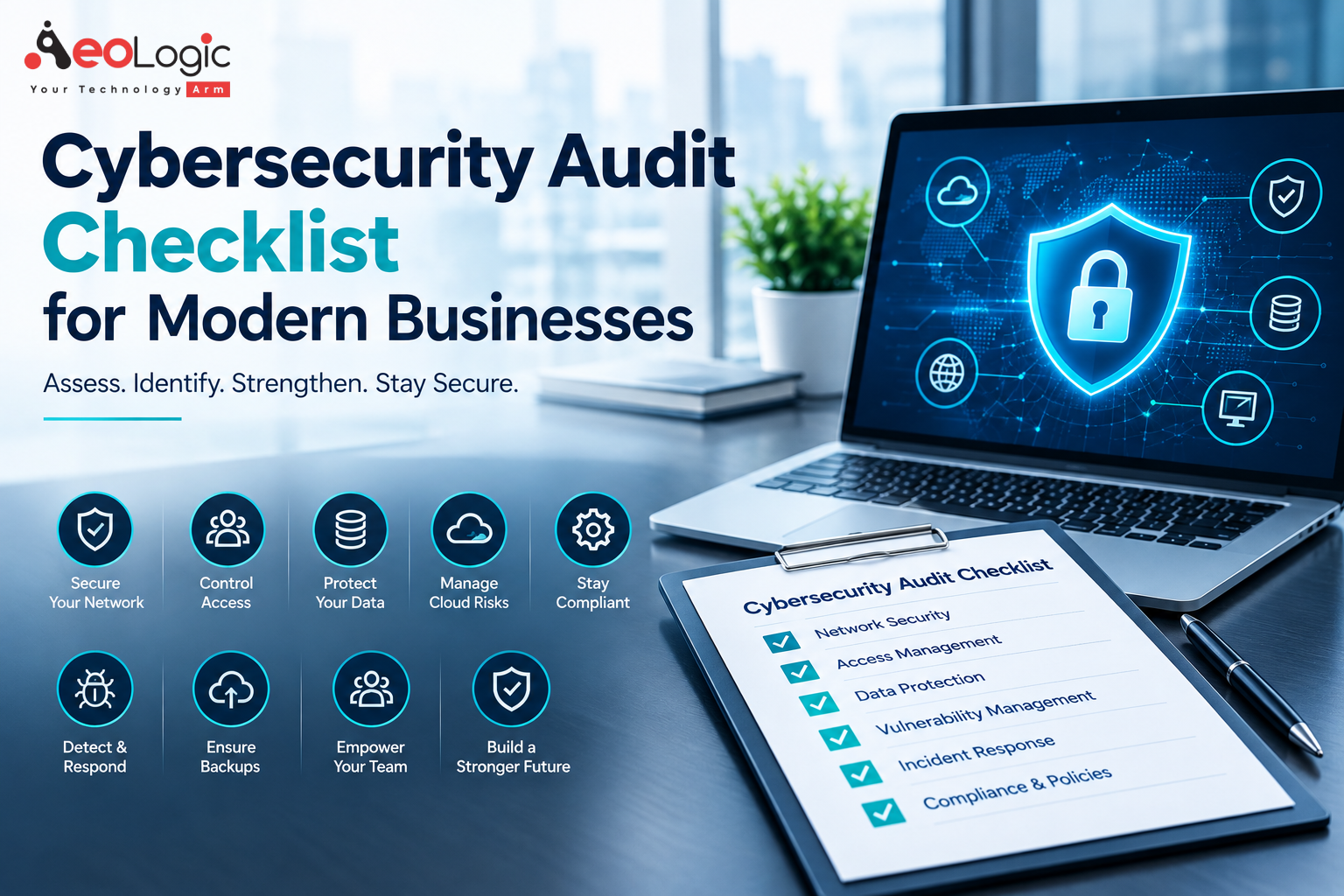

Cybersecurity has become a critical business priority as organizations increasingly depend on cloud platforms, digital transactions, connected devices, and remote working environments. While digital technologies improve productivity and customer experiences, they also create opportunities for cybercriminals to exploit security weaknesses, steal sensitive information, and disrupt business operations. A single security incident can lead to financial losses, reputational damage, legal complications, and a loss of customer trust.
For modern businesses, protecting digital assets requires more than installing antivirus software or setting up a firewall. Organizations need to evaluate their entire security environment, identify vulnerabilities, review access controls, assess data protection practices, and ensure that employees understand their role in preventing cyber threats. A structured Cybersecurity Audit Checklist helps businesses review these essential areas and determine whether their current security measures are effective.
Regular cybersecurity audits also help organizations prepare for emerging threats, improve regulatory compliance, and strengthen their incident response capabilities. Whether a business operates a small office, manages a large enterprise network, or relies on multiple cloud applications, a systematic audit provides a clearer understanding of security risks and the actions needed to address them.
What is a Cybersecurity Audit?
A cybersecurity audit is a systematic assessment of an organization’s IT infrastructure, security policies, applications, networks, and operational practices. Its purpose is to identify weaknesses, evaluate existing controls, and determine whether security measures adequately protect business information and digital systems.
An audit may examine user permissions, network configurations, software updates, data encryption, backup procedures, endpoint protection, employee awareness, and incident response plans. Depending on the organization’s size and industry, the assessment may also review compliance with relevant security standards, contractual obligations, and data protection requirements.
Unlike a one-time security review, an effective audit should be repeated periodically and whenever significant changes occur, such as adopting a new cloud platform, acquiring another business, or introducing remote access systems.
A well-planned Cybersecurity Audit Checklist helps standardize these reviews, making it easier to document findings, prioritize vulnerabilities, assign responsibilities, and track remediation progress over time.
Why Modern Businesses Need Regular Cybersecurity Audits
Cyber threats continue to evolve as attackers develop new methods to exploit software vulnerabilities, manipulate employees, and gain unauthorized access to business systems. Phishing, ransomware, credential theft, insecure applications, and cloud misconfigurations can affect organizations of almost any size.
Regular audits help businesses identify security gaps before they become serious incidents. For example, an organization may discover that former employees still have active accounts, critical systems are missing security updates, or sensitive files are accessible to more users than necessary. Correcting these weaknesses reduces the opportunities available to attackers.
Audits also support business continuity by assessing whether critical applications, databases, and operational processes can recover from a security incident. In regulated industries, they can help demonstrate that appropriate controls and documented procedures are in place.
Most importantly, cybersecurity audits encourage proactive risk management. Rather than responding only after an attack occurs, organizations can use audit findings to guide security investments, improve internal processes, and build a stronger security culture.
Cybersecurity Audit Checklist for Modern Businesses
1. Review IT Assets and Network Infrastructure
The first step in a cybersecurity audit is understanding which systems, devices, applications, and services the organization owns or uses. Businesses cannot adequately protect assets they do not know exist.
The review should cover laptops, desktops, servers, mobile devices, network equipment, cloud resources, business applications, databases, and connected operational technology. Organizations should maintain an accurate asset inventory that identifies system owners, business purposes, software versions, and security requirements.
Network infrastructure should also be assessed for unnecessary open ports, outdated protocols, insecure configurations, and inadequate separation between critical systems and general user networks. Guest Wi-Fi, employee devices, production environments, and sensitive databases may require different levels of access and isolation.
A comprehensive Cybersecurity Audit Checklist should also account for third-party applications and unmanaged devices that connect to company resources. Identifying these assets helps security teams establish visibility, reduce exposure, and prioritize protection according to business risk.
2. Evaluate Identity and Access Management
Unauthorized access remains a major security concern for organizations. Weak passwords, excessive permissions, compromised accounts, and poorly managed employee access can allow attackers to reach sensitive systems without exploiting sophisticated technical vulnerabilities.
Businesses should review how user identities are created, verified, modified, and disabled. Access permissions should follow the principle of least privilege, meaning employees receive only the access required to perform their responsibilities.
Multi-factor authentication should be enabled for critical systems, particularly email, administrator accounts, cloud services, remote access tools, and financial applications. Privileged accounts should receive additional protection, with administrative activities monitored and restricted wherever possible.
The audit should also verify that access is removed promptly when employees leave or change roles. Shared accounts should be minimized because they make it harder to identify who performed a particular action.
3. Inspect Network Security Controls
Network security controls help prevent unauthorized connections, restrict malicious traffic, and limit the spread of threats within business environments.
An audit should examine firewall rules, intrusion detection and prevention capabilities, secure remote access, network segmentation, and the configuration of wireless networks. Organizations should confirm that firewall rules have documented business justifications and that obsolete permissions are removed.
Remote access should rely on approved, securely configured technologies. Unnecessary internet-facing services should be disabled, and exposed systems should receive particular attention because attackers frequently scan public networks for vulnerable services.
Network logs should be collected and reviewed to identify unusual connection attempts, suspicious traffic patterns, and unexpected communication between systems. Monitoring becomes more effective when alerts are connected to a defined investigation and escalation process.
4. Check Software Updates and Vulnerability Management
Outdated software can contain known vulnerabilities that attackers exploit to gain access, execute malicious code, or disrupt operations. Businesses need a consistent process for identifying weaknesses and applying appropriate fixes.
The audit should review operating systems, business applications, firmware, security tools, web servers, and third-party components. Organizations should verify that supported software receives updates and that unsupported systems have documented replacement or mitigation plans.
Vulnerability scanning can help identify missing patches, insecure configurations, and exposed services. Findings should be prioritized according to severity, exploitability, business impact, and the sensitivity of affected assets.
Penetration testing may provide additional insight into how weaknesses could be exploited in practice. However, it should be performed with proper authorization, a defined scope, and safeguards against disrupting production systems.
5. Assess Data Protection and Privacy
Business data includes customer information, employee records, financial documents, intellectual property, authentication credentials, and confidential operational information. Protecting this data requires organizations to understand where it is stored, how it is accessed, and how it moves between systems.
Businesses should classify information according to sensitivity and establish appropriate controls for each category. Sensitive data should be encrypted during transmission and, where appropriate, at rest. Access permissions should be reviewed regularly, and unnecessary copies of confidential information should be removed securely.
The audit should also examine data retention schedules, deletion procedures, privacy notices, and the handling of information shared with external service providers. Organizations must determine which legal and contractual obligations apply to their activities rather than assuming that a single compliance framework covers every requirement.
A practical Cybersecurity Audit Checklist should assess whether data protection policies are implemented in daily operations, not simply documented in company procedures.
6. Review Cloud Security and Third-Party Access
Cloud services allow businesses to scale infrastructure quickly, collaborate remotely, and deploy applications without maintaining every system internally. However, misconfigured storage, excessive permissions, exposed credentials, and poorly managed integrations can introduce security risks.
The audit should examine cloud identity permissions, storage access policies, logging configurations, encryption settings, backup arrangements, and public exposure of sensitive resources. Organizations should confirm that responsibilities between the cloud provider and the business are clearly understood.
Third-party vendors also require careful assessment. A supplier may have access to company data, internal applications, or operational systems, making its security practices relevant to the organization’s overall risk.
Businesses should evaluate vendor access requirements, contractual security commitments, incident notification procedures, and the controls used to protect shared information. Access should be limited to what the supplier genuinely needs and reviewed when the relationship changes or ends.
7. Test Backup and Disaster Recovery Procedures
Backups are essential for recovering from ransomware attacks, accidental deletion, hardware failures, and other disruptive events. However, simply creating backups does not guarantee that business systems can be restored successfully.
Organizations should identify critical applications and data, define acceptable recovery time objectives, and establish recovery point objectives that reflect how much data loss the business can tolerate. Backup frequency and retention periods should align with these requirements.
The audit should verify that backups are protected from unauthorized access and, where appropriate, isolated or made immutable to reduce the risk of attackers deleting them. Backup credentials should not automatically provide unrestricted access to production systems.
Recovery testing is equally important. Businesses should periodically restore selected files, databases, and systems to confirm that backup copies are usable and recovery procedures work as expected. Results should be documented, and any gaps should be addressed before an actual emergency occurs.
8. Examine Employee Awareness and Security Policies
Employees can help prevent cyber incidents, but they can also unintentionally introduce risk through phishing, unsafe downloads, weak passwords, or the misuse of sensitive information.
An audit should review employee security training, password policies, acceptable-use guidelines, remote working procedures, and processes for reporting suspicious activity. Training should explain how to recognize phishing attempts, verify unusual payment requests, handle confidential information, and report possible security incidents quickly.
Organizations should also evaluate whether employees understand the risks of using unauthorized applications or sharing business information through unapproved channels. Security policies must be clear, practical, and consistently communicated.
Simulated phishing exercises can help identify training needs when conducted responsibly and used to improve awareness rather than punish employees. Managers should ensure that reporting a suspected incident is straightforward and that employees know whom to contact.
9. Validate Incident Response and Monitoring
Even organizations with strong preventive controls may experience security incidents. A documented incident response plan helps teams identify threats, limit damage, preserve evidence, and restore normal operations.
The audit should determine whether the business has assigned incident response responsibilities, escalation procedures, communication plans, and defined processes for handling compromised accounts, malware infections, data exposure, and service disruptions.
Security logs should be available for important systems, and alerts should be reviewed according to the organization’s risk profile. Businesses should verify that monitoring tools generate actionable notifications and that someone is responsible for investigating them.
Incident response exercises can reveal gaps in coordination and decision-making. Teams should also understand when legal counsel, specialist responders, regulators, customers, or other stakeholders need to be involved, depending on the incident and applicable obligations.
10. Document Findings and Prioritize Remediation
An audit is valuable only when its findings lead to meaningful improvements. After reviewing technical controls and business processes, the organization should document identified weaknesses, supporting evidence, potential consequences, and recommended corrective actions.
Findings should be prioritized according to risk rather than treating every issue as equally urgent. A vulnerability affecting a public-facing critical system may require immediate attention, while a lower-impact documentation issue may be scheduled for a later review.
Each corrective action should have an assigned owner, target completion date, and clear definition of what successful remediation looks like. High-risk issues may require temporary safeguards while a permanent solution is being implemented.
A repeatable Cybersecurity Audit Checklist makes it easier to compare findings across audit periods, track unresolved risks, and provide management with a clear view of security progress.
How to Turn Audit Findings into Continuous Improvement
A cybersecurity audit should not be treated as a document that is completed and forgotten. Organizations need a repeatable process for converting findings into measurable security improvements.
Risk-Based Remediation and Follow-Up
Businesses should begin by addressing critical vulnerabilities, exposed sensitive information, and weaknesses that could interrupt essential operations. Security teams should then review progress with system owners, validate completed fixes, and reassess any risks that remain unresolved.
Management should receive regular reports that explain the most significant risks, remediation status, and resources required to improve security. Lessons from incidents, technology changes, and audit results should be incorporated into updated policies and future assessments.
Conclusion
Cybersecurity requires continuous attention as businesses adopt new applications, expand cloud usage, connect devices, and manage increasingly complex digital environments. A systematic audit helps organizations understand their security posture, identify weaknesses, and establish priorities for protecting business-critical systems and information.
A well-maintained Cybersecurity Audit Checklist supports this process by bringing together asset management, access controls, network security, vulnerability management, data protection, cloud security, employee awareness, backup testing, and incident response. Regular assessments help businesses move from reactive security measures toward a more proactive and measurable approach.
By documenting findings, assigning remediation responsibilities, and validating improvements, organizations can strengthen their defenses and build greater confidence among customers, employees, and business partners. The goal is not simply to complete an audit, but to establish a continuous process that helps protect business operations as threats and technology evolve.
Frequently Asked Questions
Q1. What is a Cybersecurity Audit Checklist?
A Cybersecurity Audit Checklist is a structured guide used to evaluate an organization’s security controls, IT infrastructure, data protection practices, and compliance requirements. It helps businesses identify vulnerabilities, assess risks, and determine which security improvements are necessary to protect digital assets.
Q2. How often should a business conduct a cybersecurity audit?
Businesses should conduct cybersecurity audits at least annually, with more frequent assessments for high-risk environments. Additional audits may be necessary after major infrastructure changes, security incidents, cloud migrations, or changes in regulatory requirements. Continuous monitoring helps identify emerging risks between formal audits.
Q3. What are the main areas covered in a Cybersecurity Audit Checklist?
A Cybersecurity Audit Checklist typically covers IT asset inventory, identity and access management, network security, software updates, vulnerability management, data protection, cloud security, employee awareness, backup procedures, incident response, and regulatory compliance. The exact scope depends on the organization’s size, industry, and risk exposure.
Q4. What are the common cybersecurity risks businesses should look for during an audit?
Common risks include weak passwords, excessive user permissions, outdated software, phishing vulnerabilities, misconfigured cloud services, insufficient data encryption, insecure networks, and inadequate backups. Businesses should also examine third-party access and incident response procedures to identify weaknesses that could lead to data breaches or operational disruptions.
Q5. How can businesses improve security after completing a cybersecurity audit?
Businesses can improve security by prioritizing high-risk findings, applying software updates, strengthening access controls, enabling multi-factor authentication, protecting sensitive data, and testing backup and recovery procedures. Assigning responsibility for corrective actions and conducting regular follow-up assessments helps ensure that identified vulnerabilities are resolved effectively.