
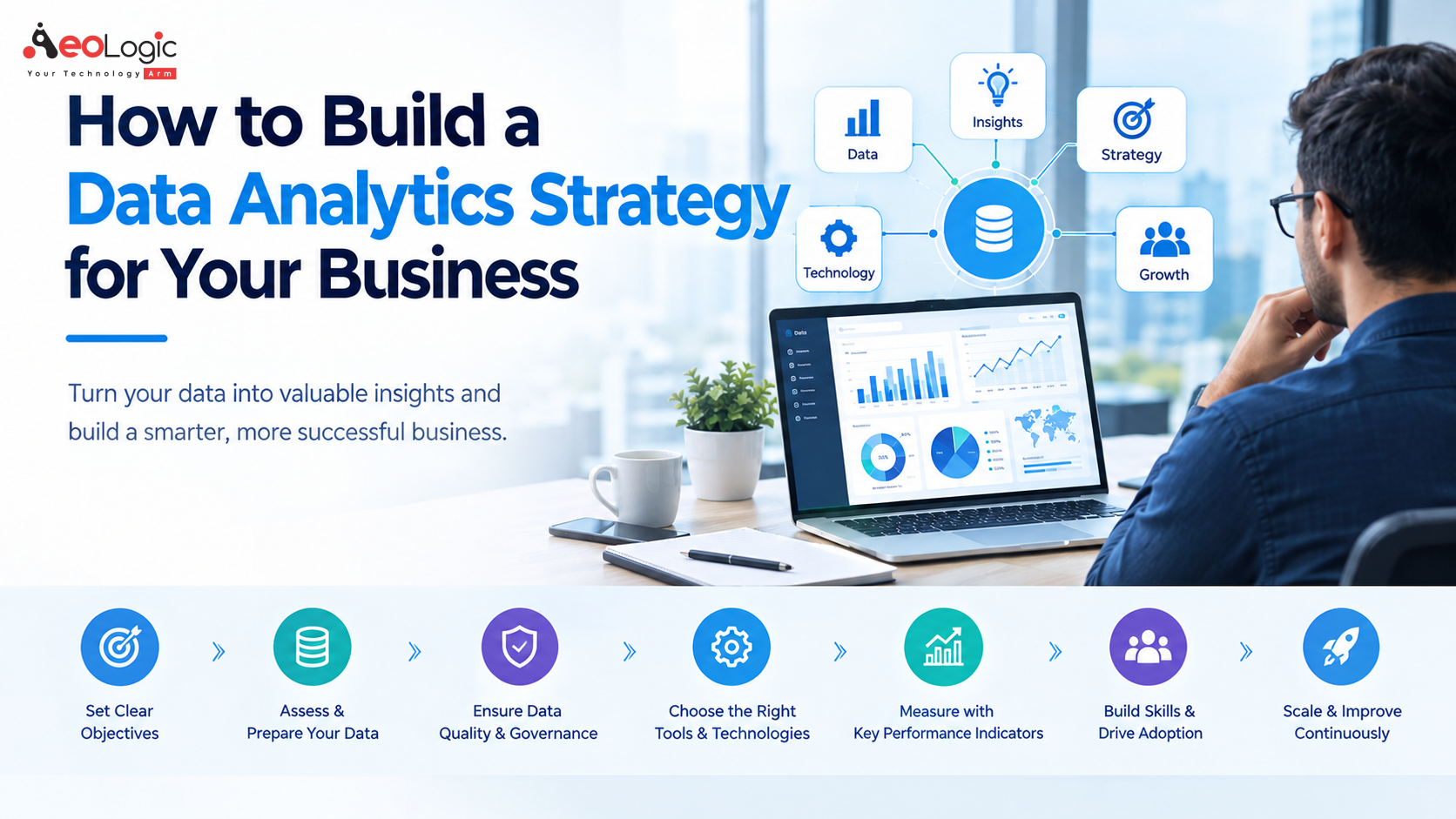

Businesses generate large amounts of data through websites, customer interactions, sales transactions, marketing campaigns, supply chains, and daily operations. However, collecting data does not automatically lead to better decisions. Organizations need a clear approach to understand this information, identify meaningful patterns, and use insights to improve business performance. A well-planned Data Analytics Strategy helps businesses connect their data with their goals.
It defines what information needs to be collected, how it should be analyzed, which tools are required, and how insights can support decision-making. Instead of relying only on assumptions or outdated reports, businesses can use relevant data to understand customer behavior, monitor performance, reduce costs, and identify growth opportunities.
Whether a company is a growing startup or an established enterprise, building an effective analytics approach requires more than purchasing software. It involves setting measurable objectives, improving data quality, selecting suitable technologies, and developing a culture where teams use insights in their everyday work.
What is a Data Analytics Strategy?
A Data Analytics Strategy is a structured plan that explains how an organization will collect, manage, analyze, and use data to achieve its business objectives. It connects data-related activities with practical outcomes such as improved customer retention, increased revenue, operational efficiency, and better forecasting.
For example, an e-commerce company may want to understand why customers abandon their shopping carts. Its analytics approach could combine website behavior, transaction records, customer feedback, and marketing campaign data to identify common reasons. The business can then test changes to its checkout process and measure whether the abandonment rate improves.
An effective strategy also establishes responsibilities, technology requirements, governance policies, and performance indicators. These elements help ensure that analytics projects solve real business problems instead of producing reports that teams rarely use.
Why does Your Business Need a Data Analytics Strategy?
Better Business Decision-Making
Business decisions become more reliable when they are supported by accurate and relevant information. Analytics helps decision-makers understand what is happening, why it may be happening, and which actions are worth testing.
For example, sales teams can identify products with declining demand, while finance teams can compare expenses against revenue trends. Managers can use these insights to prioritize investments and adjust plans based on measurable evidence.
Improved Customer Understanding
Customer preferences change over time, and businesses need to understand these changes to remain competitive. Analyzing purchasing behavior, engagement patterns, support requests, and feedback can reveal what customers value and where they experience difficulties.
These insights can support more relevant marketing campaigns, better product recommendations, and improvements to the customer experience. Businesses must still handle personal information responsibly and follow applicable privacy requirements.
Greater Operational Efficiency
Analytics can reveal bottlenecks, repeated errors, unnecessary costs, and underused resources. Manufacturing businesses may examine production delays, while logistics companies can analyze delivery performance and fuel consumption.
With the right information, organizations can identify processes that require improvement and evaluate whether operational changes deliver measurable results.
Stronger Competitive Advantage
Businesses that understand their performance and market conditions can respond more effectively to emerging opportunities. Analytics can help identify changing customer demand, evaluate product performance, and recognize areas where competitors may be serving customers more effectively.
However, analytics creates value only when insights lead to appropriate action. The quality of the decisions and the organization’s ability to execute them remain essential.
Steps to Build a Data Analytics Strategy for Your Business
Building an analytics approach is an ongoing process. The following stages provide a practical way to connect business priorities with data, technology, and measurable outcomes.
Step 1: Define Clear Business Objectives
Start by identifying the business problems you want analytics to solve. Avoid beginning with a particular tool or technology before understanding the expected outcome.
A retail company might want to increase repeat purchases, while a logistics business may aim to reduce delivery delays. A healthcare organization may focus on resource utilization or appointment scheduling. Each objective requires different data, analytical methods, and success measures.
A strong Data Analytics Strategy connects these priorities with measurable targets. For instance, if the goal is to improve customer retention, the business could measure repeat purchase rates, customer churn, and the effectiveness of retention campaigns.
Clear objectives also help teams prioritize analytics projects. Instead of trying to analyze every available dataset, organizations can focus on the information most likely to influence important decisions.
Step 2: Assess Your Existing Data
Before investing in new tools, understand what data your business already collects and where it is stored. Information may exist across CRM platforms, ERP systems, spreadsheets, marketing tools, financial applications, and operational databases.
Reviewing these sources helps identify duplicate records, inconsistent formats, missing values, outdated information, and gaps in data collection. It also reveals whether departments use different definitions for the same business metrics.
For example, two teams may calculate customer acquisition costs differently because they include different expenses. Establishing shared definitions helps create more consistent reporting and reduces confusion during decision-making.
The assessment should also identify who owns each dataset, who can access it, and whether the organization has appropriate permissions to use it for the intended purpose.
Step 3: Improve Data Quality and Governance
Reliable analytics depends on reliable data. Even advanced analytical models can produce misleading results when their inputs are incomplete, inaccurate, or inconsistent.
Data quality practices should address accuracy, completeness, consistency, timeliness, and duplication. Organizations can introduce validation rules, standardized formats, automated checks, and regular data reviews to improve reliability.
Data governance defines how information is collected, accessed, maintained, protected, and shared. It establishes accountability and helps ensure that business teams follow consistent policies.
A practical Data Analytics Strategy should also address privacy, access controls, retention policies, and security requirements. These measures are particularly important when handling customer information, employee records, financial data, or other sensitive business information.
Step 4: Choose the Right Analytics Tools and Technologies
The technology stack should match the organization’s objectives, existing infrastructure, data volume, technical capabilities, and budget. A smaller business may begin with business intelligence dashboards and its existing reporting tools, while a larger enterprise may require a cloud data platform, advanced analytics, and integrated data pipelines.
Business intelligence platforms help teams explore performance through dashboards and reports. Data warehouses and data lakes support the storage and analysis of information from multiple sources. Data integration tools help transfer information between systems, while statistical and machine learning tools can support forecasting and more complex analysis.
The goal is not to adopt as many tools as possible. It is to create a manageable environment where authorized users can access trustworthy information and turn it into useful insights.
Organizations should also evaluate integration capabilities, scalability, vendor costs, security features, and maintenance requirements before making long-term technology decisions.
Step 5: Establish Key Performance Indicators
Key performance indicators, or KPIs, help businesses measure whether analytics initiatives are delivering the intended results. Each objective should have relevant metrics and a baseline against which progress can be evaluated.
For example, a sales team may monitor conversion rates, average order value, and revenue growth. A customer service team may measure resolution time, customer satisfaction, and repeat complaints. An operations team may track processing time, resource utilization, and operating costs.
KPIs should be clearly defined so that different teams interpret them consistently. It is also important to distinguish between activity metrics, such as the number of reports generated, and outcome metrics, such as reduced costs or improved retention.
Reviewing performance regularly allows organizations to identify progress, investigate unexpected results, and adjust their approach when necessary.
Step 6: Develop an Analytics Team and Build Data Skills
Technology alone cannot create an analytics-driven organization. Employees need the skills and support required to interpret data, ask meaningful questions, and apply insights to their responsibilities.
Depending on business needs, an analytics team may include data analysts, data engineers, business intelligence specialists, data scientists, and governance professionals. Smaller organizations may distribute these responsibilities across existing teams or work with external specialists.
Business users should also receive training on dashboards, KPI definitions, data interpretation, and the limitations of analytical findings. This helps prevent decisions based on incomplete comparisons or misleading conclusions.
Leaders can encourage adoption by using data during planning meetings, explaining how insights inform decisions, and giving teams access to relevant information. Over time, these practices can make evidence-based decision-making part of the organization’s normal workflow.
Step 7: Start With a Pilot Project
Rather than transforming every department at once, select a manageable project that addresses a specific business problem. A pilot allows the organization to test its data, tools, workflows, and assumptions before expanding the approach.
For example, a logistics company could analyze delivery delays across one region. The team might combine route information, delivery timestamps, traffic conditions, and operational records to identify recurring causes.
The organization can then introduce targeted improvements and compare performance against the original baseline. This makes it easier to determine whether the analysis created measurable value.
A pilot also reveals practical challenges, such as missing data, integration issues, limited user adoption, or unclear KPI definitions. Resolving these problems early reduces the risk of scaling an ineffective solution.
Step 8: Scale, Monitor, and Improve Continuously
Once the pilot demonstrates value, the organization can extend successful practices to other teams or business functions. Scaling should include reusable data standards, secure access, documentation, and clear ownership.
Analytics requirements may change as the business grows, new systems are introduced, and customer expectations evolve. Therefore, the strategy should be reviewed regularly rather than treated as a one-time implementation project.
Monitoring should examine both technical performance and business outcomes. Teams can assess data freshness, dashboard usage, analytical accuracy, project costs, and progress toward defined objectives.
A successful Data Analytics Strategy evolves through ongoing measurement, feedback, and refinement. This approach helps businesses keep their analytics investments aligned with changing priorities.
Common Challenges in Building a Data Analytics Strategy
Data Silos and Integration Issues
When information is stored across disconnected systems, creating a consistent business view becomes difficult. Organizations can address this by identifying priority data sources, establishing common definitions, and implementing suitable integration processes.
Limited Budgets and Technical Resources
Businesses may lack the budget or internal expertise required for a large analytics program. Starting with a focused use case, existing tools, and clear success criteria can help demonstrate value before additional investment.
Low Employee Adoption
Employees may avoid analytics tools if dashboards are confusing or insights do not relate to their daily work. Providing role-specific reports, practical training, and clear explanations can improve adoption.
Security and Privacy Risks
Centralizing data can introduce additional security responsibilities. Businesses should use appropriate access controls, encryption, monitoring, retention policies, and privacy safeguards based on the sensitivity of their information.
Best Practices for Long-Term Success
An effective analytics program begins with business priorities rather than technology trends. Organizations should focus on a limited number of meaningful use cases, maintain consistent data definitions, assign ownership, and measure outcomes against clear baselines.
Teams should also document assumptions and limitations so that decision-makers understand how conclusions were reached. Automated reporting can reduce repetitive work, but important findings still require business context and human judgment.
As analytics capabilities mature, organizations can introduce predictive modeling, forecasting, and AI-supported analysis where these methods provide a clear advantage. These initiatives should be tested carefully and monitored for reliability, fairness, and business relevance.
The most sustainable approach combines appropriate technology with good governance, skilled employees, leadership support, and continuous improvement.
Conclusion
Building an analytics capability requires a clear understanding of business goals, reliable data, suitable technologies, and a commitment to using insights in everyday decisions. Organizations that approach analytics systematically can improve customer understanding, streamline operations, identify risks, and make better use of available resources.
A well-designed Data Analytics Strategy should begin with a specific business problem, establish measurable KPIs, improve data quality, and introduce tools that fit existing requirements. Pilot projects provide an opportunity to validate the approach before scaling it across the organization.
Frequently Asked Questions
Q1. What is a Data Analytics Strategy?
A Data Analytics Strategy is a structured plan that explains how a business collects, manages, analyzes, and uses data to achieve its objectives. It connects data with business goals, defines key performance indicators, establishes governance practices, and identifies the tools needed to generate actionable insights.
Q2. Why is a Data Analytics Strategy important for businesses?
A Data Analytics Strategy helps businesses make informed decisions, understand customer behavior, improve operational efficiency, reduce unnecessary costs, and identify growth opportunities. It also ensures that analytics investments support measurable business objectives instead of producing reports without clear business value.
Q3. What are the key steps to building a Data Analytics Strategy?
The main steps include defining business objectives, assessing existing data, improving data quality, selecting appropriate analytics tools, establishing KPIs, developing employee skills, testing a pilot project, and continuously monitoring results. These steps help organizations build an analytics approach that can grow with their needs.
Q4. Which tools are used to implement a Data Analytics Strategy?
Businesses may use business intelligence platforms, data warehouses, cloud data platforms, data integration tools, statistical software, and machine learning technologies. The right combination depends on the organization’s budget, data volume, technical capabilities, security requirements, and business objectives.
Q5. How can businesses measure the success of their Data Analytics Strategy?
Businesses can measure success through KPIs such as revenue growth, customer retention, conversion rates, operational costs, processing time, and resource utilization. They should establish baseline measurements before implementation and regularly compare results to determine whether analytics initiatives are delivering measurable improvements.