
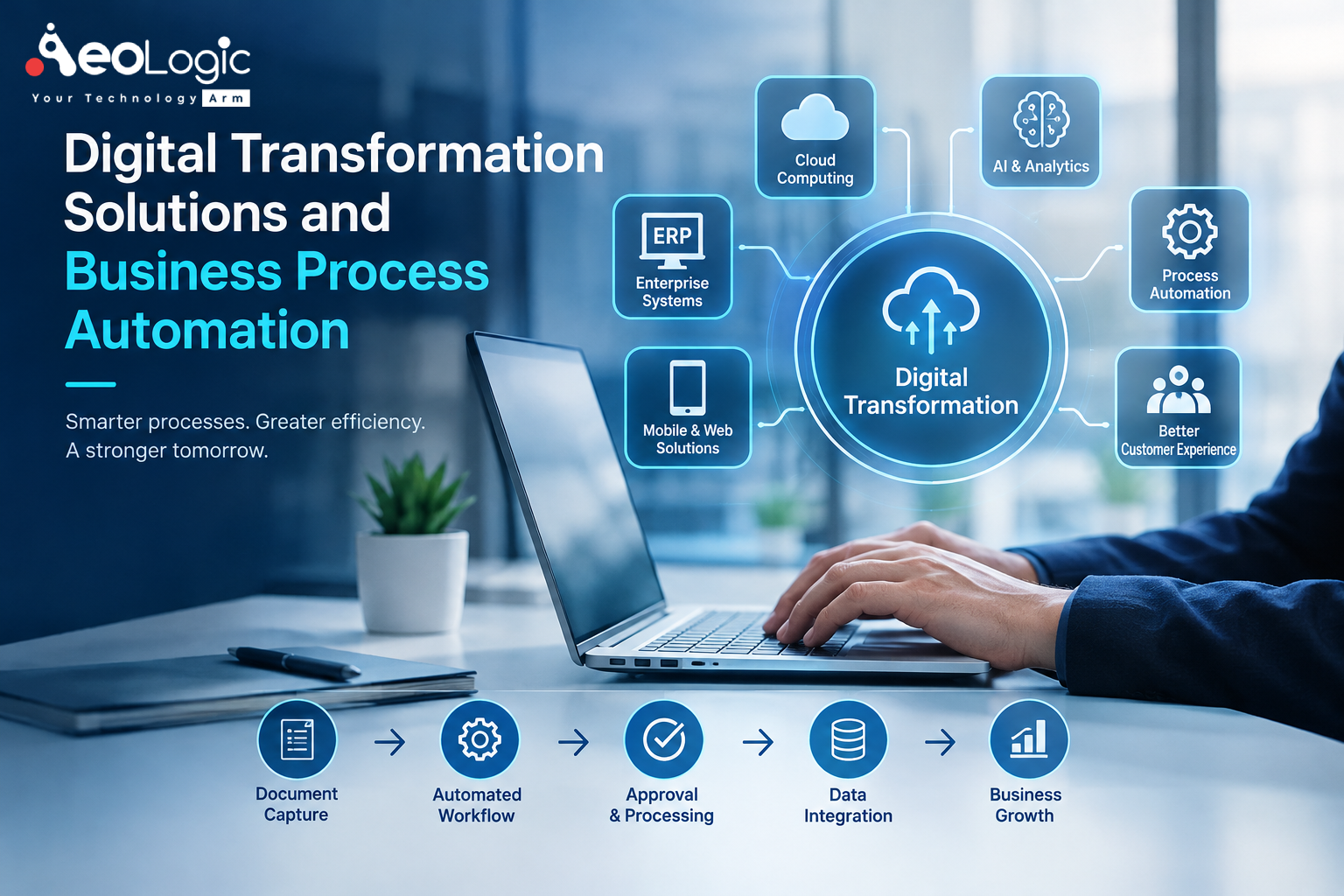

Digital transformation is no longer just about adopting new technologies; it is about improving how businesses operate, make decisions, serve customers, and achieve long-term growth. Organizations are investing in cloud computing, artificial intelligence, workflow automation, data analytics, and integrated enterprise systems to improve efficiency and remain competitive. However, implementing digital tools does not automatically guarantee better business outcomes. Companies need a clear way to measure whether their digital initiatives are delivering meaningful results, which is where Digital Transformation KPIs become essential.
Digital transformation solutions help organizations modernize traditional operations, connect disconnected systems, and automate repetitive business activities. When combined with business process automation, these solutions can reduce manual workloads, improve accuracy, accelerate service delivery, and increase operational visibility. Measuring these improvements allows business leaders to understand what is working, identify performance gaps, and make informed decisions about future technology investments.
Understanding Digital Transformation Solutions and Business Process Automation
Digital transformation solutions involve using modern technologies to improve business processes, customer experiences, and organizational performance. These solutions may include enterprise resource planning systems, customer relationship management platforms, artificial intelligence applications, cloud infrastructure, and advanced data analytics tools. Their primary purpose is to help businesses move away from inefficient manual operations toward connected, data-driven workflows.
Business process automation complements digital transformation by reducing the need for repetitive human intervention in everyday activities. For example, automated invoice processing can extract information, validate records, route approvals, and update financial systems without requiring employees to perform every step manually. Similarly, automated customer onboarding can simplify document collection, verification, communication, and account creation.
The real value of these initiatives becomes visible when businesses evaluate their outcomes against clearly defined objectives. Digital Transformation KPIs provide measurable indicators that connect technology investments with improvements in productivity, operational efficiency, customer satisfaction, and financial performance.
Why Businesses Need Digital Transformation KPIs
Digital initiatives often involve significant investments in software, infrastructure, employee training, integration, and process redesign. Without measurable performance indicators, organizations may struggle to determine whether these investments are producing the expected benefits. A company might successfully implement an automation platform but still experience delays because its approval processes remain complicated or its systems cannot exchange data efficiently.
Establishing Digital Transformation KPIs helps organizations assess progress beyond technology implementation. Instead of measuring success through the number of applications deployed or workflows automated, businesses can evaluate how these changes affect everyday operations and strategic goals.
These indicators also create accountability across departments. Technology teams can monitor system performance, operations managers can evaluate process efficiency, and business leaders can assess financial outcomes. When departments use shared measurements, they can identify problems earlier, prioritize improvements, and ensure digital initiatives support broader organizational objectives.
Essential Digital Transformation KPIs for Measuring Business Performance
1. Process Automation Rate
The process automation rate measures the proportion of eligible business activities completed automatically rather than through manual intervention. It helps organizations understand how effectively automation technologies are being adopted across departments.
For example, a finance department may automate invoice validation, payment reminders, and expense approvals. Monitoring the percentage of transactions completed without manual assistance reveals whether automation is reducing administrative workloads as intended.
A higher automation rate is not always an indication of better performance. Businesses should also assess process accuracy, exception rates, and employee involvement to ensure automation improves outcomes rather than simply increasing the number of automated tasks.
2. Operational Efficiency and Cycle Time
Operational efficiency measures how effectively an organization uses its resources to complete business activities, while cycle time tracks the time required to finish a process from beginning to end. Both indicators are important for understanding the practical impact of digital transformation.
For instance, automating purchase order approvals may reduce processing time from several days to a few hours. Similarly, integrating inventory management with sales systems can help employees access accurate stock information without repeated manual checks.
Tracking these Digital Transformation KPIs allows organizations to identify bottlenecks, compare performance before and after implementation, and determine whether new workflows are producing faster, more consistent results.
3. Return on Digital Investment
Return on investment measures the financial benefits generated by a digital initiative relative to its total cost. Organizations should consider software licensing, implementation, integration, employee training, maintenance, and ongoing operational expenses when calculating the overall investment.
Benefits may include lower administrative costs, reduced processing errors, increased employee productivity, improved customer retention, and additional revenue opportunities. Businesses should also distinguish between measurable financial savings and expected future benefits to avoid overstating results.
A practical return-on-investment assessment helps decision-makers compare different projects and prioritize initiatives that offer sustainable business value.
4. Employee Productivity and Adoption Rate
Digital transformation succeeds when employees can use new systems effectively in their daily work. Employee productivity measures the amount of valuable work completed within a specific period, while adoption rate indicates how consistently employees use the new technology.
For example, an organization introducing an automated customer support platform can monitor active usage, task completion rates, training progress, and the time employees spend resolving customer requests. These measurements can reveal whether the technology is simplifying work or creating additional complexity.
Employee feedback is equally important because low adoption may result from inadequate training, confusing interfaces, or workflows that do not match actual business requirements. Organizations should combine usage data with productivity measurements to evaluate whether digital tools are genuinely helping their teams.
5. Customer Experience and Satisfaction
Digital transformation can improve customer experiences by reducing response times, simplifying transactions, and providing consistent service across communication channels. Businesses can measure these improvements through customer satisfaction scores, customer retention rates, support resolution time, and customer effort scores.
For example, automated support routing can direct customer requests to the appropriate department, while integrated CRM platforms can provide employees with a complete view of previous interactions. These capabilities help reduce repetitive communication and enable more personalized service.
Digital Transformation KPIs related to customer experience help organizations determine whether operational improvements are translating into meaningful benefits for the people they serve.
6. Error Rate and Data Accuracy
Manual processes often introduce problems such as duplicate records, incorrect data entry, inconsistent reporting, and missed approvals. Business process automation can reduce these risks by applying predefined rules, validation checks, and standardized workflows.
Organizations should monitor transaction error rates, data completeness, duplicate records, failed integrations, and the frequency of process exceptions. These measurements help determine whether automated workflows are producing more reliable results than previous manual methods.
However, automation does not eliminate every source of error. Poor-quality input data, incorrect business rules, and inadequate system testing can still affect results. Regular monitoring and process reviews are necessary to maintain accuracy as business requirements change.
How Business Process Automation Improves Measurable Results
Business process automation creates value by simplifying repetitive activities and connecting different stages of a workflow. Instead of requiring employees to transfer information between multiple systems, integrated automation can move data, trigger approvals, generate notifications, and update records according to predefined rules.
In finance, automation can streamline invoice processing, reconciliation, expense management, and financial reporting. In human resources, it can simplify employee onboarding, attendance management, leave approvals, and document administration.
These improvements become easier to evaluate when organizations establish baseline performance measurements before implementation. If a process previously required six hours and now takes two hours, the organization can calculate the reduction in processing time and examine how the saved capacity is being used.
Digital Transformation KPIs also help businesses distinguish between isolated improvements and sustainable operational progress. A faster process may still create problems if it increases error rates or requires extensive manual corrections. Therefore, businesses should evaluate speed, quality, cost, and customer impact together rather than relying on a single performance indicator.
Challenges in Measuring Digital Transformation Success
One common challenge is the absence of reliable baseline data. If organizations do not document existing process times, error rates, operating costs, and customer outcomes, it becomes difficult to determine whether a digital initiative has delivered measurable improvement. Establishing baseline measurements before implementation creates a stronger foundation for comparison.
Another challenge is fragmented data across departments. When finance, operations, sales, and customer service use disconnected systems, collecting consistent performance information can become complicated. Data integration and centralized reporting can help organizations establish a more reliable view of business performance.
Unrealistic expectations can also affect measurement. Some benefits, such as reduced processing time, may appear quickly, while others, including improved customer retention or stronger employee adoption, may take longer to develop. Organizations should set realistic measurement periods and review results regularly.
Businesses should also avoid tracking too many indicators at once. A long list of metrics can make reporting difficult and distract teams from the outcomes that matter most. Selecting a focused group of Digital Transformation KPIs that directly supports business priorities can make performance monitoring more practical and actionable.
Best Practices for Implementing Digital Transformation KPIs
Organizations should begin by defining the business problem they want to solve rather than selecting metrics simply because they are easy to measure. A company seeking to improve customer service may prioritize resolution time, satisfaction, and first-contact resolution, while a manufacturing organization may focus on equipment availability, production cycle time, and defect rates.
Each KPI should have a clear definition, a reliable data source, a measurement frequency, and an accountable owner. This structure helps departments interpret results consistently and reduces confusion when performance is reviewed across the organization.
It is also important to connect operational indicators with strategic business outcomes. Measuring automation volume provides insight into technology adoption, but combining it with cost savings, productivity, and error reduction offers a clearer picture of actual business value.
Organizations should review their performance regularly and adjust measurements as priorities evolve. Monthly reviews may be suitable for operational processes, while broader financial and strategic outcomes may require quarterly assessments. Dashboards can make trends easier to identify, helping decision-makers respond to emerging issues before they affect overall performance.
The Role of AI and Advanced Analytics in Performance Measurement
Artificial intelligence and advanced analytics are making business performance monitoring more proactive. Instead of relying exclusively on historical reports, organizations can use predictive models to identify emerging bottlenecks, forecast demand, detect unusual transactions, and estimate potential operational risks.
For example, predictive analytics can help a logistics company identify delivery delays based on historical performance, traffic patterns, and shipment information. AI-powered systems can also analyze customer service interactions to identify recurring complaints and opportunities for process improvement.
Integrated dashboards can bring together information from ERP, CRM, finance, and automation platforms, allowing managers to examine performance across multiple business functions. When implemented with appropriate data governance and human oversight, these capabilities can improve visibility and support more informed decision-making.
As digital ecosystems become more complex, Digital Transformation KPIs can help organizations evaluate whether AI and automation initiatives are generating measurable improvements rather than simply introducing new technology.
Conclusion
Digital transformation and business process automation can help organizations improve efficiency, reduce operational costs, strengthen data accuracy, and deliver better customer experiences. However, achieving these benefits requires more than deploying modern systems. Businesses need measurable objectives, reliable performance data, and regular reviews to understand how technology affects their operations.
By selecting relevant Digital Transformation KPIs, organizations can connect technology investments with business priorities, identify opportunities for improvement, and measure progress over time. Combining operational metrics with financial, customer, and employee indicators provides a more complete understanding of transformation success.
Frequently Asked Questions
Q1. What are Digital Transformation KPIs?
Digital Transformation KPIs are measurable indicators used to evaluate the success of digital initiatives within an organization. They help businesses track improvements in operational efficiency, process automation, employee productivity, customer satisfaction, data accuracy, and return on investment.
Q2. Which KPIs are most important for measuring digital transformation success?
The most important KPIs include process automation rate, operational cycle time, return on investment, employee adoption rate, customer satisfaction, and error rate. Businesses should select indicators based on their digital transformation goals, industry requirements, and desired business outcomes.
Q3. How does business process automation improve digital transformation results?
Business process automation reduces repetitive manual tasks, minimizes human errors, accelerates approvals, and improves workflow consistency. It allows employees to focus on higher-value activities while helping organizations reduce operational costs and improve overall productivity.
Q4. How can businesses measure the ROI of digital transformation solutions?
Businesses can measure ROI by comparing the financial benefits of digital initiatives with their total implementation and operating costs. Benefits may include labor savings, reduced errors, faster processing, improved customer retention, and increased revenue generated through more efficient business operations.
Q5. How often should businesses review Digital Transformation KPIs?
Businesses should review operational KPIs monthly or more frequently when necessary, while financial and strategic performance indicators can be evaluated quarterly. Regular monitoring helps organizations identify performance gaps, adjust automation strategies, and ensure digital initiatives continue to support business objectives.