
Businesses rely heavily on software to manage operations, customer relationships, financial processes, supply chains, employee workflows, and business data. As organizations grow, the software that once supported their operations may gradually become outdated, difficult to maintain, and unable to support changing business requirements. This is where legacy software modernization becomes an important strategic consideration for organizations that want to remain competitive without allowing outdated technology to slow down growth.
Replacing legacy software with custom software is not a decision that should be made simply because an existing system looks old. Many older applications continue to provide value when they are stable, secure, and capable of supporting current requirements. However, when limitations begin affecting productivity, scalability, security, integration, or customer experience, continuing to depend on the existing platform can become more expensive than replacing it.
Understanding When Legacy Software Becomes a Business Problem
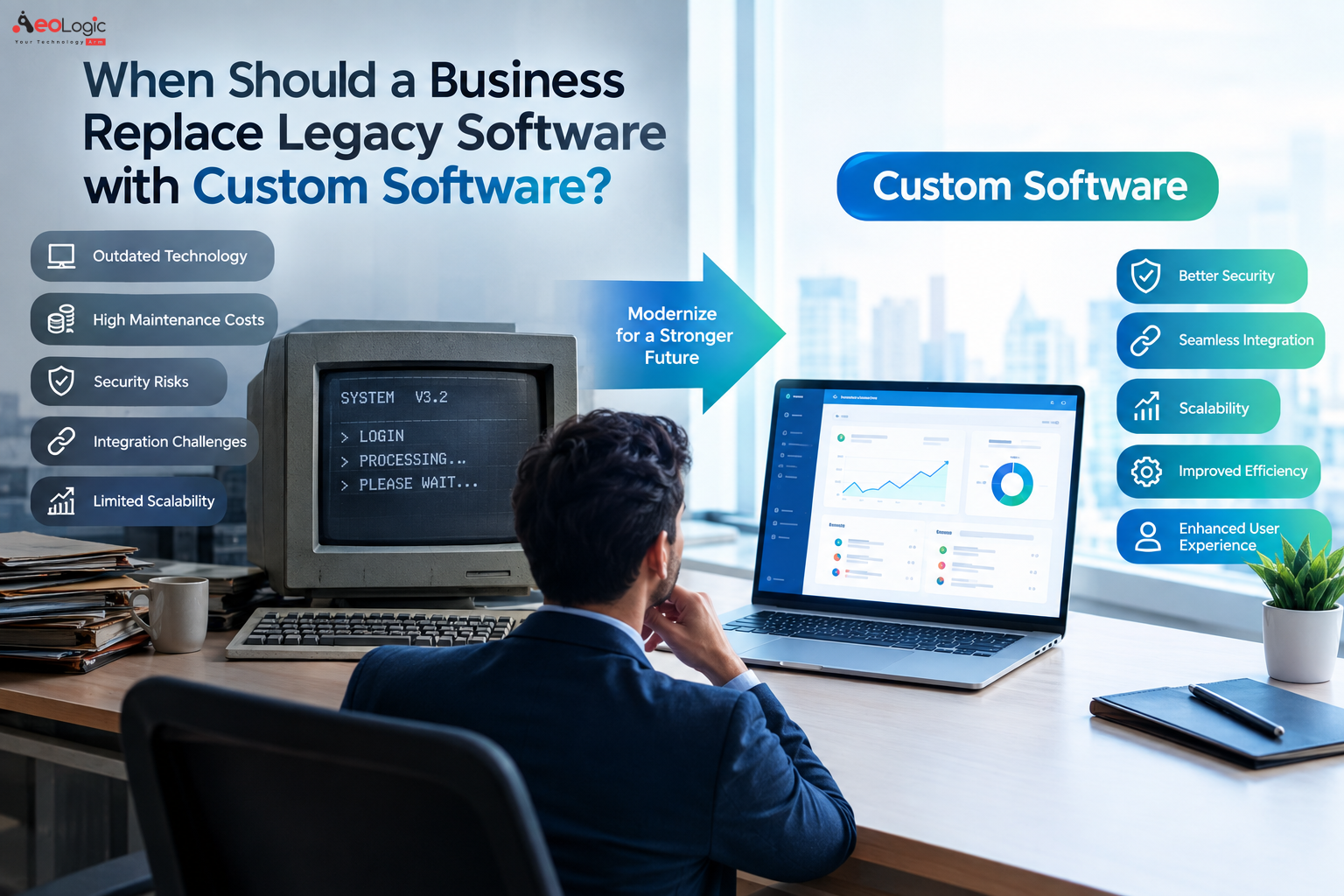
Outdated Technology Can Limit Business Growth
Legacy software often reflects the business requirements and technology standards that existed when it was originally developed. Over time, business processes become more complex, customer expectations change, and new digital technologies become essential. A system that was once considered efficient may eventually become a barrier to innovation.
Organizations may find themselves modifying processes simply because their software cannot support better approaches. Employees may rely on spreadsheets, manual data entry, disconnected applications, or workarounds to complete tasks that should otherwise be automated. These inefficiencies can gradually increase operational costs and create unnecessary complexity.
Maintenance Costs Can Become Difficult to Justify
One of the clearest signs that a company should consider legacy software modernization is the rising cost of maintaining an existing application. Older systems may depend on outdated programming languages, unsupported frameworks, obsolete databases, or specialized technical knowledge that is becoming increasingly difficult to find.
Maintenance may also require frequent patches, manual fixes, and customized support from a limited number of developers. When organizations spend significant resources simply keeping an old system operational rather than improving business capabilities, the existing technology may no longer provide an acceptable return on investment.
When Security and Compliance Become Major Concerns
Older Systems May Create Security Vulnerabilities
Cybersecurity requirements have changed significantly as businesses have become more dependent on digital infrastructure. Legacy applications may not have been designed to address modern security threats, identity management requirements, encryption standards, or sophisticated access-control models.
If an application cannot easily receive security updates or integrate with modern security tools, the organization may face increasing exposure to cyber risks. In such circumstances, legacy software modernization can provide an opportunity to redesign the application around stronger security practices rather than continuously applying temporary fixes to an outdated architecture.
Compliance Requirements Can Expose Technology Gaps
Industries such as healthcare, finance, manufacturing, logistics, and government operate under strict regulatory and data-management requirements. A legacy platform that lacks proper audit trails, access controls, reporting capabilities, or data governance features can make compliance increasingly difficult.
Custom software can be designed around the organization’s specific regulatory environment and operational requirements. Instead of forcing business processes into a system that was never designed for current compliance expectations, companies can create an application where security, reporting, governance, and compliance are incorporated into the architecture.
When Integration Becomes Too Difficult
Businesses Need Connected Systems
Modern organizations rarely operate with a single software application. ERP platforms, CRM systems, payment gateways, analytics platforms, cloud services, IoT devices, communication tools, and third-party applications often need to exchange information continuously.
Legacy systems may lack modern APIs or integration capabilities, forcing teams to build complicated workarounds. Data may have to be exported manually from one system and uploaded into another, creating delays and increasing the possibility of errors.
When integration limitations prevent important business systems from communicating efficiently, legacy software modernization can help create a more connected technology environment. A custom application can be designed with modern APIs, cloud services, automation capabilities, and integration requirements from the beginning.
Data Silos Can Reduce Decision-Making Quality
Businesses depend on accurate and accessible data to make informed decisions. When legacy systems store information in isolated databases or incompatible formats, management may struggle to obtain a reliable view of operations.
Custom software can bring data sources together and provide centralized access to important operational information. This can help organizations improve reporting, analytics, automation, and decision-making while reducing dependency on disconnected systems.
When the User Experience Has Become Outdated
Employee Productivity Depends on Usability
Software should help employees complete their work efficiently rather than forcing them to navigate complicated processes. Older applications often contain outdated interfaces, unnecessary steps, and workflows that were designed around historical business processes.
If employees require extensive training simply to perform routine activities, or if they regularly create workarounds because the system is difficult to use, the software may be reducing productivity.
A custom application can be designed around actual user workflows, allowing organizations to simplify navigation, automate repetitive actions, and create interfaces that reflect current operational requirements. This can make legacy software modernization valuable not only from a technology perspective but also from an employee productivity perspective.
Customer Expectations Also Matter
Customers increasingly expect fast, convenient, and personalized digital experiences. If an outdated backend system prevents a company from delivering responsive portals, mobile applications, real-time updates, or personalized services, the technology can directly affect customer satisfaction.
Replacing outdated software with a modern custom solution can provide greater flexibility to improve customer-facing experiences while connecting them with internal business processes.
When Scalability Becomes a Challenge
Growing Businesses Need Flexible Architecture
A system that works for a small organization may not perform effectively when transaction volumes, users, locations, products, or customers increase. Legacy applications may have been designed around fixed capacities and architectures that are difficult to scale.
Organizations experiencing rapid growth should evaluate whether their existing platform can support future demand. If expanding the system requires expensive infrastructure changes or complex modifications, custom software may offer a more sustainable approach.
Custom Software Can Support Future Requirements
The value of custom development is not limited to solving today’s problems. A properly designed system can provide an architecture that supports future integrations, automation, analytics, user growth, and changing business models.
This makes legacy software modernization particularly relevant for companies that are planning significant expansion. Instead of repeatedly modifying an outdated platform, organizations can create a technology foundation that evolves alongside the business.
When Business Processes Have Changed
Software Should Reflect Current Operations
Companies rarely operate exactly as they did five or ten years ago. New departments may have been created, business models may have changed, processes may have been automated, and customers may interact with the organization through new channels.
Legacy software may continue to reflect processes that are no longer relevant. Employees then have to adapt modern workflows to an outdated application rather than allowing technology to support the way the business actually operates.
A custom software solution can be designed around current workflows and future objectives. This allows organizations to eliminate unnecessary processes, automate repetitive activities, and build functionality that directly supports strategic priorities.
Manual Workarounds Are a Warning Sign
Frequent spreadsheet usage, duplicate data entry, manual approvals, offline records, and repetitive reconciliation processes are strong indicators that existing software may no longer be sufficient.
These workarounds may initially appear manageable, but they can create hidden operational costs. They consume employee time, increase the likelihood of errors, and make business processes more difficult to monitor.
When these problems become widespread, legacy software modernization can help organizations replace fragmented workarounds with integrated digital workflows.
When Replacement Makes More Sense Than Upgrading
Not Every Legacy System Needs to Be Replaced
Modernization does not automatically mean completely abandoning an existing application. In some situations, upgrading specific components, migrating databases, improving integrations, or introducing an API layer may be enough.
The right decision depends on the system’s architecture, business value, security condition, scalability, integration requirements, and long-term maintenance costs.
Calculate the Long-Term Business Value
Organizations should compare the cost of maintaining the existing system with the expected value of a modern custom solution. The analysis should consider development expenses, maintenance costs, productivity improvements, security risks, integration requirements, scalability, and potential revenue opportunities.
If maintaining the current application continues to generate increasing costs while providing limited opportunities for improvement, replacement may become the more financially sensible option.
How to Approach Legacy Software Modernization
Start With Business Requirements
Successful modernization begins with understanding business problems rather than selecting technology first. Organizations should identify which processes are inefficient, which capabilities are missing, which integrations are required, and which problems have the greatest impact on customers and employees.
This approach ensures that the new solution is designed around measurable business objectives instead of simply recreating an old application using newer technology.
Consider a Phased Transformation
Replacing a mission-critical application all at once can create significant operational risk. A phased approach can allow organizations to modernize individual modules, migrate data gradually, introduce new interfaces, and test integrations before completely retiring the old platform.
For many businesses, this approach makes legacy software modernization more manageable while reducing disruption to daily operations.
Making the Decision at the Right Time
The decision to replace legacy software should ultimately depend on whether the existing system continues to support business objectives. If the platform is secure, reliable, scalable, easy to integrate, and reasonably affordable to maintain, replacement may not yet be necessary.
However, when outdated technology starts restricting growth, increasing maintenance costs, creating security concerns, preventing integrations, reducing productivity, or damaging customer experiences, delaying action can become more expensive.
The goal of legacy software modernization is not simply to introduce newer technology. It is to create a software environment that supports the organization’s current needs while providing the flexibility required for future growth.
Frequently Asked Questions
Q1. When should a business replace legacy software?
A business should consider replacing legacy software when it becomes difficult to maintain, creates security risks, limits scalability, prevents integrations, or negatively affects employee productivity and customer experience. Rising maintenance costs and frequent manual workarounds are also strong indicators that modernization may be necessary.
Q2. What are the main benefits of legacy software modernization?
The main benefits include improved security, better system performance, easier integration, greater scalability, improved user experience, and reduced maintenance challenges. Legacy software modernization can also help businesses automate processes and create a technology foundation that supports future growth.
Q3. Is custom software better than upgrading legacy software?
Custom software can be a better option when the existing system has significant architectural limitations or cannot support important business requirements. However, upgrading may be more practical when the current platform remains secure, scalable, and adaptable. The decision should be based on long-term business and technology requirements.
Q4. How much does legacy software modernization cost?
The cost varies depending on application complexity, data migration requirements, integrations, security needs, technology stack, and the scope of modernization. A detailed technical and business assessment is usually required to determine whether upgrading, partially rebuilding, or completely replacing the software provides the best return on investment.
Q5. How can businesses reduce risks during software modernization?
Businesses can reduce modernization risks by clearly defining requirements, evaluating existing systems, planning data migration carefully, testing integrations, and using a phased implementation approach. Gradually replacing critical components can minimize disruption while allowing teams to validate the new solution before fully retiring the legacy platform.